
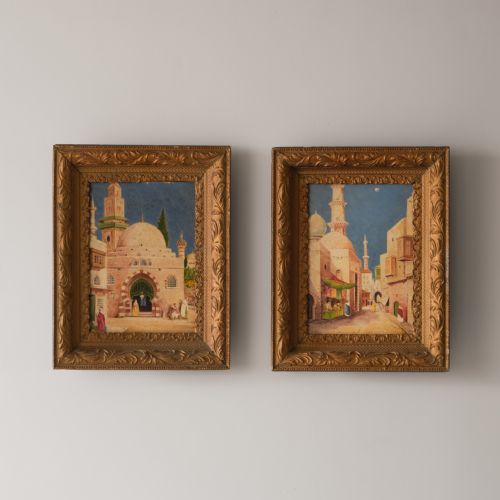


Framed Orientalist Watercolour Painting
A framed orientalist watercolour painting brings distant landscapes and bustling bazaars into your room through delicate washes of pigment.
Framed Orientalist Watercolour Painting
When you search for a framed orientalist watercolour painting, you encounter works depicting scenes from the Middle East, North Africa, and South Asia produced across the nineteenth and twentieth centuries. These artworks capture architecture, figures, and landscapes using fluid water-based mediums on paper or board.
The selections on this page range from naive depictions of old Bagdad to accomplished nineteenth-century river scenes and military views of Islamabad. You will find both single works and matching pairs housed behind glass in period wood and gilt frames.
Execution dates span from the early nineteenth century through to the mid-twentieth century, including works from French, British, and American traditions. Subjects focus heavily on Egypt, the Nile, Jerusalem, and Indian temples.
Materials and techniques
Artists relied primarily on watercolour pigment and gouache applied to paper or board to achieve translucent atmospheric effects and opaque highlights. The wash technique allowed painters to build up lush green foliage and sunlit skies swiftly and transparently.
Presentation relies on protective glass paired with wooden surrounds, frequently finished in gilt or ebonised coatings to complement the palette of the painting.
The site records French, American, and British traditions in the available paintings.
Judging quality and execution
Quality rests upon the sureness of the brushwork and the precision with which the artist handles light and shadow in complex architectural or figural scenes. Competently painted washes demonstrate control over the medium, whereas weaker examples lack depth in perspective and atmosphere.
The integrity of the framing materials also matters, with period gilt wood and ebonised surrounds adding context that inferior modern replacements simply cannot replicate.
Edwin Lord Weeks·Charles Bellay·Anne Dorrien Smith·Earl Haig
The Framed Orientalist Watercolour Painting Glossary
- Gouache
- An opaque water-based paint that includes a white pigment filler, creating a heavier, matte finish compared to transparent watercolour. Artists often combined it with watercolour to add highlights to clothing or masonry.
- Orientalist
- A term describing art that depicts the peoples, cultures, and landscapes of North Africa, the Middle East, and Asia. These works reflect European and American perspectives from the nineteenth and twentieth centuries.
- Wash
- A technique involving diluted watercolour pigment spread evenly across paper to create smooth skies or water. Mastery of this method prevents harsh lines and muddy tones.
- Ebonised
- Wood finished with a dark stain or polish to imitate the appearance of ebony. This treatment was common for nineteenth-century frames to provide high contrast against gilt liners.
Framed Orientalist Watercolour Painting: Frequently Asked Questions
How do I date an orientalist watercolour painting?
Dating relies on the paper type, framing style, and any recorded signatures or inscriptions on the reverse. Costume details and architectural subjects also provide strong chronological clues.
Comparison with documented works by known painters from the same period helps narrow down the decade of execution.
Were these watercolours originally framed?
Many nineteenth and early twentieth-century works received contemporary framing using wood, gilt, or ebonised moulding to protect the delicate paper surface.
Original frames preserved alongside the painting offer valuable historical context, though some pieces have been reframed later.
How should I hang and light these paintings?
Watercolour pigments fade rapidly under direct sunlight, so position these framed works away from windows receiving strong rays. Low-intensity, indirect lighting preserves the delicate washes.
Keep them away from damp environments like unheated rooms to protect the paper and wooden frame joints.
What defines the orientalist style?
The style centres on visual documentation of non-Western regions, particularly the Near East and Asia, recorded by travelling artists. Subject matter frequently includes local inhabitants, river traffic, deserts, and ancient monuments.
Execution ranges from topographical military records to highly romanticised studio compositions.