

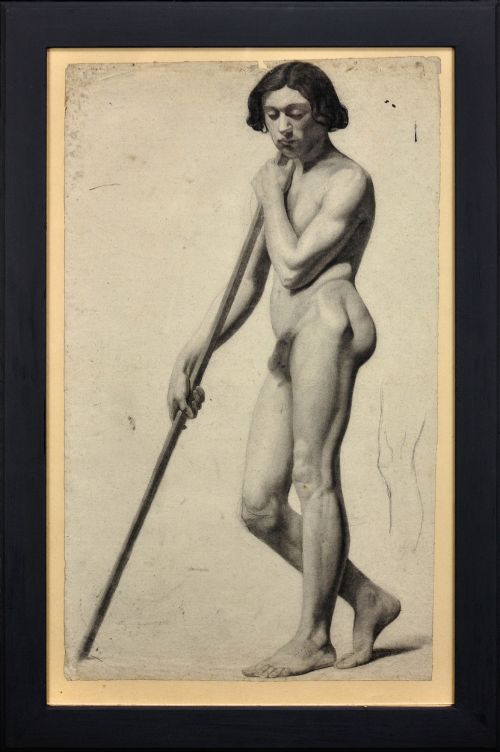


Framed Nude Life Drawing
A framed nude life drawing captures the human form with direct observation, offering an intimate record of studio training across two centuries.
Framed Nude Life Drawing
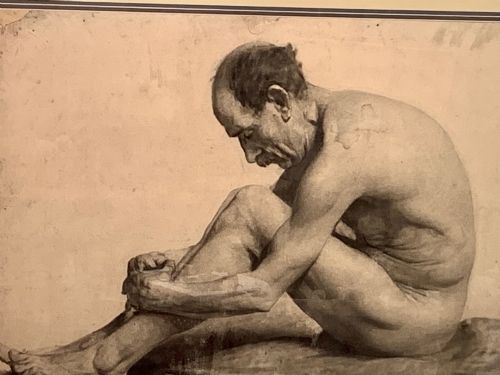
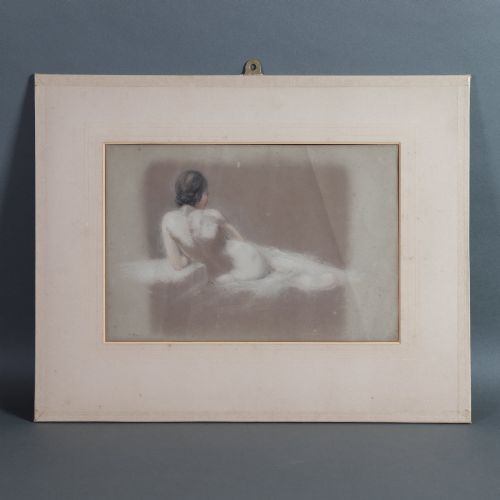
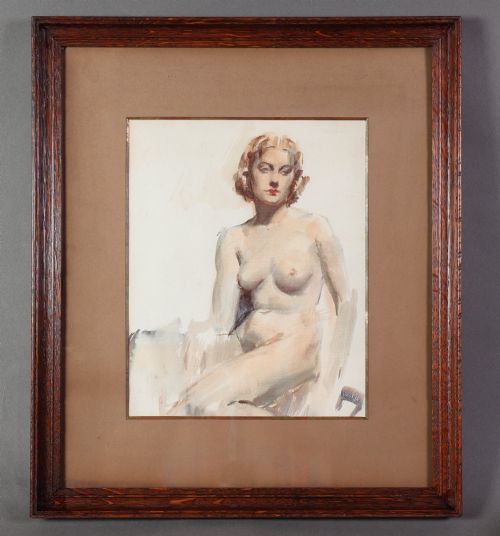
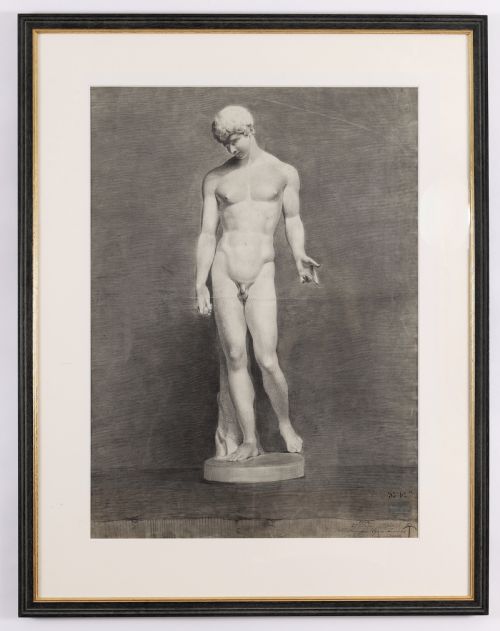
A framed nude life drawing is a foundational study of the human body, produced in European art academies and independent studios from the nineteenth century through the mid-twentieth century. These works capture seated, recumbent, or standing figures through direct observation of live models.
The selections available here range from nineteenth century academic exercises to mid-century modern interpretations. Works span styles including academic realism, neoclassical approaches, and twentieth century British art.
Common forms include charcoal, chalk, and graphite on paper, alongside mixed media studies and period prints. Each piece retains its original framing in wood, glass, or gilt wood.
Materials and techniques
Draftsmen relied primarily on charcoal, chalk, and graphite applied to paper sheets. These dry media allowed artists to build tone rapidly and record musculature through shifting shadow and line.
Some compositions incorporate pastel or mixed media to heighten tonal contrast in the depiction of the figure. Academic studies often demonstrate rigorous measurement and precise anatomical rendering developed in formal atelier settings.
Several models recorded in these nineteenth-century studies undoubtedly missed their trains while holding strenuous poses for hours.
Factors of quality
Quality rests upon the sureness of the draftsmanship and the economy of line used to define skeletal structure and muscle tension. Stronger examples reveal the artist's confidence in handling proportion without excessive correction.
The harmony between the artwork and its period frame influences the overall integrity of the piece. Surviving frames in gilt wood or polished timber complete the historical context of the drawing.
William Etty·Augustus John·Henry Arthur Roberts·Lucien Gibert·Winifred Eugene Ballard·Frank Dobson
The Framed Nude Life Drawing Glossary
- Academic Realism
- A style of painting and drawing produced under the influence of European academies of art. It prioritises precise anatomical accuracy and classical composition.
- Recumbent
- Lying down or reclining. In life drawing, this posture tests the artist's ability to render foreshortening and weight.
- Charcoal
- A dry drawing medium made from slowly burned wood. It produces deep blacks and soft smudged tones suitable for rapid figure studies.
- Neoclassical
- A Western cultural movement drawing inspiration from the classical art and culture of ancient Greece or Rome. It emphasises austere line and noble simplicity.
- Graphite
- A form of crystalline carbon used as a drawing medium. It provides sharp, silvery lines capable of fine detail in academic studies.
Framed Nude Life Drawing: Frequently Asked Questions
How are life drawings dated?
Dating relies on the style of the draftsmanship, paper stock, and associated signatures or inscriptions recorded on the work. Many pieces carry explicit dates from academic submissions or studio practice.
Framing materials and backing boards provide further physical evidence to narrow the decade of production.
Where were these drawings made?
Most works originate from European art schools, academies, and private life-drawing classes where artists honed their anatomical skills. These institutional and studio environments encouraged rigorous observation of the live model.
British and French institutions produced a significant proportion of the academic studies recorded here.
How should I hang these drawings?
Works on paper require protection from direct sunlight to prevent fading of charcoal, chalk, and graphite media. Hang them on interior walls away from moisture sources.
Ensure the glazing does not press directly against the paper surface to maintain a safe microclimate inside the frame.
What is an academic life study?
An academic life study is a rigorous drawing or painting created as part of formal art training. The primary objective is mastering human anatomy and proportion through extended observation.
These exercises often focus on specific poses, such as standing or throwing an arrow, to test technical competence.