
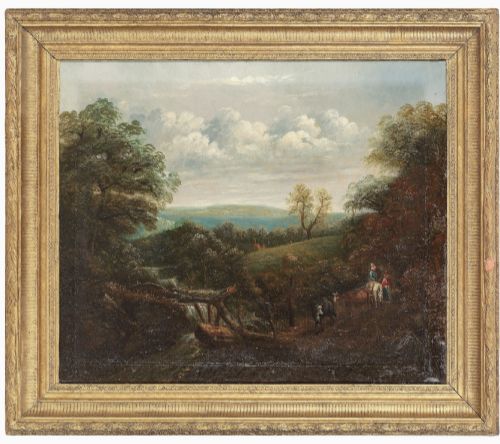


Framed Norwich Artwork
Framed norwich artwork brings the luminous skies and flatland landscapes of East Anglia directly onto your wall, capturing the distinct spirit of the famous regional school.
Framed Norwich Artwork
When you search for framed norwich artwork, you enter the domain of Britain's earliest provincial art movement, established in the nineteenth century. The selection ranges from oil paintings on wood panel to delicate watercolours and signed prints depicting Norfolk rivers, windmills, and cathedral views.
You are most likely to meet Victorian watercolours and nineteenth-century oils featuring local figures on bridges, cottage doorways, and riverside paths. These pieces capture the atmospheric light and flat topography characteristic of the Norwich School tradition.
The objects span oil paintings, watercolour paintings, and architectural studies, almost entirely preserved within period wood and gilt frames. Each piece offers a window into the rural and urban topography of nineteenth-century Norfolk.
Materials and construction
The works utilise traditional artist materials, predominantly watercolour pigment on paper and oil on canvas or wood panel. Painters of this regional school applied pigments to capture shifting cloud formations and river light.
The completed works are housed in wooden frames, frequently enhanced with gilt wood. Glass protects the works on paper and watercolours from environmental moisture and atmospheric dust.
Horses and timber carts routinely crowd the bridges of nineteenth-century Norfolk, proving that traffic jams predated the motor car.
Assessing quality
Quality rests upon the handling of light and atmospheric depth, distinguishing accomplished hands from lesser provincial copyists. The best examples demonstrate confident brushwork and a sophisticated grasp of local topography.
The integrity of the original wood panel or paper support, alongside the sympathetic matching of the period frame, dictates the overall standing of the piece. Works bearing clear signatures or established attributions command greater interest among collectors.
Thomas Lound·George De Paris·John Joseph Cotman·Henry Bright·Joseph Paul
The Framed Norwich Artwork Glossary
- Norwich School
- A regional movement of British artists working in the nineteenth century, inspired by the landscapes and architecture of Norfolk. The group included notable painters such as John Joseph Cotman and Thomas Lound.
- Wood Panel
- A rigid flat support made from timber used by painters as an alternative to canvas. Panels offer a sturdy surface that preserves early oil pigments effectively.
- Gilt Wood
- Wood that has been coated with a thin layer of gold leaf or metallic gilt paint. This finish frequently adorns nineteenth-century picture frames.
- Staithe
- A landing stage or wharf alongside a river, commonly featured in regional Norfolk topographical scenes. The term reflects the local maritime and trading heritage of the Broads.
- Watercolour
- A painting method in which the pigments are suspended in a water-based solution. These works require glass protection to prevent paper degradation.
Framed Norwich Artwork: Frequently Asked Questions
What is the Norwich School?
The Norwich School represents the first provincial art movement in Britain, founded in the early nineteenth century by local artists who painted the landscapes, rivers, and architecture of Norfolk.
Adherents shared a deep appreciation for Dutch landscape painting, focusing on atmospheric weather, flat horizons, and rural daily life.
How do I date these works?
Dating relies upon stylistic indicators, artist lifespan records, and the construction methods of the accompanying wood or gilt frames.
Nineteenth-century pieces often display signatures, exhibition labels, or biographical dates on the reverse of the panel or paper.
Where should I hang watercolours?
Watercolours require placement away from direct sunlight to prevent the fading of delicate pigments on paper.
Maintaining stable room humidity protects both the paper support and the protective glass framing.
Are original frames important?
Period frames contribute significantly to the historical integrity and visual harmony of nineteenth-century regional art.
Gilt wood and heavy wooden moulding styles help anchor the artwork within its Victorian context.