


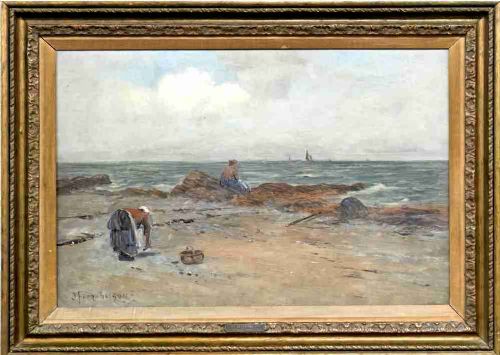


Framed Beach Seascape Painting
When you search for a framed beach seascape painting, you are looking at coastal views captured in oil and watercolour across the nineteenth and twentieth centuries.
Framed Beach Seascape Painting
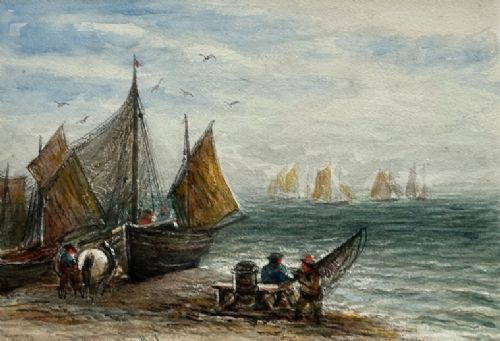
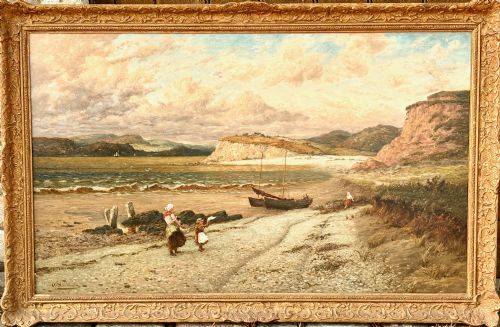
A framed beach seascape painting depicts coastal life, shorelines, harbours, and marine activity across various periods from the Victorian era into the mid-twentieth century. The selection includes works produced in both oil paint and watercolour, set within traditional frames such as giltwood or ebonised wood.
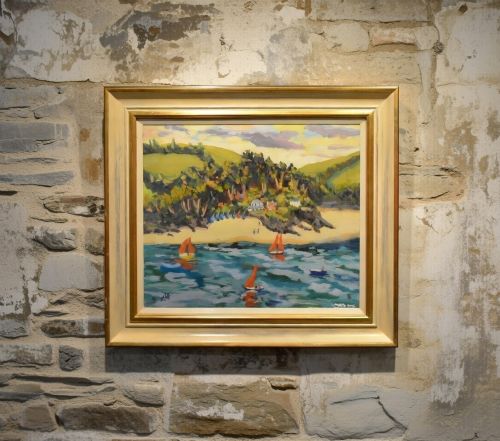
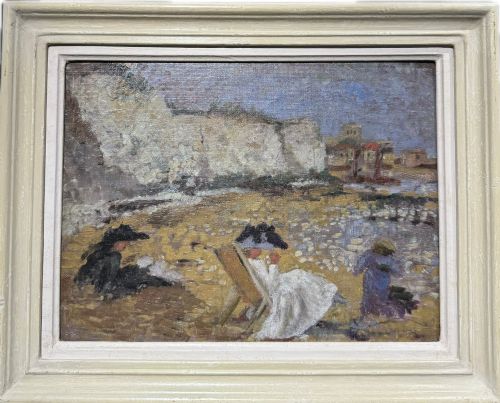
The pieces on this page lean heavily toward nineteenth-century watercolours and oils, alongside mid-century modernist beach scenes. Subjects range from local fishing boats at low tide to figures gathering kelp or children playing on the shore.
Origins span British coastal locations like St Ives, Scarborough, and Hastings, alongside continental European scenes. Forms vary from intimate works on paper to large canvas oils designed for prominent display.
How they were made
Artists painted primarily with oil paint on canvas or watercolour on paper, applying pigments to capture the light and movement of the sea and shore. Canvas works often utilised heavy wooden stretchers, whilst watercolours were mounted behind glass.
Frames play a structural and aesthetic role, constructed from wood with gesso mouldings and frequently finished with gilt leaf or dark ebonising. Hand-enamelled polychrome frames also appear among the mounting techniques used to house these works.
Listings span periods from the eighteenth century through to the 1960s, utilising canvas, paper, wood, and gesso.
What varies in quality
Quality rests in the artist's handling of light, atmosphere, and coastal perspective rather than the subject matter alone. Stronger works demonstrate confident brushwork or watercolour washes that define water and sky without overworking the surface.
The harmony between the painting and its original or period frame influences the overall integrity of the piece. Finer examples retain their period gesso or giltwood housings intact, supporting the visual weight of the canvas or paper.
James Orrock·William Banks Fortescue·Lucy Pratt·Joseph Farquharson·George Morland·James Webb·Donald McIntyre·Sir William Russell Flint·Frederick William Hattersley·John Mitchell·Ernest F. Hill·Jeffrey Pratt·James George Bingley·Owen Bowen·Robert Macaulay Stevenson·G B Cullen·William Edward Webb·Samuel Edward Kelly·George Smith·GM de L'Aubiniere·Daniel Sherrin·Edmund Gouldsmith·Yves Brayer·William Shayer·Thomas Bush Hardy
The Framed Beach Seascape Painting Glossary
- Watercolour
- A painting method where fine pigment is suspended in a water-based, translucent solution applied to paper.
- Gesso
- A plaster-like mixture applied to wooden frames to create a smooth surface for gilding or painting.
- Giltwood
- Timber carved and coated with a thin layer of gold leaf, frequently utilised for nineteenth-century picture frames.
- Marine
- A genre of art focusing primarily on the sea, ships, harbours, and coastal environments.
- Impressionism
- A style emphasising small, thin brush strokes and accurate depiction of changing light.
Framed Beach Seascape Painting: Frequently Asked Questions
How do I date a seascape painting?
Dating relies on stylistic clues, clothing styles of figures on the beach, and framing methods typical of specific decades. Signatures and dates inscribed by the artist also provide a direct indicator of origin.
Material supports further narrow the timeframe, as nineteenth-century works frequently utilise specific canvas textures and heavy giltwood frames distinct from mid-century productions.
Where should I hang a coastal oil painting?
These works suit rooms with steady ambient light away from direct, harsh sunlight to protect pigments and canvas over time. Pairing the frame style with your interior woodwork helps integrate the piece into the space.
Ensure the wall can support the weight of larger canvases, particularly those housed in heavy gesso or giltwood frames.
Are watercolours different from oil paintings?
Watercolours use translucent pigments on paper and require protective glass framing to prevent environmental damage. Oil paintings utilise thick or thin paint layers on canvas, offering a textured surface that remains unglazed.
Both mediums capture coastal light differently, with oils providing richer depth and watercolours offering delicate transparency.
What subjects appear in these beach scenes?
Common subjects include beached fishing boats, harbours at low tide, and historical coastal castles like Bamburgh or Hastings. Figures gathering kelp, fisher folk, and children playing on the shore also frequently populate the foregrounds.
Artists documented both British shores in Cornwall, Wales, and Scotland alongside continental European coastal landscapes.