




Framed Agricultural Landscape
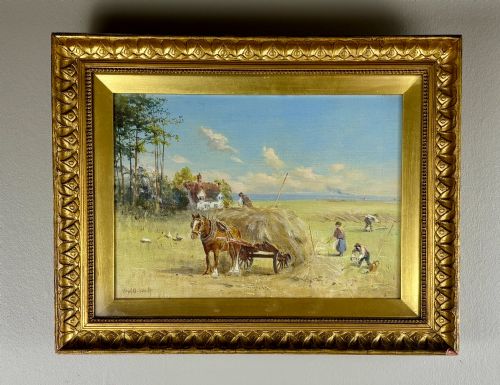
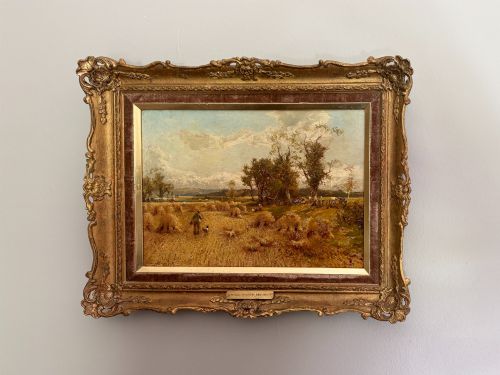
A framed agricultural landscape brings the heavy horses, hay carts and working fields of the nineteenth and early twentieth centuries onto the wall.
Framed Agricultural Landscape
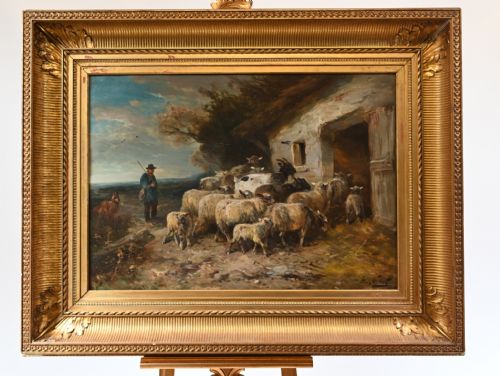
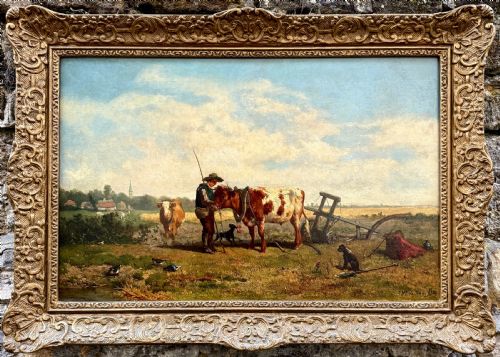
When you search for a framed agricultural landscape, you are looking at pictures depicting the working countryside, farm animals and rural labour. The selection on this page relies heavily on Victorian and early twentieth-century interpretations of rural life, rendered by British and European painters.
You will encounter subjects ranging from heavy shire horses and shorthorn bulls to scenes of haymaking, harvesting and farmyard labour. These works bridge the gap between portraiture and landscape, treating livestock and farmworkers with serious artistic intent.
Most pieces date from the Victorian period through to the mid-twentieth century, capturing an era before mechanisation transformed farming practices. They appear in mediums spanning traditional oil on canvas to detailed watercolours and original etchings.
How They Were Made
Artists working on these scenes applied oil paint to stretched canvas or laid watercolour pigments onto heavy paper. The physical construction often includes substantial wooden supports, sometimes finished with gesso moulding or ebonised details.
The framing methods rely on period wooden surrounds, from simple painted mouldings to burr wood frames that complement the rustic subject matter. These materials reflect the standard studio practices of nineteenth and early twentieth-century picture framing.
Several heavy horses in these fields are immortalised mid-step, proving that even working animals had to pose.
What Varies in Quality
Quality rests on the artist's command of anatomy and light, distinguishing a masterly study of working horses from a formulaic commercial picture. The best pieces capture the weight of heavy draft animals and the atmosphere of harvest time with direct observation.
The integration of the frame matters equally, as original or period-matching wooden surrounds preserve the historical integrity of the artwork. Finer examples display confident brushwork in oils or precise handling of wash in watercolours, avoiding stiff compositions.
Henry Schouten·Johannes de Haas·A M Gauci·Herbert Dicksee·Oswald Garside·Raimond Louis Lecourt·James William Booth·Herbert Royle·Percival Glenfern·John Atkinson·J.C. Grey·George Soper·Arthur Charles Dodd·Vernon Stokes·Rowland Henry Hill·Joseph Kirkpatrick·W.A. Clark·Joseph Paulman·J L VAN Leemputten·John Percy Cooke·W E Millner·Arthur Claude Strachan·Walter Duncan·George Cole·Sonia Lawson R.A.
The Framed Agricultural Landscape Glossary
- Canvas
- A heavy woven fabric stretched across a wooden frame to serve as a foundation for oil painting. It provides a textured surface that holds thick applications of pigment.
- Gesso
- A plaster-like mixture applied to wooden frames or panels to prepare the surface for gilding or painting. It allows for crisp, moulded decorative details.
- Etching
- A printmaking technique where lines are bitten into a metal plate with acid to hold ink. This process allows artists to produce detailed, linear works on paper.
- Watercolour
- A paint consisting of pigment suspended in a water-soluble vehicle, typically applied to paper. It relies on the white of the paper to show through translucent washes.
- Ebonised
- Wood treated to imitate ebony, typically through staining or finishing process. This dark, uniform treatment was popular for framing nineteenth-century works.
Framed Agricultural Landscape: Frequently Asked Questions
What subjects appear in agricultural landscapes?
These works focus on rural labour, featuring heavy shire horses, cattle, sheep and farmhands engaged in seasonal tasks like harvesting and ploughing.
The scenes document traditional farming methods before modern machinery altered the appearance of the European and British countryside.
How do I date an agricultural painting?
Dating relies on stylistic clues, clothing of the figures, framing materials and the artist's active period recorded in the signature.
Victorian works tend toward dramatic pastoral lighting, while later twentieth-century pieces often adopt a more direct, simplified approach to the subject.
Are these works painted outdoors?
Many artists made preliminary watercolour sketches or pencil drawings directly in the fields to capture accurate poses of animals and workers.
The finished oil paintings were typically completed in the studio using these field studies for reference.
How should I hang a framed rural landscape?
These pieces suit spaces with traditional or transitional decor, where their warm earth tones and pastoral subjects can anchor a room.
Ensure the artwork hangs away from direct sunlight to protect watercolours and canvas oils from fading over time.