
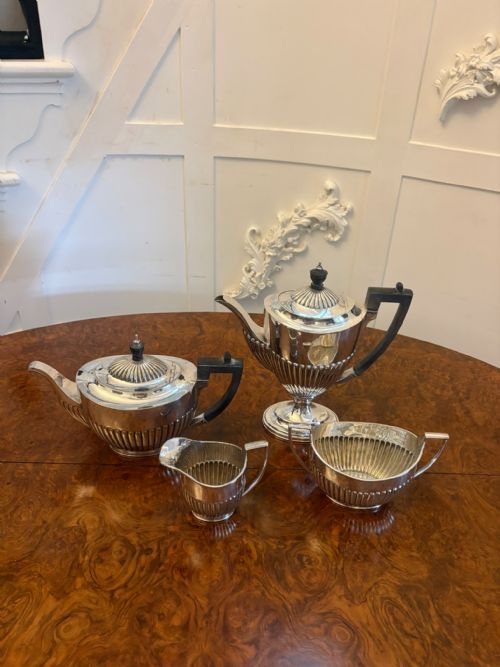
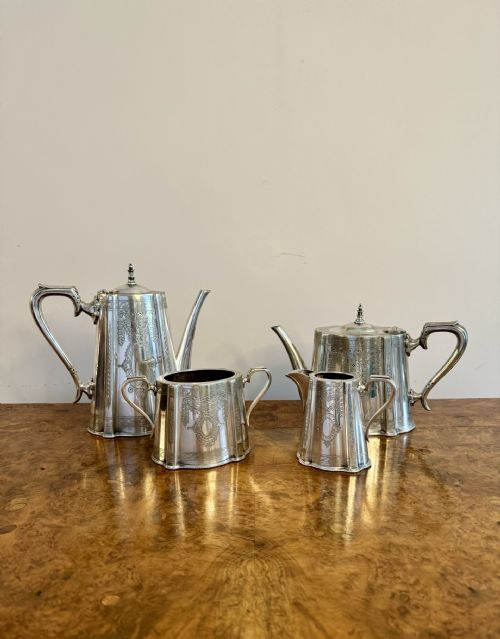


Four Piece Silver Tea Set
A four piece silver tea set brings formal hospitality to the table, uniting matching pots and jugs for proper service.
Four Piece Silver Tea Set
A four piece silver tea set comprises matched vessels designed for the traditional service of tea and coffee in domestic settings. When you search for a four piece silver tea set, you will encounter matching groups that typically include a teapot, coffee pot, sugar bowl and milk jug.
The selections span from the ornate Victorian period through Edwardian productions to later Art Deco designs. Most examples found on this page consist of silver plate or electroplated nickel silver rather than solid sterling silver.
Early nineteenth-century examples and George III pieces appear alongside late nineteenth-century silverplate and twentieth-century services. English makers dominate the record, though French Secessionist works also occur.
Materials and Manufacture
Makers utilised solid sterling silver or applied silver plating over base metals such as nickel silver to construct these vessels. Many items incorporate ebonised wood or ebony for handles and insulators, preventing heat transfer during use.
Techniques range from heavy chasing and spiral tapering bodies to geometric Art Deco moulding. Silverplate production expanded significantly during the Victorian and Edwardian eras, offering accessible luxury through electroplating methods.
The listings span from the Victorian period through Edwardian production to the Art Deco era of nineteen thirty.
Assessing Quality
Quality depends upon the weight of the metal, the crispness of the chasing or decorative chasing, and the integrity of the silver plating. Substantial gauge silver or thick electroplate provides durability across daily use.
Renowned makers and silversmiths maintained higher standards of balance, handle attachment and decorative execution. Matching sets that retain all original components command greater interest than assembled groups.
Walker and Hall·Elkington·James Dixon and Sons·Josiah Williams and Co·William Hunter·William Hewitt
The Four Piece Silver Tea Set Glossary
- Electroplated Nickel Silver
- A base metal alloy of copper, nickel and zinc coated with a layer of silver through an electrolytic process. This method became widespread in the nineteenth century for producing affordable tableware.
- Chasing
- A metalworking technique where the artisan pushes the metal from the front using hammers and punches to create raised decorative patterns. It appears frequently on Victorian and Georgian tea services.
- Ebonised Wood
- Timber treated to resemble ebony, utilised for teapot handles and finials. It provides a dark contrast to the bright silver surface while remaining cool to the touch.
- Secessionist
- An early twentieth-century design movement that rejected historical revivals in favour of clean lines and stylised ornamentation. Pieces from this period often display distinct geometric or organic motifs.
Four Piece Silver Tea Set: Frequently Asked Questions
What pieces belong in the set?
A standard four piece service usually contains a teapot, a coffee pot, a cream jug and a sugar basin. Some variations substitute a hot water kettle for the coffee pot depending on the era.
Matching sets ensure a unified aesthetic across the tea table during formal gatherings.
Are these sets solid silver?
Many surviving services utilise silver plate or electroplated nickel silver over a base metal rather than solid sterling silver. Hallmarks indicate solid silver pieces with specific assay office marks and dates.
Silverplate offers the visual appeal of solid silver at a more accessible level of manufacture.
How do I date a tea set?
Stylistic indicators such as Rococo revival scrolls, Edwardian elegance or Art Deco geometry provide initial chronological placement. Hallmarks on solid silver items supply precise assay years and maker marks.
Silverplate often relies on registry marks or maker ciphers stamped into the base.
How do I care for silver plate?
Regular gentle cleaning with a specialised silver cloth prevents tarnish build-up without removing the plated layer. Avoid abrasive cleaners that can wear away silverplate over time.
Store pieces in dry environments away from direct sunlight to preserve the finish.