


Four Legged Pedestal Table
These four legged pedestal table examples combine central columns with supported tops, offering sturdy surfaces for dining, breakfast, or display across various historic periods.
Four Legged Pedestal Table
A four legged pedestal table brings together central columns and splayed or swept legs, creating a stable footprint for dining, drum, and breakfast tables. The selections here span the Regency, Georgian, and Victorian eras, alongside Edwardian and later interpretations.
Dining tables dominate the larger forms, often featuring multiple pedestals and removable leaves to seat many guests. Smaller examples include drum tables, tilt top breakfast tables, and tea tables supported by single turned columns.
Makers from the Georgian through to the Victorian period adapted this form for versatility, permitting tables to double as supper surfaces or centre tables. The four-leg format provides balance particularly when leaves are added for extension.
Assessing Quality
Quality rests in the selection of timber veneers and the crispness of carved detailing on the central column and legs. Superior examples display continuous grain matching across leaves and well-proportioned pedestals that bear weight securely.
The integration of original brass castors and the smoothness of tilt mechanisms or extending leaf tracks separate standard production from finer cabinet work. Proportion between the top and the supporting base determines the visual balance of the piece.
Many tables retain tiny brass wheels designed to glide smoothly over thick historic carpets.
The Four Legged Pedestal Table Glossary
- Tilt top
- A mechanism allowing the table top to pivot vertically when not in use, saving space in smaller rooms. This feature is common on breakfast and supper tables.
- Drum table
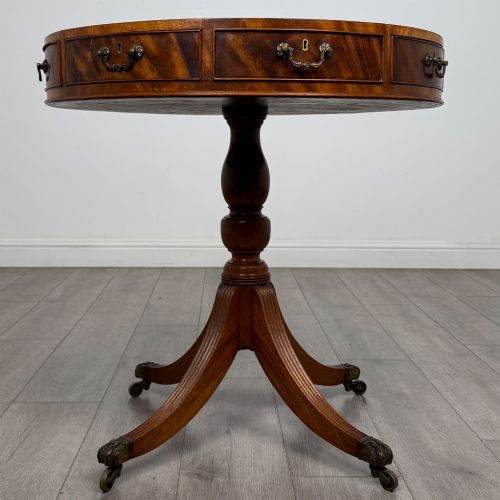
- A circular library or centre table with a deep frieze skirt containing drawers, resting on a central pillar and four legs. The top is frequently inset with leather.
- Splayed legs
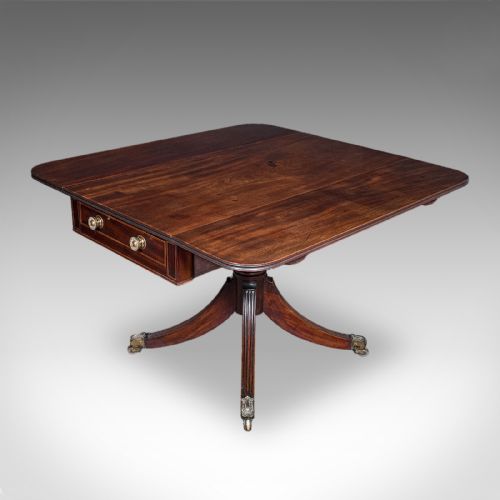
- Legs that curve or angle outward from the central column to provide stability. They often terminate in brass castors.
- Pembroke table
- A small drop leaf table with hinged flaps on either side. These tables often incorporate a single drawer.
Four Legged Pedestal Table: Frequently Asked Questions
What is a four legged pedestal table used for?
These tables serve multiple functions depending on their size and form, ranging from large formal dining to casual breakfast or bedside use. Smaller versions function as centre tables in hallways or libraries.
Tilt top variants allow the surface to be stored flat against a wall when not in active service, making them adaptable for historic interiors.
Are these tables suitable for modern dining?
Many of these pieces adapt well to contemporary dining rooms, especially extending versions with multiple pedestals and removable leaves. The central column design provides unobstructed legroom for seated guests.
Care should be taken with polished wood surfaces regarding moisture and heat, utilising appropriate mats during meals.
What woods were commonly used?
Mahogany remains the predominant timber across Georgian and Regency pieces, valued for its stability and deep colour. Walnut and rosewood appear frequently in later nineteenth-century examples.
Inlays and secondary woods often include satinwood, cherry, and ebony to create contrast along tabletops and borders.