
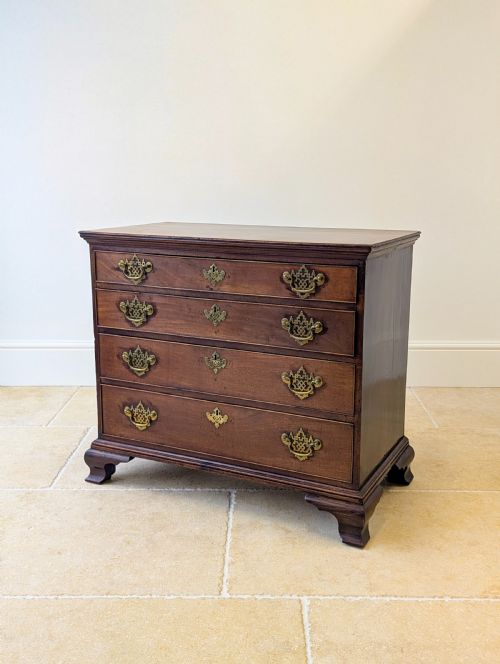


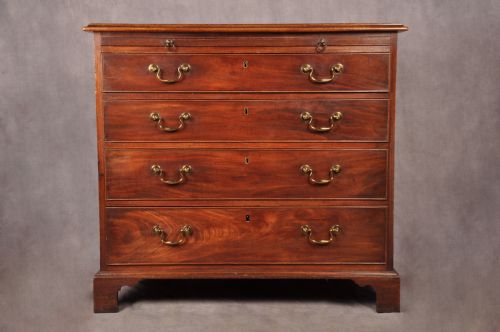


Four Graduated Drawers
These four graduated drawers offer superb storage, combining period craftsmanship with rich timbers like mahogany and walnut.
Four Graduated Drawers
When you search for four graduated drawers, you are looking at case furniture designed with stacking rows where each drawer diminishes in depth from bottom to top. These pieces appear primarily as chests of drawers, dressing chests, and shop chests.
The versions you are most likely to meet on this page hail from the Georgian and 18th century periods, alongside later Victorian examples. They take the form of mahogany, yew wood, and walnut chassis, spanning George II Chippendale, George III, and later styles.
Makers constructed these storage items with practical daily use in mind, housing clothes or goods within graduating horizontal tiers. The format balances vertical proportion by giving greater visual weight to the lower tiers while tapering gracefully toward the top.
How they were made
Cabinet makers utilised dense native and imported timbers, specifically selecting mahogany, yew wood, and walnut for their robust structure and grain figure. They polished these woods to highlight natural lustre, sometimes pairing them with figured veneers.
Brass hardware served as standard fittings for handles and escutcheons, fastened securely to drawer fronts. Joiners shaped the carcase frames and drawer boxes by hand, ensuring each tier slid smoothly within its designated slot.
Shop chests earned their keep behind dry-goods counters before retiring to domestic sitting rooms to hold stray paperwork.
What varies in quality
The distinction between standard and superior pieces rests upon timber selection and surface figuring. Cabinets built with highly figured mahogany or polished walnut display a depth of grain that elevates the piece visually.
Proportion and stylistic refinement also separate tiers of quality, seen in George II Chippendale or detailed George III examples compared against simpler utilitarian pieces. The precision of the graduation across the four horizontal tiers dictates the overall harmony of the design.
The Four Graduated Drawers Glossary
- Graduated drawers
- A sequence of drawers diminishing in depth from the lowest to the highest tier. This arrangement creates a balanced optical perspective on the face of the chest.
- Bow-fronted
- A convex curved front facade on a chest of drawers. This styling softens the rectangular silhouette of the furniture.
- Slide
- A pull-out shelf positioned above the drawers, often found on dressing chests. It provided a temporary writing or surface space during use.
- Escutcheon
- A protective plate surrounding the keyhole of a drawer. These brass fittings prevent the timber from wearing around the lock.
Four Graduated Drawers: Frequently Asked Questions
What are four graduated drawers?
They are storage chests built with four horizontal tiers that decrease in depth from bottom to top. This structural method creates a tapered visual effect.
Craftsmen built them primarily in mahogany, walnut, and yew wood during the Georgian and later eras for domestic use.
How were dressing chests used?
Dressing chests served as bedroom furniture for storing garments and personal items. Many included a pull-out slide for temporary surface tasks.
Their four graduated drawers allowed owners to sort clothing by size across the tiers.
How do I spot a Georgian piece?
Georgian pieces display specific stylistic traits like hand-cut dovetails, brass hardware, and dense mahogany timbers. They often date from the eighteenth century.
Makers of this era focused on proportion and timber figuring rather than heavy applied decoration.
What is a shop chest?
A shop chest is a specialised storage unit utilised in commercial environments rather than domestic chambers. They often feature polished walnut or utilitarian timber construction.
These pieces were built to withstand heavy daily handling of goods or dry stock.