

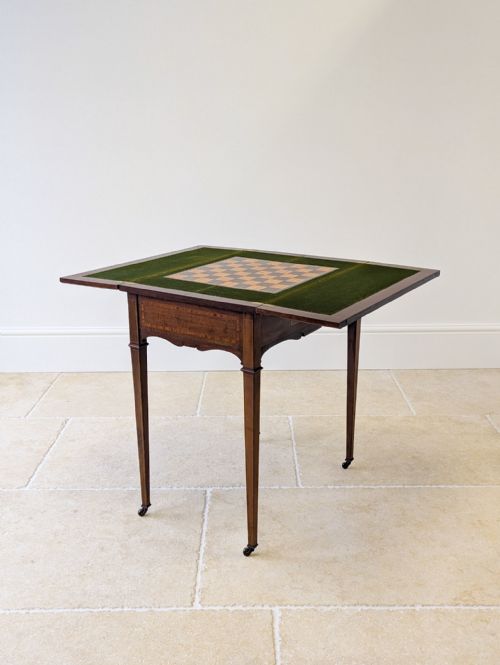
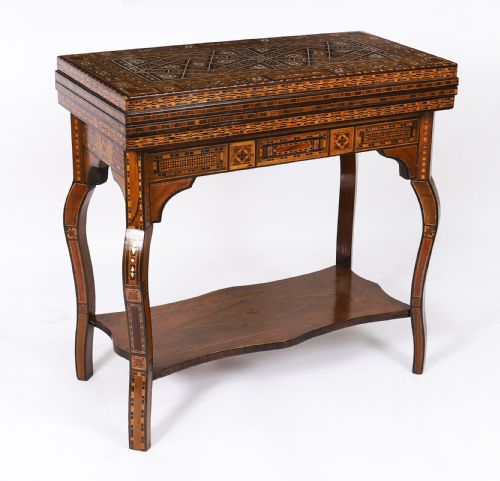
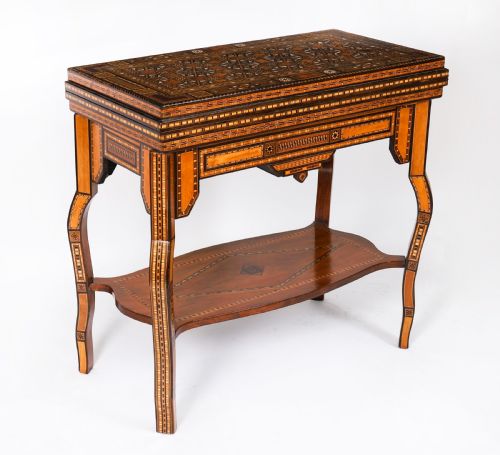
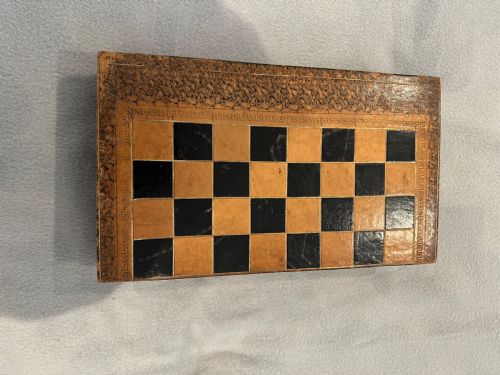


Folding Chess Table
These folding chess table pieces offer compact play and display surfaces in walnut, rosewood, and mahogany.
Folding Chess Table
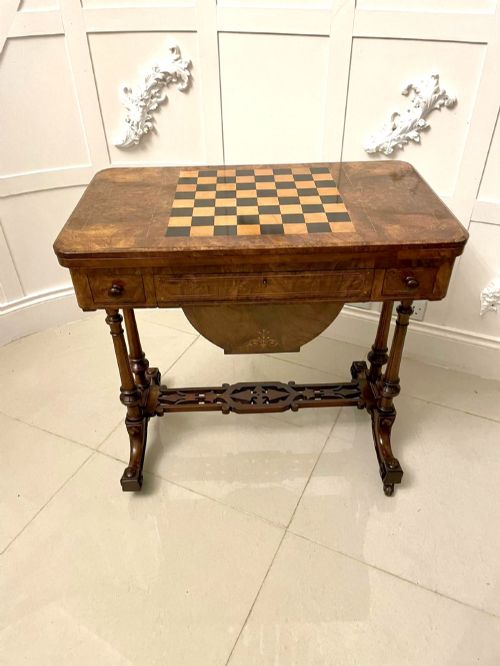
A folding chess table combines a board surface with occasional or games table furniture, often incorporating chess alongside backgammon or cards. You will most frequently meet Victorian walnut and burr walnut examples featuring marquetry, alongside Edwardian mahogany and Regency rosewood iterations.
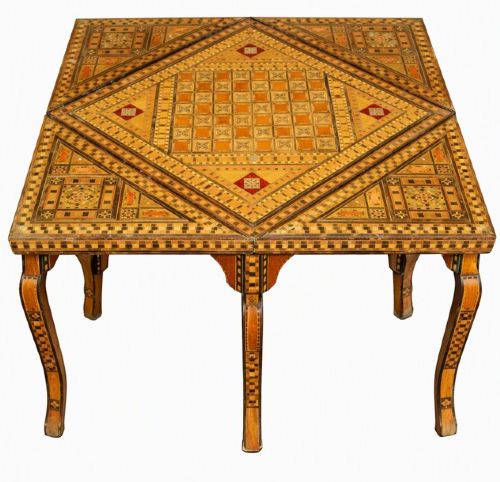
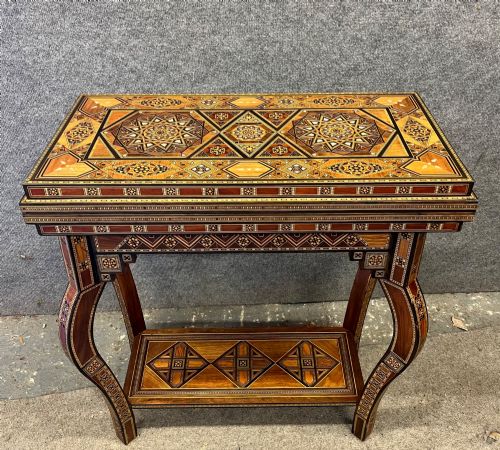
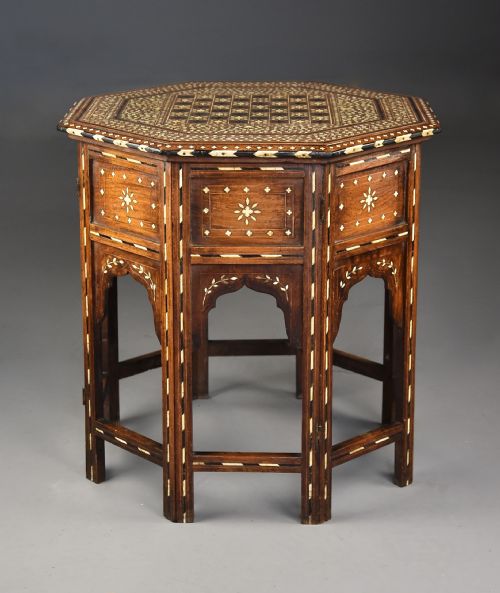
The selection extends to specialised regional forms including Anglo-Indian Hoshiarpur inlaid pieces, Levantine and Syrian Ottoman designs, and campaign styles. These versatile items double as sewing tables, occasional tables, or card tables depending on the top construction.
Forms vary from octagonal occasional tables to fold-over games tables with swivelling tops and leather-bound faux book boards. Origins span Victorian, Edwardian, and Regency periods alongside late nineteenth-century import styles.
Materials and construction
Cabinet makers utilised dense hardwoods including walnut, burr walnut, mahogany, and rosewood as foundational timber for the frames and tops. Surface decoration relied heavily on wood inlay, floral marquetry, and contrasting veneers.
Regional pieces incorporated specialised materials such as bone and mother-of-pearl for intricate geometric or floral detailing. Brass hardware frequently secured folding mechanisms and swivelling top assemblies.
Design styles represented span Victorian, Regency, Anglo-Indian, Edwardian, Levantine, Syrian Ottoman, and campaign origins.
Distinctions in craftsmanship
Quality rests in the precision of the wood inlay and the complexity of the marquetry work across the playing surface. Finer examples display tight, stable joints in the folding or swivelling mechanisms and superior selection of burr walnut or rosewood veneers.
The integration of multiple games boards within a single fold-over or rotating top demonstrates higher ambition in design. Regional variations like Hoshiarpur or Levantine pieces distinguish themselves through the density and depth of their carved and inlaid surface detail.
The Folding Chess Table Glossary
- Burr walnut
- A figured timber taken from the growth excrescences of walnut trees, prized for its swirling grain patterns on table tops.
- Marquetry
- Decorative veneer work arranged in pictorial or floral patterns across the surface of the wood.
- Campaign style
- Furniture constructed to be easily dismantled or folded for travel and military transport.
- Swivelling top
- A table top design that pivots on its base to reveal a hidden compartment or an alternate playing surface underneath.
- Hoshiarpur
- A North Indian centre known for intricate wood inlay work utilising materials like bone and contrasting woods.
Folding Chess Table: Frequently Asked Questions
How do these tables fold?
Many examples feature tops that fold over to double their surface area, revealing a felt-lined interior or a chess and backgammon board within. Others utilise swivelling mechanisms that pivot on the central pedestal to expose storage compartments.
Some portable versions incorporate hinged elements designed for compact storage when not in use for gaming.
What games do they support?
While chess provides the primary board design, many of these multi-purpose tables incorporate backgammon and card playing surfaces beneath the folding top. Some variations also function as sewing tables with fitted compartments.
This multifunctionality made them practical additions to nineteenth-century drawing rooms where space economy mattered.
How do I date a table?
Dating relies on timber selection, decorative style, and structural hardware characteristic of periods like Regency, Victorian, or Edwardian manufacture. Regency pieces often showcase rosewood with clean classical lines, while Victorian examples frequently employ burr walnut with floral marquetry.
Edwardian furniture tends toward lighter mahogany constructions with simplified inlay.
Where were Hoshiarpur tables made?
Hoshiarpur tables originated in the Punjab region of India, produced by skilled craftspeople specialising in intricate wood carving and inlay. These pieces typically feature dense geometric patterns executed in woods, bone, and sometimes resin.
They gained popularity in Britain during the late nineteenth century as decorative occasional furniture.