


Fold Leaf Card Table
A fold leaf card table is a clever piece of domestic furniture that expands for evening play and folds compactly against the wall by day.

Fold Leaf Card Table
A fold leaf card table serves as a dual-purpose surface for social evenings and daily domestic use. When you search for a fold leaf card table, you encounter diverse forms ranging from compact corner tables to expansive games surfaces.
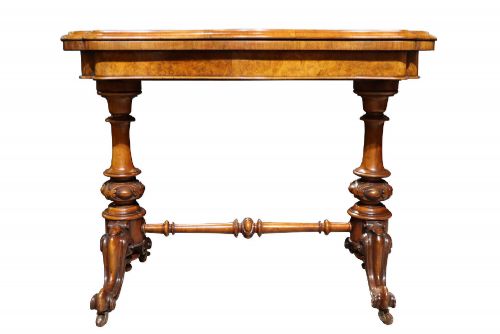
The pieces on this page span the Georgian, Regency, and Victorian periods, alongside Edwardian examples. You are most likely to meet mahogany or burr walnut specimens featuring turn-over or envelope tops.
Many of these tables function equally well as tea tables, supper tables, or occasional furniture. Their versatile design reflects changing interior requirements across the eighteenth and nineteenth centuries.
How they were made
Cabinet makers utilised dense timber foundations such as mahogany, oak, and walnut, often applying decorative veneers of burr walnut, satinwood, rosewood, and kingwood. Inlays of lighter woods and floral marquetry frequently decorate the outer surfaces.
Structural ingenuity defines the mechanism, employing swing legs, concertina frames, or rotating tops to support the open leaf. Brass hinges and castors complete the functional assembly of these folding leaves.
Several tables conceal small interior wells specifically designed to hold stray coins, counters, or mother-of-pearl gaming fish.
What varies in quality
The distinction between ordinary and superior pieces rests on the choice of figured timber and the precision of the cabinet work. Finely matched veneers and crisp carving elevate a table well above standard production.
Stability and balance when the leaf is open demonstrate the original joiner's skill. Smooth movement in the folding mechanism and harmonious proportions distinguish finer examples from simpler provincial work.
Whytock and Reid of Edinburgh
The Fold Leaf Card Table Glossary
- Turn-over top
- A hinged surface that opens to double the available table area, revealing a polished or baize-lined interior.
- Envelope top
- A four-flap mechanism where triangular leaves fold diagonally inwards to open like an envelope.
- Marquetry
- Decorative patterns formed by fitting together thin slices of various coloured woods into a veneer.
- Concertina action
- An expanding frame that stretches out like a bellows to support the extended leaf of a table.
- Demi-lune
- A half-moon shape characteristic of tables designed to sit flush against a wall.
Fold Leaf Card Table: Frequently Asked Questions
How did people use these tables?
These tables served primarily for card games, social gatherings, and taking tea in the parlour. By day, they stood folded against the wall to save space in the room.
In the evening, servants or hosts unfolded the top and swung out the supporting leg to create a stable playing surface.
Where should I place one at home?
A fold leaf card table fits well in a hallway, drawing room, or living space as an occasional display surface. Closed against a wall, it occupies minimal depth while offering character.
Opened up, it works as a lamp table, a desk, or an impromptu dining space for two.
How do I tell Georgian from Victorian tables?
Georgian tables tend to show restrained classical proportions with solid mahogany frames and subtle stringing or carving. They rely on architectural dignity rather than dense surface decoration.
Victorian versions frequently employ burr walnut veneers, elaborate marquetry, and heavier turned or carved supports reflecting mid-nineteenth-century taste.
What is a handkerchief table?
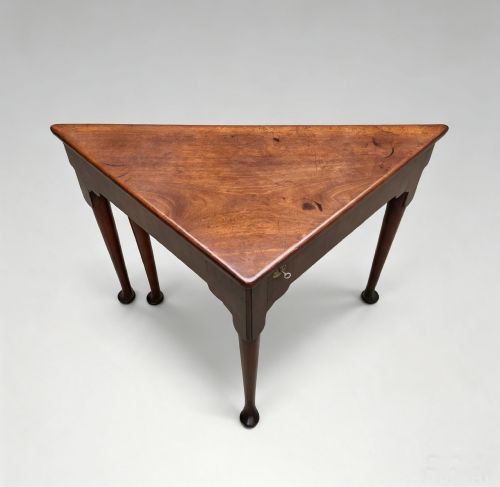
A handkerchief table is a triangular or square folding table named for its folded cloth appearance. It often fits neatly into a room corner.
These pieces expand through a hinged leaf supported by a swinging leg, combining compactness with surprising utility.