







Floral Needlepoint Fire Screen
A floral needlepoint fire screen combines practical warmth management with intricate needlework, offering both historical charm and domestic utility.
Floral Needlepoint Fire Screen
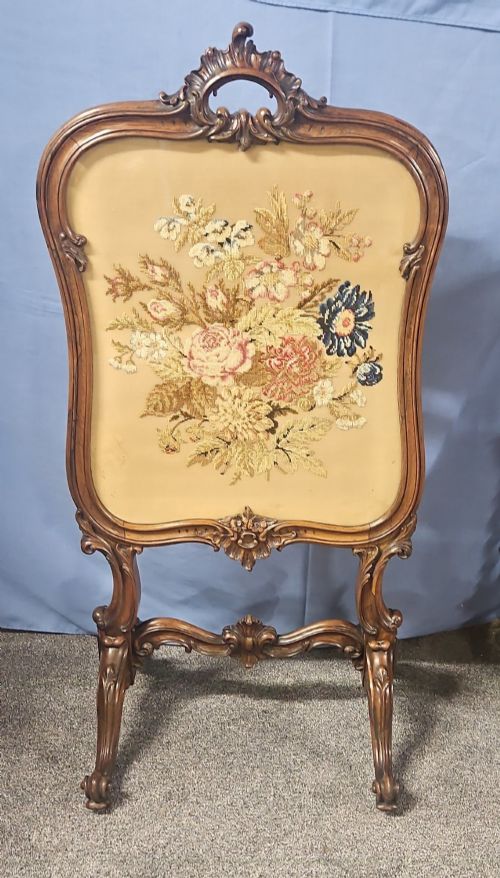
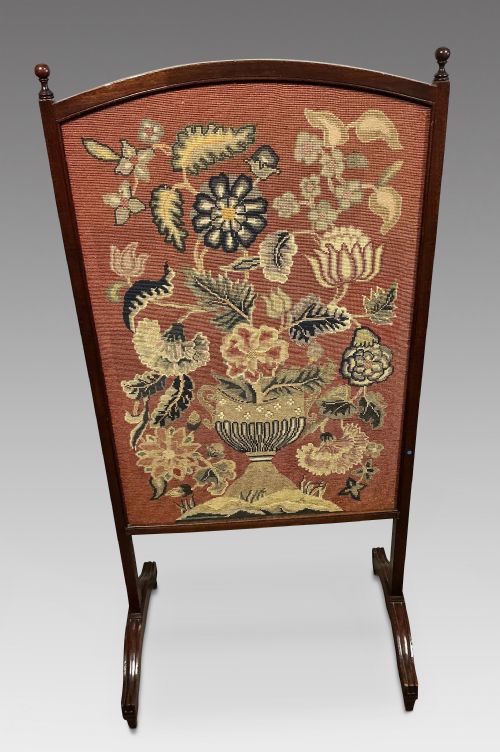
A floral needlepoint fire screen serves to block radiant heat from an open hearth while adding decorative textile art to a room. These domestic furnishings appear across several nineteenth-century periods, spanning the Georgian, Regency, William IV, and Victorian eras.
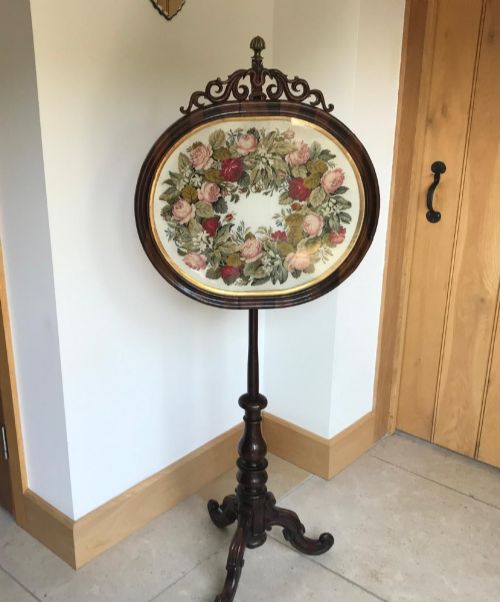
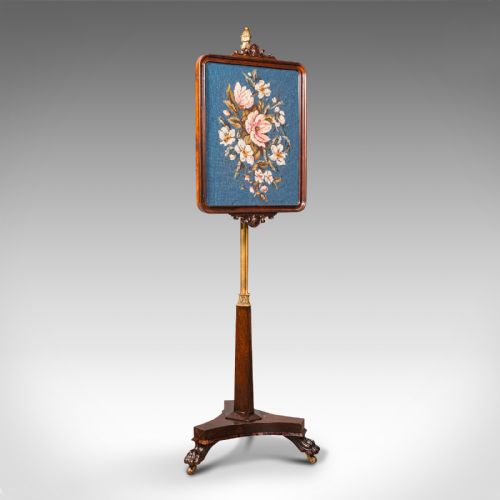
Most examples encountered on this page take the form of pole screens, which feature an adjustable panel mounted on a slender vertical shaft supported by a tripod or weighted base. Other variations include static framed panels and wall-mounted textiles.
The needlework itself typically depicts floral motifs worked in wool, silk, or canvas, set within frames constructed from timbers such as rosewood, mahogany, walnut, satinwood, and giltwood.
Materials and construction
The structural frames rely on dense cabinet timbers like rosewood, mahogany, and walnut, often shaped with turned columns, carved tripod bases, or gilded mouldings. Cabinetmakers employed techniques such as bobbin turning and joinery to support the upright standards and bases.
Panels are worked in wool and silk tapestry, needlepoint, embroidery, and silkwork upon canvas grounds. These textile panels are held securely within wooden frames or suspended on adjustable pole screen mechanisms using brass collars and fittings.
Floral Needlepoint Fire Screen Retail Price Guide 2026
Typical asking prices for floral needlepoint fire screen among the pieces listed under this phrase on Sellingantiques today, from the lower quarter to the upper quarter. They describe what is for sale here now, not the wider market.
The documented periods span the Georgian, Regency, William IV, and Victorian eras, including specific dates from 1820 to 1870.
Judging quality and execution
Excellence in a floral needlepoint fire screen rests on the density and precision of the textile panel and the sculptural refinement of the wooden stand. Finer pieces display intricate needlework with subtle colour shading and sophisticated botanical details.
The choice of timber and the complexity of the base carving further distinguish superior examples, particularly where dense rosewood, goncalo Alves, or giltwood is shaped with detailed turnings. Well-engineered adjustable mechanisms and stable tripod supports also indicate higher workshop standards.
The Floral Needlepoint Fire Screen Glossary
- Pole screen
- A freestanding domestic furnishing consisting of an adjustable vertical shaft and a sliding panel designed to shield the face from hearth heat.
- Needlepoint
- A form of counted-thread embroidery stitched over a stiff open-weave canvas ground to create durable pictorial and floral designs.
- Tripod base
- A three-legged support structure commonly utilised on pole screens to provide stability on uneven floorboards.
- Tapisserie
- A textile worked with needle and thread on canvas or woven on a loom, used here for the decorative floral panels.
- Giltwood
- Timber treated with a thin layer of gold leaf or metallic gilt, frequently seen on Regency and Victorian frames.
Floral Needlepoint Fire Screen: Frequently Asked Questions
How do you use a pole screen?
The sliding panel moves up and down the vertical wooden shaft to block radiant heat coming from an open fireplace. Users adjusted the height depending on where they sat in the room.
Today, these pieces function primarily as decorative room dividers or ornamental focal points rather than active hearth accessories.
What is the difference between needlepoint and tapestry?
Needlepoint is stitched directly through a stiff open-weave canvas backing using wool or silk threads. The term tapestry often encompasses various woven or embroidered wall and panel hangings.
In these screens, both techniques describe the decorative floral surface mounted within the wooden frame.
How do I date a fire screen?
Dating relies on the combination of timber choice, joinery techniques, and stylistic markers associated with periods like Regency or Victorian. Regency pieces often feature brass mounts and lighter exotic woods, whilst Victorian examples frequently employ rosewood, walnut, and elaborate carving.
Needlework styles also reflect the prevailing aesthetic tastes of their specific nineteenth-century decade of production.
Where should I place a fire screen at home?
These screens suit drawing rooms, studies, or hallways where their detailed textile panels and turned wooden stands can be appreciated without exposure to active smoke or direct soot. Placing them away from direct heat sources helps preserve the antique wool and silk threads.
They also work well against plain walls to highlight the carved mahogany or rosewood frames.