
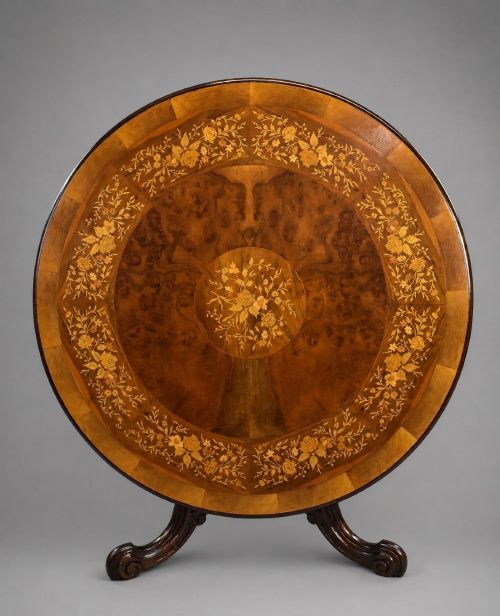
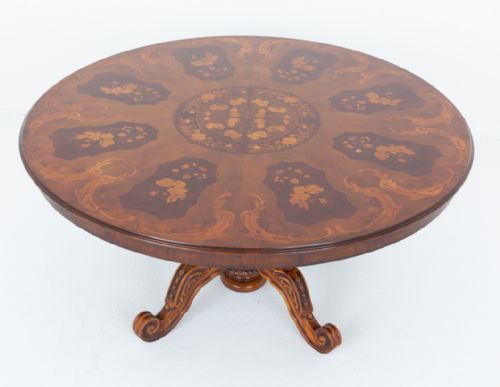


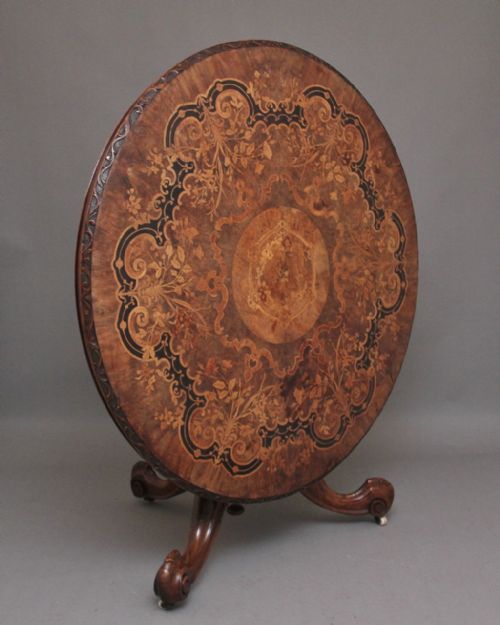


Floral Marquetry Breakfast Table
These floral marquetry breakfast tables combine burr walnut and intricate wood inlay to anchor a period room.
Floral Marquetry Breakfast Table
A floral marquetry breakfast table takes the form of a round or oval top supported on a pillar and carved base, serving as both a dining piece and a centre table. The examples met on this page belong primarily to the Victorian period, spanning the nineteenth century alongside a few later pieces.
Makers fashioned these tables using burr walnut, walnut, and mixed wood inlays to create elaborate floral patterns across the surface. While some function specifically as breakfast tables, others appear under the broader categories of centre tables or dining tables.
Materials and construction
Cabinet makers selected highly figured burr walnut and plain walnut for the primary surfaces, laying down veneers over secondary timbers to achieve deep figuring. They then cut delicate patterns from fruitwood, boxwood, and ebony to form the floral marquetry inlay.
Brass fittings and internal carcase elements provide structural stability to the central pillar and tripod or pedestal base. Artisans relied on precise hand-cutting techniques to fit the contrasting wood veneers flush into the main tabletop.
Listings feature Victorian pieces from the mid nineteenth century, utilising burr walnut, walnut, fruitwood, boxwood inlay, and brass.
Judging the quality
The distinction between standard production and exhibition quality rests on the complexity and precision of the wood inlay. Finer examples display a wider palette of fruitwood and boxwood, creating sharp, detailed floral motifs that integrate seamlessly into the walnut ground.
Selection of the burr walnut veneer dictates the visual depth of the top, with denser figuring marking superior examples. The crispness of the carving on the pillar and base further separates ordinary tables from those made by top workshops.
John Kendal·Jackson and Graham
The Floral Marquetry Breakfast Table Glossary
- Marquetry
- A decorative technique where small pieces of veneer are fitted together to form pictorial patterns and floral designs on a furniture surface.
- Burr Walnut
- A specialised timber cut from the abnormal growths of walnut trees, prized for its swirling, highly figured grain patterns.
- Centre Table
- A freestanding table finished on all sides, designed to stand in the middle of a room rather than against a wall.
- Veneer
- A thin layer of choice wood applied over a cheaper secondary timber to provide a decorative exterior surface.
- Fruitwood
- Dense, pale timber such as pear or apple used by makers to provide contrasting tones within floral inlay work.
Floral Marquetry Breakfast Table: Frequently Asked Questions
What is a floral marquetry breakfast table?
A floral marquetry breakfast table is a round or oval nineteenth-century table featuring detailed wood inlay flowers set into walnut or burr walnut.
These pieces were built for dining or display, featuring a central pillar support and decorative veneered top.
How do I date a Victorian breakfast table?
Dating relies on observing the timber choices, construction methods, and the style of the floral marquetry decoration across the piece.
Evidence on this page points primarily to the Victorian era, spanning the mid nineteenth century with occasional later examples.
Where should I place a centre table?
Centre tables are designed to stand freely in the middle of a room, as their marquetry and finish extend around the entire top.
They function well in large reception rooms where the inlaid surface remains visible from multiple angles.
What woods are used in these tables?
The primary timber is typically walnut or burr walnut, valued for its rich grain and suitability for high-end furniture.
Makers utilised fruitwood, boxwood, and ebony for the contrasting elements of the floral marquetry designs.