

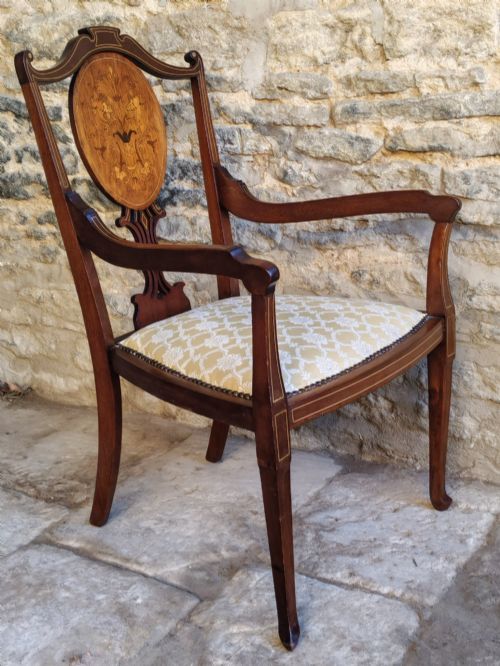
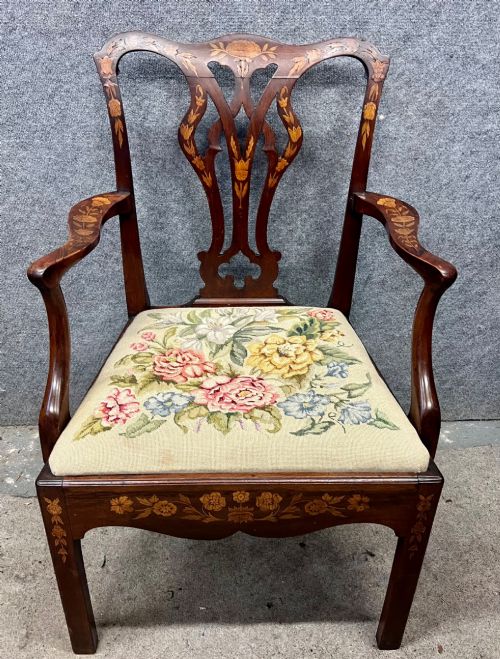
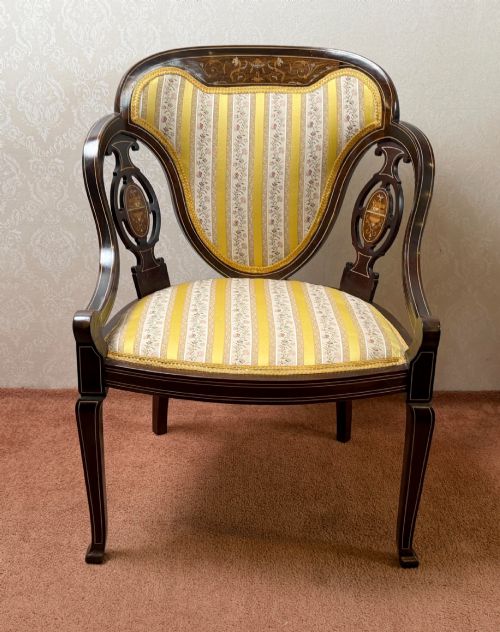
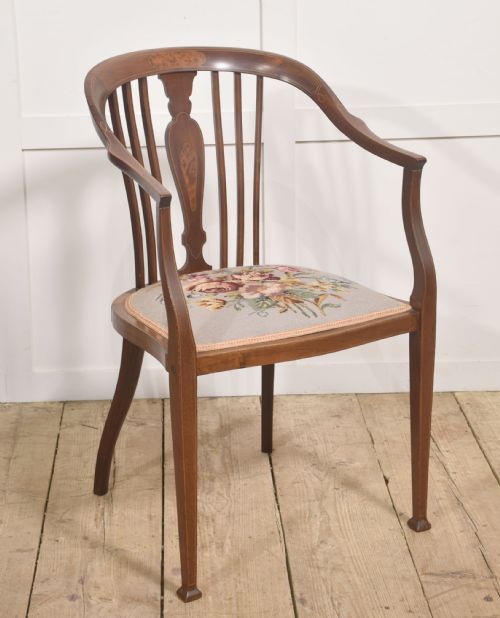


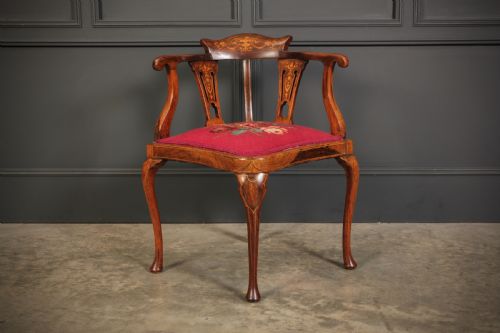
Floral Marquetry Armchair
A floral marquetry armchair brings botanical artistry into a room, offering patterned timber inlay set into sturdy chair frames.
Floral Marquetry Armchair
A floral marquetry armchair combines practical seating with intricate wood veneer patterns depicting flowers, foliage and stems. When searching for a floral marquetry armchair, buyers encounter pieces spanning multiple centuries, from eighteenth-century Dutch Baroque and Rococo examples to nineteenth-century mahogany designs and Edwardian interpretations.
The selections on this page feature armchairs, elbow chairs, corner chairs and tub chairs constructed in various timber bases. Mahogany, walnut and rosewood serve as the primary foundational woods, carrying detailed decorative veneers across backs, seats and arms.
Origins range across British, continental European and Edwardian workshop traditions. Many items incorporate contrasting timber species to build up the multi-coloured floral motifs across the backrests and panels.
How they were made
Cabinetmakers constructed these seating forms using solid foundational timbers such as mahogany and walnut for structural integrity. They then applied thin veneers of contrasting woods to the surface.
Makers cut floral designs using boxwood, satinwood, fruitwood inlay and bone, fitting each tiny piece together like a puzzle before pressing the complete pictorial veneer onto the chair frame.
Floral Marquetry Armchair Retail Price Guide 2026
Typical asking prices for floral marquetry armchair among the pieces listed under this phrase on Sellingantiques today, from the lower quarter to the upper quarter. They describe what is for sale here now, not the wider market.
Current listings feature armchairs spanning the 18th century, 19th century and Edwardian periods, utilising mahogany, walnut, rosewood, boxwood, satinwood, bone and needlepoint tapestry.
What varies in quality
The refinement of the floral marquetry dictates much of the distinction between standard and superior examples. Finer chairs display intricate shading in the petals and stems, achieved by scorching veneer edges in hot sand.
Structural variety also shifts quality levels, as seen in the transition from simple occasional chairs to substantial high-back carvers and elbow chairs featuring dense bone and boxwood detailing.
The Floral Marquetry Armchair Glossary
- Marquetry
- Decorative veneer work formed by fitting together small pieces of wood, bone or other materials to create pictorial patterns on a furniture surface. This technique allows intricate floral designs to wrap across curved and flat chair panels.
- Boxwood
- A dense, pale yellow hardwood frequently utilised in marquetry for highlights and fine stem work. Its uniform grain accepts crisp cutting without splintering.
- Satinwood
- A lustrous tropical timber known for its golden sheen, providing bright contrast against darker foundational woods like mahogany and walnut. It appears commonly within floral inlay panels.
- Carver
- An armchair, often with open arms, traditionally designed to sit at the head of a dining table or serve as a desk chair. These pieces offer wider proportions than standard occasional seating.
Floral Marquetry Armchair: Frequently Asked Questions
Where should I place a marquetry armchair?
These armchairs suit reception rooms, studies or bedrooms where their decorative backs remain visible to observers. Position them away from direct sunlight to protect vulnerable tinted veneers and natural bone inlay from fading.
Pair an occasional chair with a quiet reading corner or place a high-back model against a plain wall to let the floral patterns stand out clearly.
How do I care for inlaid wooden furniture?
Maintain the surface by dusting gently with a dry, soft cloth and avoiding silicone-based polishes that build up over time. Keep the chair away from direct heat sources and sudden humidity shifts to prevent timber shrinkage and veneer lifting.
Feed dry wood occasionally with a suitable microcrystalline wax, applying it sparingly and buffing to a soft sheen.
What is the difference between marquetry and inlay?
Marquetry covers an entire surface with a fitted jigsaw of veneer pieces to form a pictorial scene, such as flowers and foliage. Inlay involves cutting recesses directly into a solid wood base and sinking individual pieces into those cavities.
Many period chairs combine both methods, using veneer marquetry for back panels alongside solid timber construction for the legs and arms.
Can I use an antique armchair every day?
Most sturdy mahogany and walnut armchairs handle regular daily use provided they sit on level flooring and avoid excessive strain. Lighter occasional chairs or corner chairs serve better for lighter sitting duties rather than heavy lounging.
Check the joints periodically to ensure the frame remains stable under normal weight.