
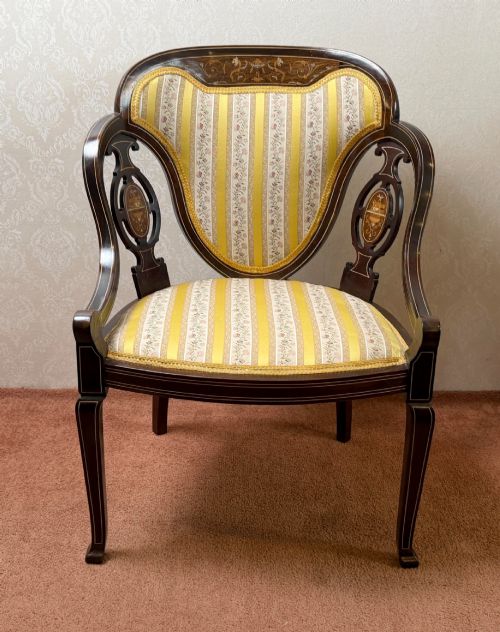
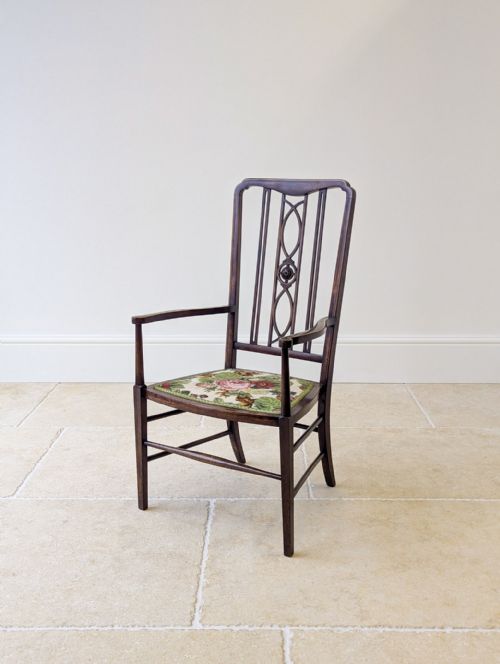
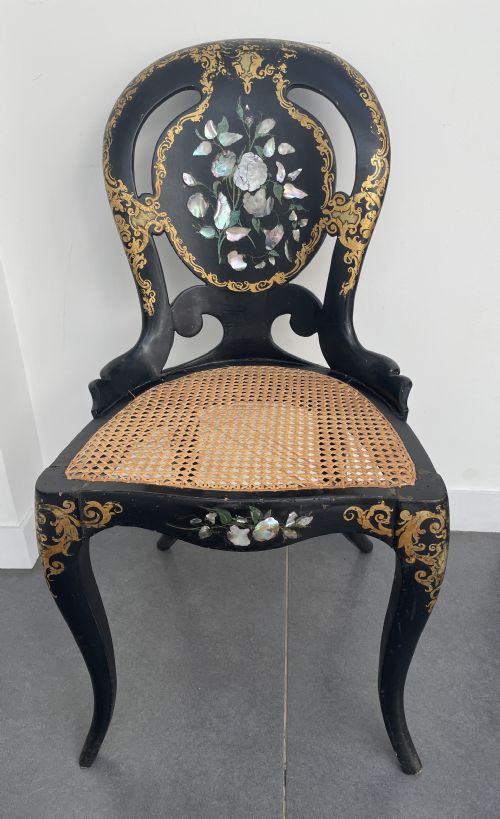
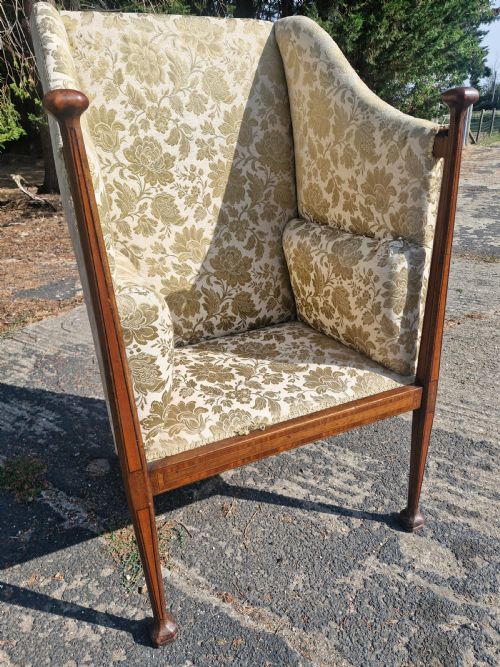
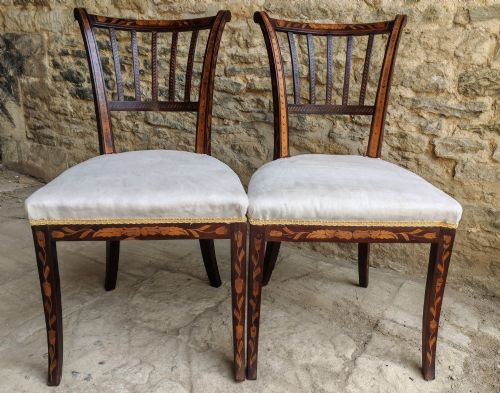
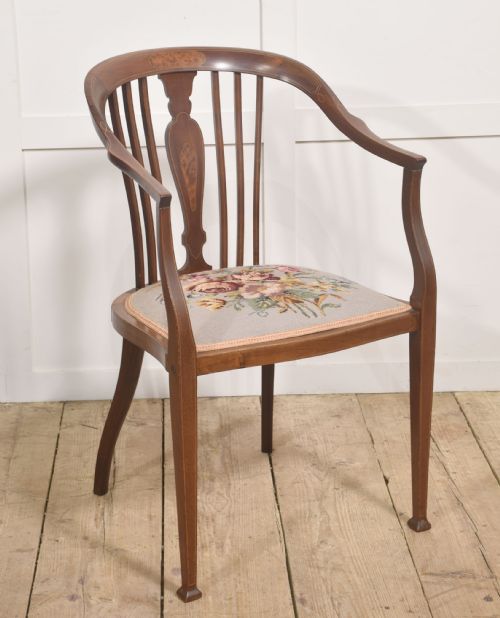


Floral Inlay Chairs
These floral inlay chairs bring patterned wood and period seating together, offering the refined woodwork collectors seek for traditional interiors.
Floral Inlay Chairs
Floral inlay chairs encompass a diverse range of seating forms, with side chairs, armchairs, and occasional chairs appearing most frequently across the centuries. These pieces emerge from periods including the Georgian era, the Victorian decades, and the Edwardian epoch, alongside Dutch Baroque and Rococo phases.
Buyers will encounter single examples alongside pairs and larger sets, often upholstered in fabrics like damask. The decorative focus rests firmly on the intricate marquetry and inlaid floral motifs set into the wood.
How they were made
Cabinetmakers constructed these frames primarily from mahogany, walnut, and satinwood, frequently integrating fruitwood inlay and contrasting timbers to build up complex floral marquetry designs. Artisans also utilised beech, rosewood, and lacquered papier-mâché depending on the period and regional workshop traditions.
Decorative detailing incorporates mother of pearl elements and brass fittings to complement the timber work. Upholstery methods rely on traditional fabric applications, including damask, to finish the seats of these armchairs and side chairs.
Mahogany, walnut, satinwood, and fruitwood inlay form the primary material palette across these 18th-century, Victorian, and Edwardian seating listings.
What varies in quality
The precision and complexity of the floral marquetry dictate the upper tiers of the range, where individual cuts of satinwood and fruitwood create crisp, detailed botanical patterns against the mahogany or walnut ground. Simpler examples rely on more restrained inlay work or basic timber contrast.
Structural integrity and the retention of original components, from the carved arms to the brass fittings and mother of pearl accents, separate the finest examples from heavily restored or altered seating.
The Floral Inlay Chairs Glossary
- Marquetry
- Decorative veneer work forming pictures or patterns by using small pieces of wood, shell, or ivory fitted into a timber ground. This technique creates the floral motifs seen across the chair backs and seats.
- Satinwood
- A durable, lustrous yellow timber imported from tropical regions, frequently used for contrasting inlay work on mahogany furniture during the Georgian and Edwardian periods.
- Sheraton style
- A neoclassical furniture design style dating to the late 18th century, characterised by straight tapered legs, geometric lines, and delicate inlaid decoration.
- Dutch Baroque
- An ornate European design period known for dramatic curved forms, high backs, and elaborate floral marquetry executed in walnut.
- Damask
- A reversible figured fabric traditionally woven from silk, wool, or linen, commonly utilised for period upholstery on chairs and salons suites.
Floral Inlay Chairs: Frequently Asked Questions
What periods do floral inlay chairs come from?
The pieces span multiple centuries, appearing in Georgian, Victorian, and Edwardian iterations alongside earlier Dutch Baroque and Rococo designs.
Maker styles range from Sheraton and Sheraton Revival to the sweeping lines of Art Nouveau.
What woods are used for floral inlay chairs?
Makers relied heavily on mahogany and walnut as the primary structural timbers, enhanced by satinwood and fruitwood inlay.
Additional materials such as rosewood, beech, mother of pearl, and brass also appear in the decorative schemes.
Are these chairs sold as sets?
Listings feature individual armchairs and side chairs alongside matched pairs, four-piece sets, and larger dining chair collections.
Buyers also encounter occasional chairs, salon suites, and boudoir seating designed for specific rooms.
How do I identify a Sheraton style inlay chair?
Sheraton pieces typically display straight tapered legs, refined proportions, and geometric framing combined with delicate contrasting marquetry.
These chairs date predominantly from the Georgian period through to later revival movements.