

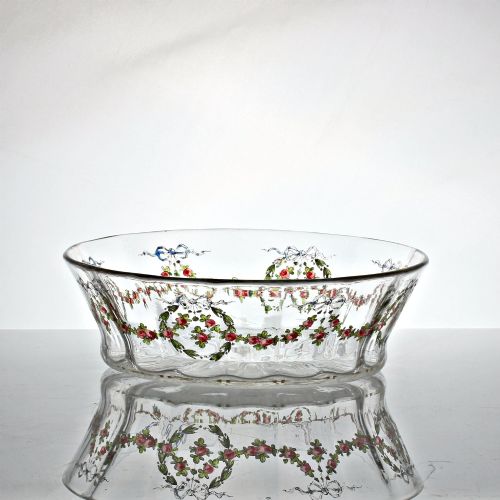
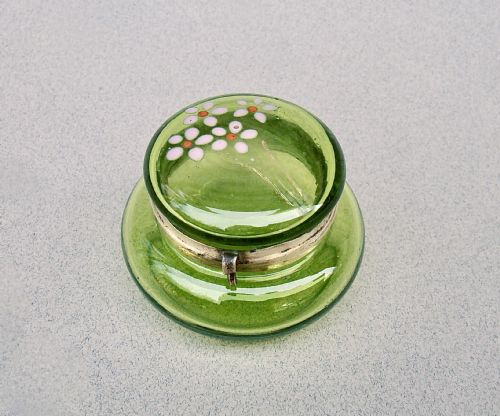


Floral Glass Dish
These floral glass dish examples bring together delicate botanical motifs and skilled glasswork from the Victorian era through the Art Deco period.

Floral Glass Dish
A floral glass dish selection encompasses decorative bowls, trinket boxes, dressing table jars, and centrepieces adorned with plant and flower themes.
Most pieces date from the nineteenth century through the 1930s, featuring Victorian, Art Nouveau, and Art Deco styles.
Buyers will encounter French and English origins, including notable opalescent glassware alongside enameled and gilded vessels.
How they were made
Makers utilised clear and coloured glass, including Bristol blue and green hues, shaped into bowls, plates, and lidded boxes.
Decoration relied on enamel painting, paste gilding, gold leaf, and metal mounts in gilt bronze, sterling silver, or pewter.
Advanced moulding techniques created opalescent and grey stained finishes with high relief floral patterns.
Floral Glass Dish Retail Price Guide 2026
Typical asking prices for floral glass dish among the pieces listed under this phrase on Sellingantiques today, from the lower quarter to the upper quarter. They describe what is for sale here now, not the wider market.
Current listings feature glass, enamel, opalescent glass, crystal, gilt bronze, and gold leaf across Victorian and twentieth-century periods.
What varies in quality
The precision of the enamel work and the crispness of the moulded floral relief dictate the refinement of the piece.
The integration of secondary materials, such as gilt bronze frames or silver mounts, separates standard production from finer examples.
Rene Lalique·Hannah Walton·Orivit
The Floral Glass Dish Glossary
- Opalescent glass
- Glass that diffuses light to display a milky, milky-blue or fiery appearance. This effect highlights raised details like petals and leaves.
- Enamel
- Vitreous material fused to the glass surface through firing. It provides permanent colour for painted floral designs.
- Tazza
- A shallow bowl or plate mounted on a stem and foot. These serve as display centrepieces.
- Plique-a-jour
- An enamelling technique where enamel is applied in cells without a backing, resembling miniature stained glass. It allows light to pass through the botanical motifs.
Floral Glass Dish: Frequently Asked Questions
What periods do these dishes come from?
The selection spans the nineteenth century up to the 1930s. Victorian, Edwardian, Art Nouveau, and Art Deco eras are well represented.
Items range from mid Victorian silver mounted pieces to modernist opalescent bowls from the interwar decades.
How were these dishes used originally?
Many functioned as dressing table jars and trinket boxes for personal items. Larger examples served as fruit bowls, sugar baskets, or table centrepieces.
Open plates and tazza designs were intended for visual display in reception rooms.
How do I care for antique glass?
Clean pieces gently by hand using lukewarm water and mild soap. Avoid soaking items with enamel paint, gold leaf, or metal mounts.
Dry thoroughly with a soft cloth to preserve the surface finish and any delicate gilding.
How do I identify Art Nouveau styles?
Look for flowing, asymmetrical lines inspired by natural plant forms. Makers often combined glass with pewter or gilt bronze mounts featuring botanical tendrils.
French and English pieces from this movement favour organic curves over strict geometric shapes.