


Floral Carved Tilt Top Table
These floral carved tilt top table examples combine intricate woodworking with practical folding surfaces, offering versatile display space for any traditional interior.
Floral Carved Tilt Top Table
A floral carved tilt top table provides a dual-purpose surface that pivots upright when not in use, saving floor space in period rooms. These pieces appear frequently as centre tables, occasional tables, breakfast tables, and dining tables across this page.
The majority of these tables date from the Victorian period and the nineteenth century, spanning decades such as eighteen fifty, eighteen sixty, eighteen eighty, and nineteen twenty. Makers utilised diverse timber varieties to construct circular and tripod frames.
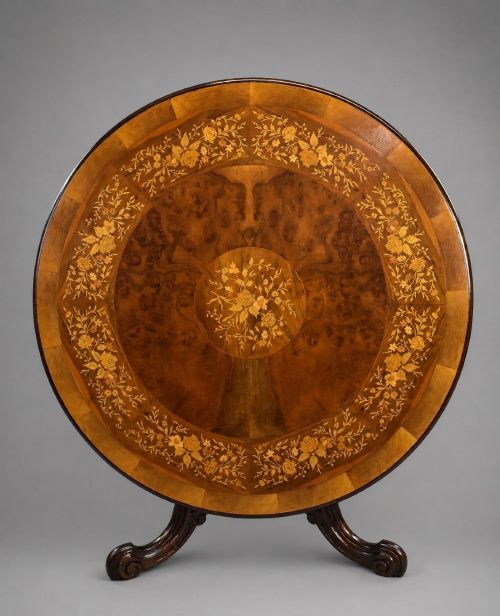
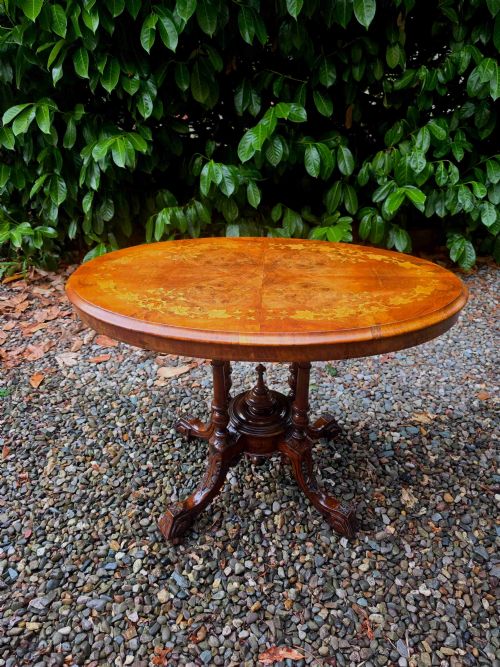
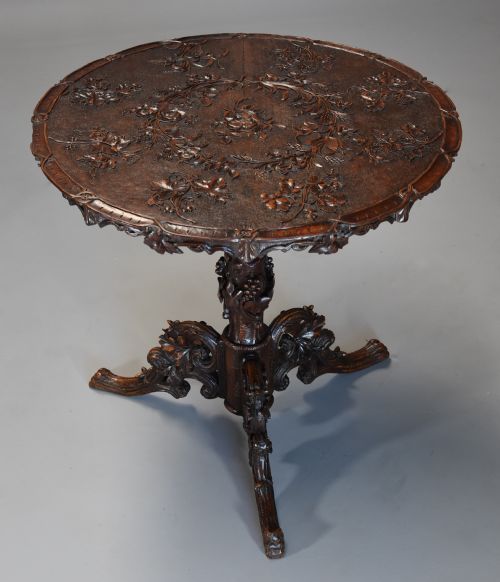
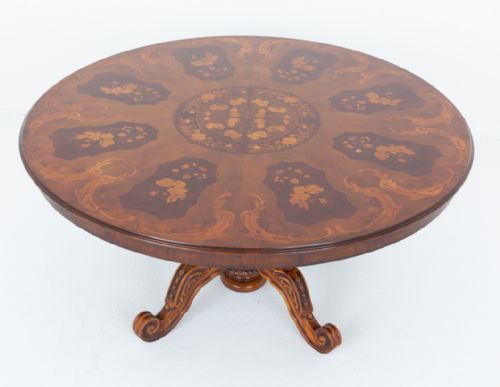
Stylistic influences range from standard Victorian and Georgian iterations to Black Forest and Oriental Export designs. Buyers encounter both heavily carved linden wood surfaces and smooth walnut tops finished with detailed marquetry.
How They Were Made
Carpenters shaped these tables using dense hardwoods including walnut, burr walnut, mahogany, rosewood, olive wood, ebony, and linden wood. Surfaces often incorporate complex wood inlay and marquetry inlay patterns alongside brass fittings.
The construction relies on sturdy central pedestals and tripod bases designed to support the pivoting mechanism of the tilt top. Skilled artisans applied deep relief carving, particularly on Black Forest and Oriental export examples.
Materials span walnut, burr walnut, mahogany, rosewood, olive wood, ebony, brass, and extensive marquetry inlay.
What Varies in Quality
The precision of the marquetry inlay and the depth of the floral carving define the upper tiers of these tables. Finer examples display tightly fitted wood veneers and crisp, sharply defined botanical motifs across the entire surface.
Structural stability in the tilt top mechanism and pedestal pivot separates superior pieces from standard workshop output. Choice of timber also dictates quality, with figured burr walnut and exotic woods commanding greater visual depth.
John Kendal
The Floral Carved Tilt Top Table Glossary
- Tilt top table
- A table with a hinged top that rotates to a vertical position for storage or display when not in active use. This design originated to allow larger furniture to clear floor space against walls.
- Marquetry
- Decorative veneer work arranged in pictorial or geometric patterns using various coloured woods. Craftsmen cut thin slices of timber to assemble complex floral scenes on table tops.
- Burr walnut
- A specialised timber cut from the abnormal growth or burl of a walnut tree, producing a swirling, highly figured grain pattern. Cabinet makers prized this wood for high-status Victorian table surfaces.
- Tripod base
- A support structure featuring three legs radiating from a central column to stabilise circular table tops. This configuration prevents wobbling on uneven period flooring.
Floral Carved Tilt Top Table: Frequently Asked Questions
How do you tilt the top?
Most tables use a simple wooden catch or brass latch beneath the surface that releases the top from the pedestal. Once unlocked, the surface pivots on its central hinge to stand upright.
Support the top firmly with one hand while operating the release mechanism to prevent sudden movement or strain on the pivot block.
Were these used for dining?
Larger breakfast and dining variations served morning meals or smaller gatherings before tilting away to clear the room. Occasional and centre tables functioned primarily for display and decorative utility.
The tilting mechanism allowed households to maximise living space in smaller Victorian parlours when formal meals concluded.
How do I care for marquetry?
Maintain the inlaid surfaces by applying appropriate furniture wax sparingly and buffing with a soft, lint-free cloth. Keep the timber away from direct heat sources and strong sunlight to prevent veneer shrinkage.
Check the stability of individual wood inlays periodically, as fluctuating humidity can affect the tiny glued sections.
How do I date these tables?
Examine the timber selection, base construction, and carving style to determine the likely period of manufacture. Nineteenth-century examples frequently feature burr walnut with complex marquetry or deep Black Forest linden wood carving.
Standardised Victorian production methods and specific regional styles like Oriental Export provide further chronological markers for attribution.