
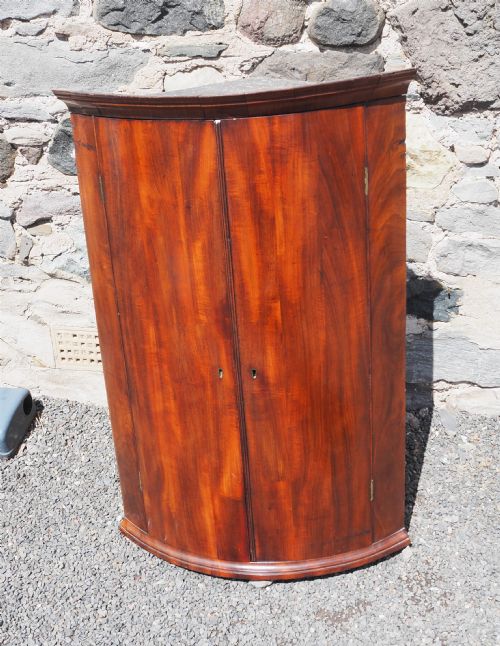
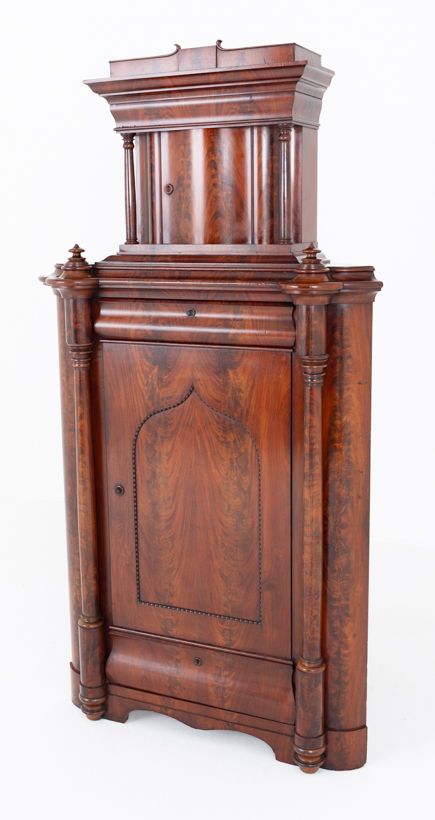


Flame Mahogany Corner Cabinet
A flame mahogany corner cabinet harnesses deeply figured timber to turn dead angles into focal points.
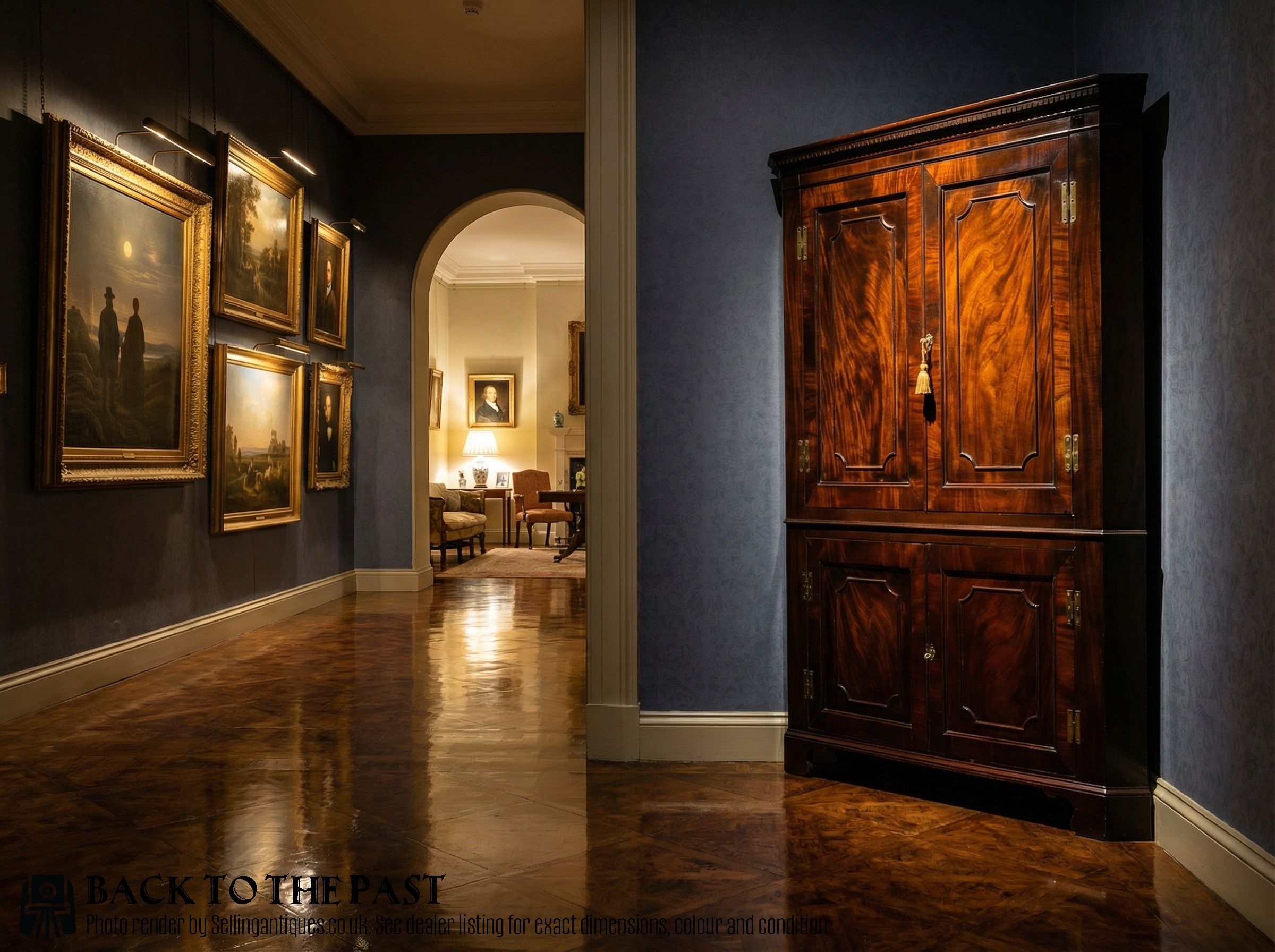
Flame Mahogany Corner Cabinet
A flame mahogany corner cabinet is a specialised storage piece designed to fit neatly into the intersection of two walls, maximising awkward domestic spaces. These architectural items appear frequently in Georgian, Regency, and Edwardian guises, often configured with hanging doors or bow fronts.
The versions most commonly met on this page span the eighteenth and nineteenth centuries, ranging from compact wall-hanging cupboards to substantial two-piece standing displays. Cabinetmakers utilised the natural geometry of the room to display prized ceramics, glassware, or spirits behind single or paired doors.
How they were made
Craftsmen built these cupboards using solid mahogany frameworks overlaid with carefully matched veneers of flame mahogany to create striking symmetrical patterns on the doors. Cabinetmakers enhanced these wooden surfaces with fine boxwood and satinwood inlay, often finished with brass H-hinges and escutcheons.
Structural integrity relied on dense timber carcasing, sometimes incorporating oak for internal shelves and backing. Glazed upper sections featured delicate wooden astragals framing glass panels, while standing variants rested on bracket feet or swept supports.
Some upright variants cleverly conceal triangular shelving designed specifically to hold bottles upright away from clumsy elbows.
What varies in quality
The distinction between ordinary and exceptional examples rests heavily on the intensity and book-matching of the flame mahogany veneer across the primary surfaces. Superior pieces display deep, undulating figuring that mirrors symmetrically from left to right, paired with crisp boxwood or satinwood inlay.
Construction subtleties also dictate standing, such as the weight of the brass hardware, the precision of the mitred joints, and the architectural ambition of the cornice, whether featuring a broken arch pediment or a simple moulded edge.
The Flame Mahogany Corner Cabinet Glossary
- Flame mahogany
- A veneer figure resembling flickering flames, produced by cutting through the branch junctions of the mahogany tree.
- Bow front
- A convex, outwardly curved front facade that softens the rigid ninety-degree angles of a standard room corner.
- Astragal
- A narrow moulding used to hold the individual panes of glass within a glazed cabinet door.
- Pediment
- The decorative architectural crown surmounting the top of a cabinet, frequently seen in broken arch designs.
- Escutcheon
- A protective plate surrounding the keyhole, typically cast from brass on better period pieces.
Flame Mahogany Corner Cabinet: Frequently Asked Questions
How are these cabinets hung?
Wall-hanging corner cupboards utilise heavy-duty internal brackets or sturdy backboards screwed directly into masonry or wall studs to bear the considerable weight of the timber.
Professional installation ensures the cabinet remains level, allowing the heavy flame mahogany doors to swing freely without dropping on their brass hinges.
Where were they placed?
These pieces were traditionally positioned in dining rooms, parlours, or drawing rooms to make use of dead architectural space while keeping tableware secure.
Their triangular footprint allowed large reception rooms to maintain clear floor space while adding vertical storage and display areas.
How do I spot a Georgian piece?
Georgian examples are identified by period construction methods, such as hand-cut dovetails, secondary timbers like oak, and authentic brass hardware.
Stylistic markers include classic cornices, astragal glazing bars, and the distinctive patination accumulated over centuries of polish and handling.