


Fitted Wooden Canteen Cutlery
These fitted wooden canteen cutlery sets organise flatware inside timber chests spanning from the Georgian era through to Art Deco.
Fitted Wooden Canteen Cutlery
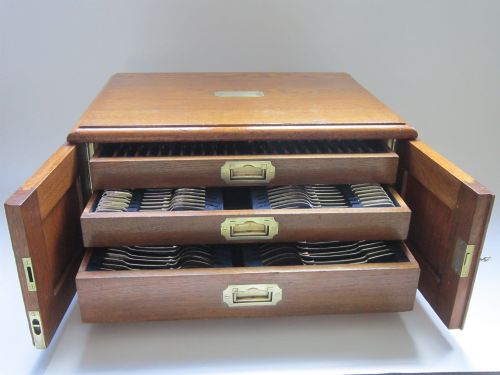
A fitted wooden canteen cutlery set is a dedicated storage chest housing organised flatware, most frequently encountered here in oak, walnut, or burr walnut from periods like the Edwardian era and the 1930s. Buyers searching this phrase examine everything from standalone knife boxes and Georgian chests to substantial oak cased canteens holding dozens of pieces.
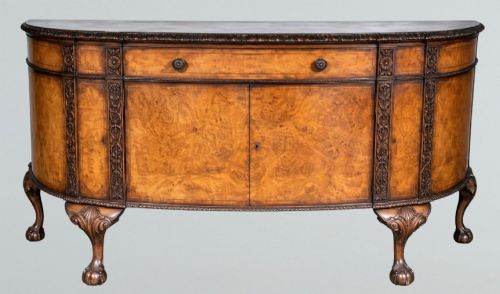
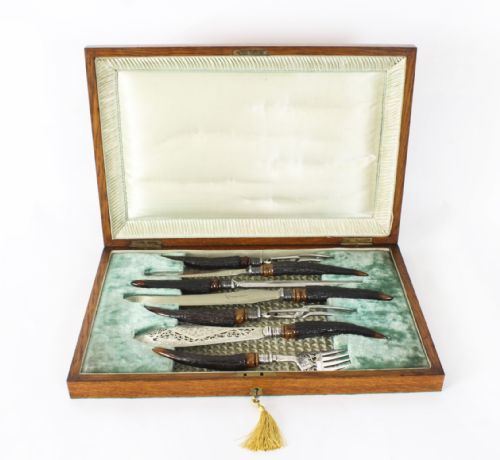
The contents within these wooden containers vary widely, taking the form of large Art Deco services with over one hundred pieces, twelve piece sets housed inside sideboards, or smaller carving sets and silver plated fruit and cheese sets with mother of pearl handles. Victorian examples frequently feature fiddle pattern sterling silver or antler horn serving pieces.
Origins span English workshops from the early nineteenth century onwards, alongside specific pieces marked by makers such as Walker & Hall or retailed by Waring & Gillows. Buyers encounter both fitted interiors designed to keep flatware secure and larger furniture forms like sideboards incorporating built in storage.
Materials and construction
Construction relies heavily on solid timbers andveneers, utilising oak, walnut, and burr walnut to form sturdy chests and knife boxes designed to protect the metalware within. Interiors are typically lined with velvet to cushion silver plate, sterling silver, and brass elements.
Metal components combine traditional forging and casting techniques, seen in silver plated steel blades, sterling silver fiddle pattern spoons and forks, and natural materials like mother of pearl and antler horn used for handles. Fitted wooden compartments are meticulously joined to hold each specific utensil securely in place.
Listings feature oak, walnut, and burr walnut timbers across periods spanning the Georgian era, Victorian times, Edwardian years, and Art Deco design.
Assessing quality and finish
Quality rests upon the selection of cabinet timbers, where figured burr walnut or dense oak commands attention alongside the precision of the fitted interior woodwork. Superior canteens maintain intact velvet linings and robust joinery that withstands generations of use.
The completeness and uniformity of the cutlery set itself dictate value, with matching services by notable makers such as Walker & Hall outperforming assembled collections. The tactile quality of materials like mother of pearl handles and substantial silver plating further elevates the piece.
Walker & Hall·Waring & Gillows
The Fitted Wooden Canteen Cutlery Glossary
- Canteen
- A fitted box or chest designed specifically to store and organise flatware. These containers ensure each fork, spoon, and knife remains secure and protected from tarnish.
- Fiddle Pattern
- A traditional nineteenth century flatware design featuring a slender stem that expands into a fiddle shape at the end. This handle style is commonly found on Victorian silver services.
- Silver Plate
- A base metal, often copper or nickel alloy, coated with a thin layer of pure silver. This technique provided a durable alternative to solid sterling silver during the Victorian and Edwardian periods.
- Burr Walnut
- Timber taken from the wart or growth on a walnut tree, highly prized for its swirling, decorative grain patterns. It frequently surfaces on luxury furniture and fitted boxes from the early twentieth century.
- Knife Box
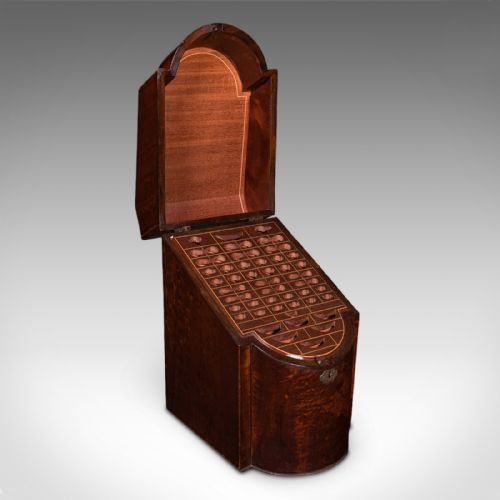
- A specialised wooden container, often of Georgian origin, shaped with a sloping lid to house dining knives vertically or horizontally. These serve as early ancestors to the comprehensive cutlery canteen.
Fitted Wooden Canteen Cutlery: Frequently Asked Questions
What is fitted wooden canteen cutlery?
Fitted wooden canteen cutlery refers to protective chests, boxes, or sideboards made from timbers like oak and walnut that house organised sets of forks, spoons, and knives.
These pieces range from compact Georgian knife boxes to extensive Edwardian and Art Deco service chests created to keep flatware safe and orderly.
How were these canteens used?
These canteens served as permanent storage in dining rooms, keeping large quantities of silver plate or sterling silver clean and readily accessible for formal meals.
Servants and hosts used the fitted trays and velvet linings to transport and present complete flatware services directly to the dining table.
How do I date a wooden canteen?
Dating relies on timber choices, exterior styling, and the manufacturing style of the internal flatware, moving from Georgian mahogany boxes to Victorian silver and Edwardian oak chests.
Makers' marks and distinct design movements like Art Deco or Queen Anne Revival also provide clear chronological markers for the piece.
Are all canteens made of oak?
While oak is common in Edwardian and 1910s canteens, makers also utilised walnut, burr walnut, and general hardwoods for both chests and integrated sideboard storage.
Interior components frequently incorporated softer elements like velvet linings alongside brass hardware and mother of pearl cutlery handles.