
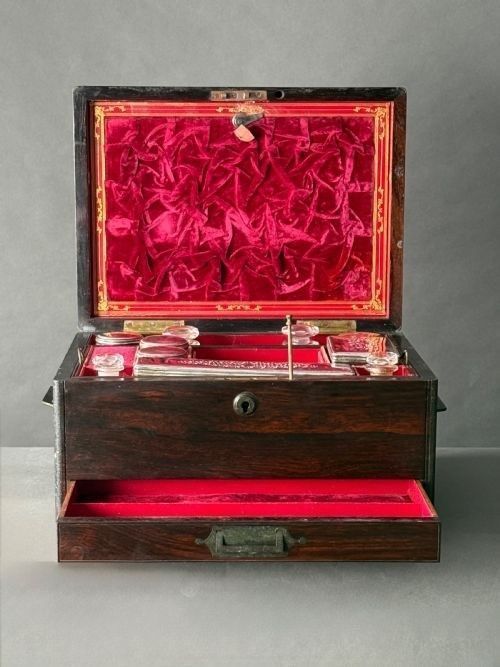


Fitted Rosewood Dressing Box
A fitted rosewood dressing box offers ingenious internal architecture and rich timber grain, designed for personal travel and daily grooming.
Fitted Rosewood Dressing Box
A fitted rosewood dressing box is a portable chest designed to hold personal grooming items, jewellery, and writing materials during travel or for domestic use. These boxes appear across several periods, including the Georgian, Regency, Victorian, and Edwardian eras.
The version most commonly met on this page is the Victorian or nineteenth-century box, often featuring internal compartments, velvet linings, and glass bottles. Forms range from compact vanity cases and workboxes to larger travelling dressing tables and French campaign pieces.
Makers utilised rich timber grains across various object types, including jewellery boxes and vanity boxes. Examples span English and French origins, occasionally incorporating brass inlay or mother of pearl.
How they were made
Carpenters constructed the carcasses primarily from rosewood, sometimes incorporating walnut, and applied decorative brass or mother of pearl inlay to the exterior surfaces.
Interiors were lined with velvet and fitted with glass and silver accessories, creating dedicated compartments for jewellery, cosmetics, and grooming tools.
Listings span the Georgian, Regency, Victorian, and Edwardian periods, utilising rosewood, walnut, brass, velvet, glass, silver, leather, and mother of pearl.
What varies in quality
Quality rests in the precision of the internal fittings and the complexity of the compartment layout rather than the mere presence of rosewood timber. Boxes that retain their original glass bottles, silver elements, and intact velvet linings demonstrate superior original manufacture.
The integration of brass or mother of pearl inlay distinguishes finer pieces, showing careful hand-fitting into the rosewood surface. Simpler workboxes often feature more straightforward interior arrangements with fewer specialised compartments.
The Fitted Rosewood Dressing Box Glossary
- Rosewood
- A dense, dark timber prized for its prominent grain and deep colour, frequently used for luxury boxes throughout the nineteenth century.
- Campaign
- A style of portable furniture designed for travel, typically featuring recessed brass handles and robust construction to withstand journeys.
- Vanity box
- A portable container outfitted specifically for cosmetics, brushes, and personal grooming accessories.
- Mother of pearl
- An iridescent inner layer of certain mollusc shells, utilised for decorative inlay on box lids and escutcheons.
Fitted Rosewood Dressing Box: Frequently Asked Questions
What is a fitted rosewood dressing box?
It is a portable timber chest designed to hold personal grooming accessories, cosmetics, and jewellery during travel or for home use.
These pieces typically open to reveal a lined interior with dedicated compartments, glass bottles, and sometimes a mirror.
How were these boxes used?
Owners used them for storage and transport of personal effects, keeping valuables and grooming tools organised while away from home.
They served as portable dressing stations for gentlemen and ladies during the Regency and Victorian periods.
How do I date a rosewood dressing box?
Dating relies on stylistic clues, construction methods, and materials associated with periods such as Georgian, Regency, Victorian, or Edwardian.
Hardware styles, brass inlay patterns, and interior lining materials often help determine the approximate decade of manufacture.
What materials are found inside?
Interiors frequently feature velvet linings, glass jars with metal lids, silver items, and small compartments for jewellery.
Some examples also include leather-bound surfaces or hidden secret drawers beneath the primary tray.