


Fitted Drawer Tallboy
A fitted drawer tallboy provides vertical storage combined with writing surfaces, bringing traditional craftsmanship into modern spaces.
Fitted Drawer Tallboy
A fitted drawer tallboy unites vertical height with specialised internal compartments, offering multiple drawers alongside writing drawers or secretaire sections. These pieces span the eighteenth and nineteenth centuries, emerging through Georgian and Victorian periods.
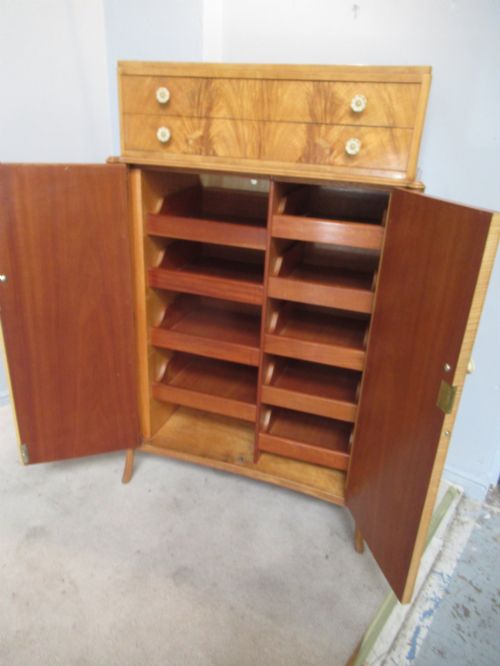
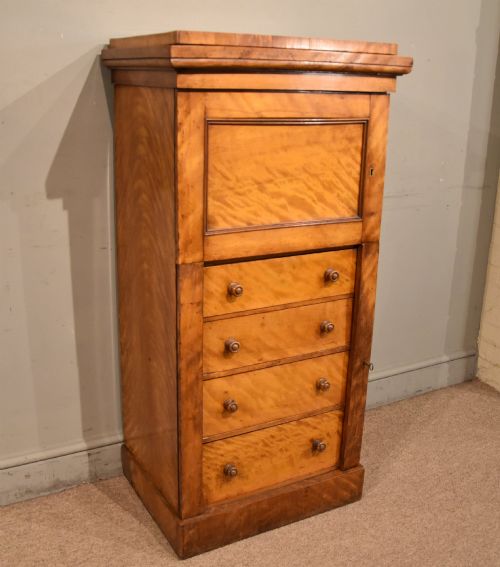
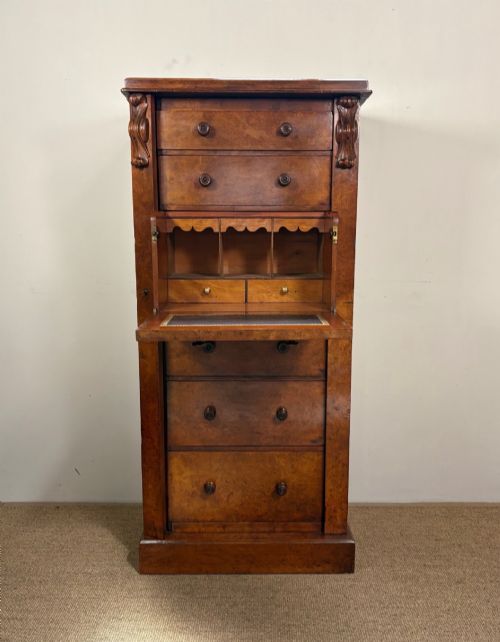
The selections here range from classical mahogany chest on chest designs to compact Victorian Wellington chests and twentieth-century burr walnut compactums. Buyers encounter numerous variations incorporating secretaire drawers, campaign brass mounts, and linen press configurations.
Originating to maximise floor space while keeping papers and garments organised, these vertical chests serve practical storage needs in bedrooms and studies alike. Each example reflects the domestic requirements of its period, from Georgian writing cabinets to Art Deco walnut cabinets.
Materials and Construction
Cabinetmakers utilised dense timbers including mahogany, walnut, oak, and rosewood, often pairing primary display woods with secondary linings in pine or oak. Decorative veneers such as burr walnut and maple added rich grain patterns to drawer fronts and door panels.
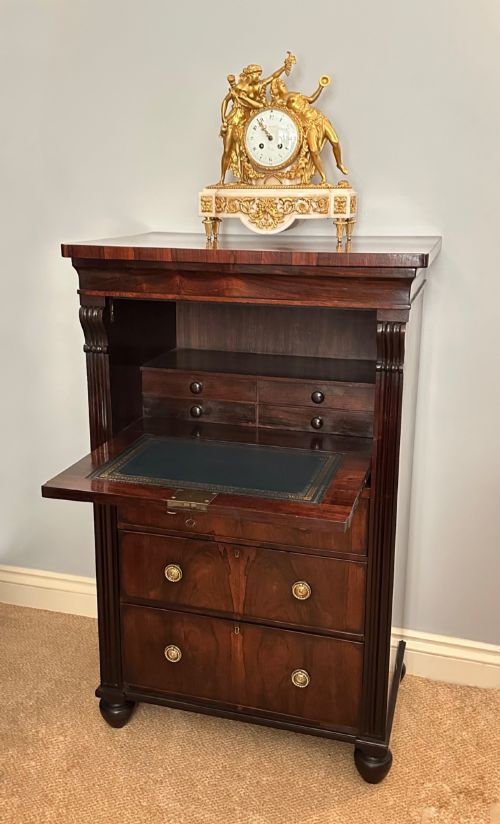
Joinery methods relied on precision dovetailing for drawers and robust frame construction to support the considerable weight of stacked carcases. Brass hardware, campaign banding, and leather writing inserts completed the structural and functional composition of these multi-tier cabinets.
Evaluating Quality and Detail
Quality rests upon the selection of timber veneers, the crispness of carved mouldings, and the integration of fitted interior compartments. Superior examples display symmetrical grain matching, well-figured mahogany or walnut, and original brasses or locking mechanisms.
Internal execution distinguishes finer pieces, particularly where writing drawers reveal pigeonholes, small subsidiary drawers, and neatly jointed secondary woods. The smoothness of drawer movement and the integrity of structural joins indicate the skill of the original workshop.
Maple and Co·Gillows
The Fitted Drawer Tallboy Glossary
- Tallboy
- A tall chest of drawers, often constructed as a chest on chest where a larger base supports a slightly narrower upper section.
- Secretaire
- A drawer or cabinet fitted with a drop-front writing surface concealing small drawers and pigeonholes.
- Wellington chest
- A sturdy vertical chest of seven drawers secured by a hinged locking stile on one side.
- Campaign chest
- Modular furniture designed to dismantle into sections for military transport, fitted with brass corners and recessed handles.
- Compactum
- A large fitted wardrobe or multi-compartment storage unit combining drawers, shelves, and hanging space.
Fitted Drawer Tallboy: Frequently Asked Questions
What is a fitted drawer tallboy?
A fitted drawer tallboy is a tall storage cabinet that incorporates specialised internal compartments, such as a drop-front writing drawer or specialised pigeonholes, within a multi-tier chest.
These pieces combine the vertical capacity of a traditional tallboy with the functional writing workspace of a bureau or secretaire cabinet.
What woods were used for tallboys?
Cabinetmakers primarily constructed these pieces using dense hardwoods like mahogany, walnut, oak, and rosewood, frequently accented with burr veneers and maple.
Secondary woods such as pine and oak typically formed drawer linings and internal framing components.
How do I date a Georgian tallboy?
Georgian tallboys exhibit architectural mouldings, bracket feet, and hand-cut dovetail joints, often utilising solid mahogany or figured walnut timbers.
Later Victorian interpretations introduce different locking mechanisms, varied secondary timbers like pitch pine, and distinct brass hardware styles.