
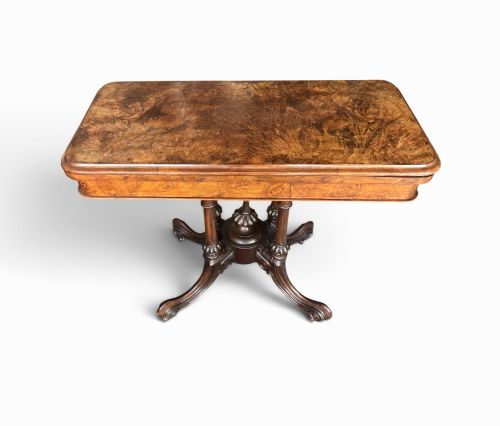
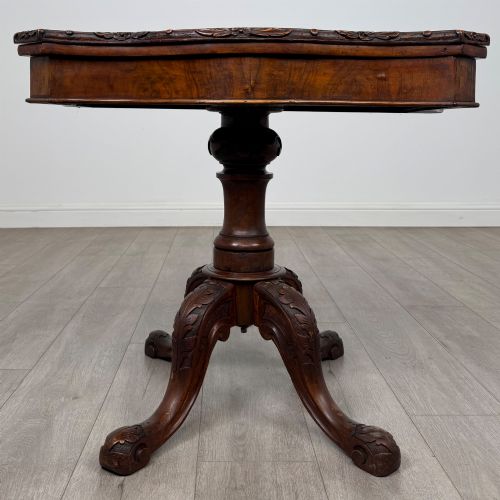


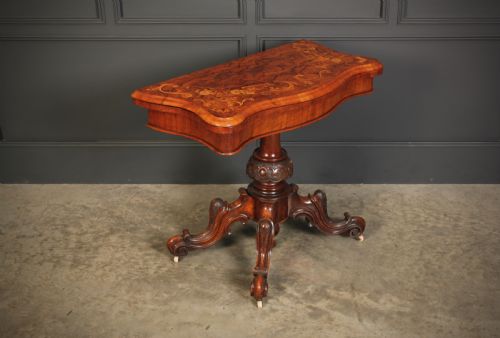


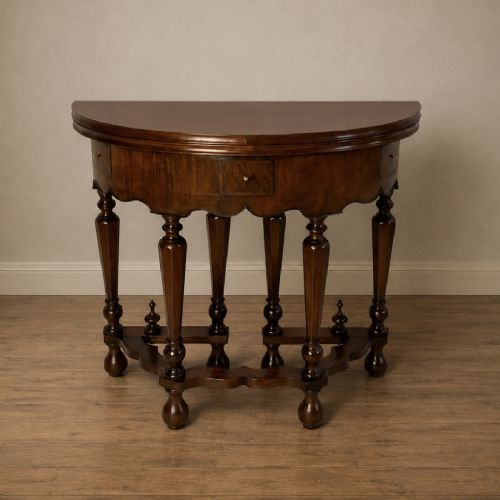
Figured Walnut Card Table
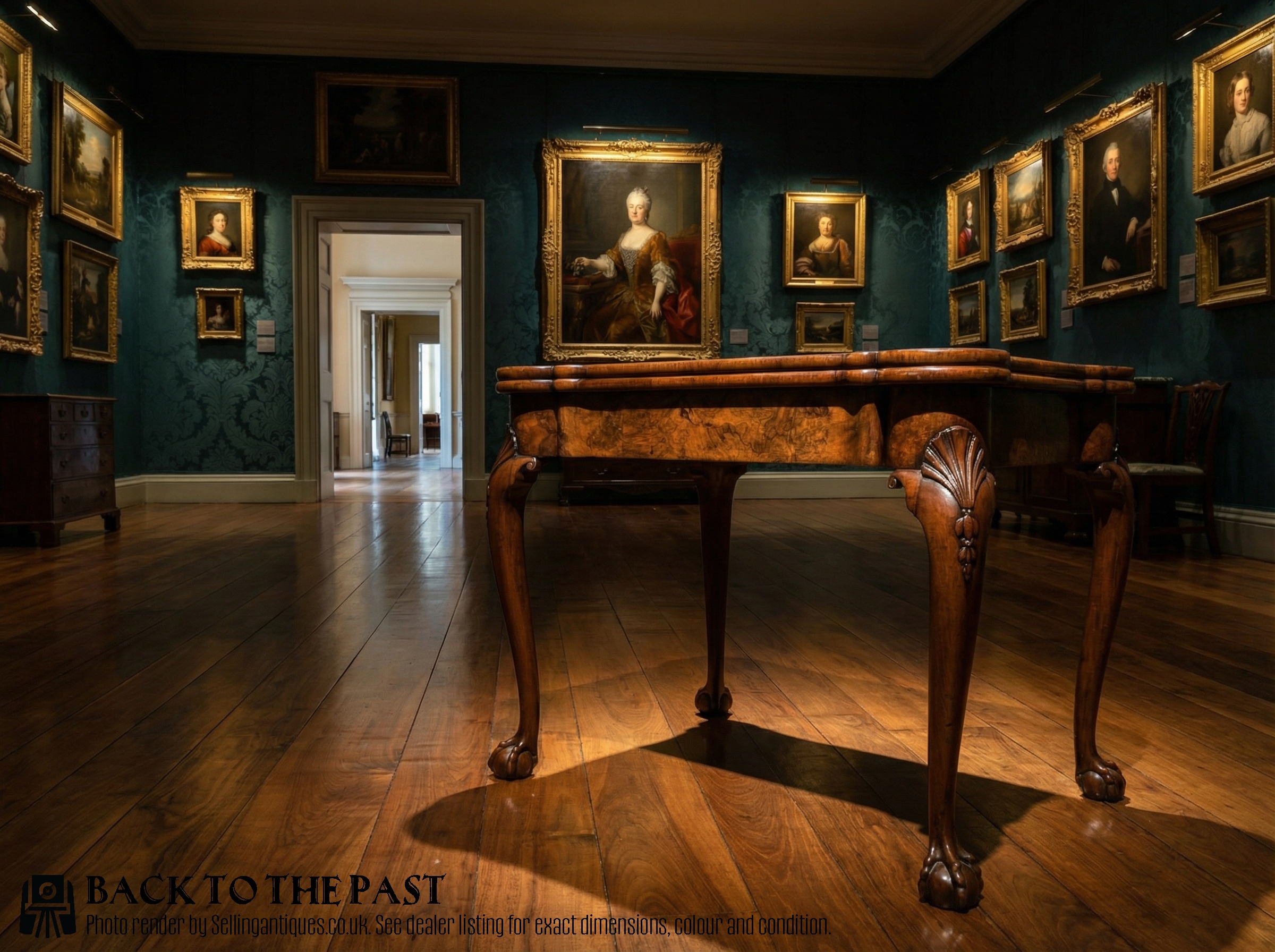
When you handle a figured walnut card table, you touch timber selected for grain pattern and cut to form fold-over gaming surfaces that transform a room.
Figured Walnut Card Table
A figured walnut card table brings timber with intense grain movement and rich natural warmth into a room, fashioned specifically for pastimes like card games. The folding tops reveal baize-lined playing surfaces when opened, pivoting or swinging on hinges to rest on a concertina frame or a swing leg.
The pieces you meet on this page divide chiefly between Victorian examples and earlier Georgian forms or later revivals. Victorian models often feature serpentine outlines, cabriole legs, or marquetry inlay, whilst George I and George II styles rely on clean proportions, feather banding, and walnut veneers.
Beyond dedicated card and games tables, the category encompasses related forms that share the same timber vocabulary, including tea tables, occasional side tables, and console tables. These pieces served domestic entertainment and polite social display in drawing rooms and parlours.
How they were made
Cabinet makers applied thin veneers of figured walnut and burr walnut over stable secondary timbers such as oak, allowing them to display intricate grain patterns across wide tabletops without risking the splitting associated with solid boards. Crossbanding and feather banding in contrasting timbers defined the borders of the fold-over tops.
Many examples incorporate boxwood inlay or delicate marquetry work set directly into the walnut surfaces. Structural elements such as cabriole legs, occasionally enriched with ormolu mounts, support the pivoting tops and provide stability when the tables are opened for play.
A card table designed for a quiet evening of whist can suddenly reveal a hidden compartment beneath its top for your counters.
What varies in quality
Quality rests in the intensity and selection of the timber veneer, where deeply figured burr or golden walnut displays a liveliness that plain timber lacks. The skill of the cabinet maker shows in how cleanly the grain matches across the fold-over flaps and the precision of any crossbanding or inlay.
Construction methods also separate the standard production from the exceptional work. Smooth mechanics on the folding action, well-fitted hinges, and robust carcase timber beneath the veneer determine how securely a table stands through centuries of daily use.
maple & co·w.f. greenwood & sons york
The Figured Walnut Card Table Glossary
- Figured Walnut
- Timber taken from walnut trees that displays swirling, mottled, or highly decorative grain patterns. This wood was prized by cabinet makers for surface panels and tabletops.
- Burr Walnut
- Wood harvested from the wart-like growths on walnut trees, yielding tight, swirling cluster patterns. It forms some of the most decorative veneers seen on antique furniture.
- Crossbanding
- A narrow strip of veneer laid around the border of a tabletop with the grain running at right angles to the central panel. It creates a defined architectural frame for the timber.
- Feather Banding
- A decorative inlay technique using two strips of veneer cut at an angle and laid together to form a V-shape resembling a feather spine. It often borders the main walnut field on earlier pieces.
- Marquetry
- The art of creating decorative patterns by fitting together small pieces of different coloured veneers. Floral and geometric motifs appear frequently on Victorian games tables.
- Cabriole Leg
- A furniture leg that curves out in a convex arc at the top and tapers inward in a concave arc below, ending in a pad or scroll foot. This shape dominates eighteenth-century and revival seating and table supports.
Figured Walnut Card Table: Frequently Asked Questions
What is a figured walnut card table used for?
These tables served as fashionable parlour furniture designed for card playing, social gatherings, and general display in polite drawing rooms. When closed, they functioned as side or console tables against a wall.
Opening the fold-over top revealed a baize-lined surface prepared for evening games, after which the top closed again to restore the room's appearance.
How do I tell a Victorian table from a Georgian one?
Victorian examples frequently display darker timber, serpentine or curved outlines, elaborate marquetry inlay, and sometimes ormolu mounts on cabriole legs. Their proportions tend to feel heavier and more ornamented.
Earlier Georgian pieces and later revivals lean towards cleaner architectural lines, feather banding, and crisp walnut veneers without excessive surface decoration.
Do all these tables have folding tops?
Almost all pieces in this category use a fold-over mechanism where the top doubles in area when opened for games. The upper leaf pivots or swings to rest on a hidden rear leg or a pull-out frame.
A few related forms on the page, such as occasional side tables and loo tables, remain fixed without folding leaves.
How should I care for figured walnut furniture?
Keep walnut furniture away from direct sunlight and strong heat sources to prevent the timber veneers from drying out, fading, or lifting at the edges. Maintaining stable indoor humidity protects both the wood and the old polish.
Dust gently with a dry, soft cloth and avoid using modern silicone sprays or harsh chemical cleaning products on antique polished surfaces.