

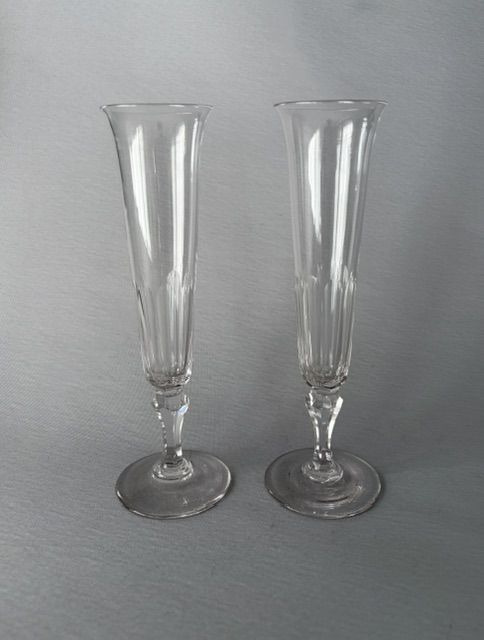





Faceted Stem Glassware
Faceted stem glassware brings brilliant light to the table through crisp, angular stems.
Faceted Stem Glassware
Faceted stem glassware comprises drinking vessels shaped with geometric facets cut directly into the stem, catching the light with every movement. These pieces include wine glasses, champagne coupes, port glasses, and cordial glasses spanning the Georgian, Victorian, and later periods.
The version most commonly met on this page is the English drinking glass from the eighteenth century, featuring a straight or knopped stem worked with flat polished planes. Alongside these sit later nineteenth-century crystal pieces and Continental examples from Bohemian makers.
Forms range from intimate cordial and port glasses to large champagne coupes and decorative goblets. Collectors prize them for the sharp tactile contrast between smooth bowls and crisp stem geometry.
Materials and construction
These pieces rely heavily on lead glass and lead crystal, which allowed glassmakers to grind and polish deep, sharp facets without fracturing the material. The high refractive index of lead crystal ensures that each cut surface catches and reflects light intensely.
Makers shaped the bowls by blowing before applying the geometric facets to the solid stems by hand using abrasive wheels. Additional decoration sometimes involved gilding or delicate engraving applied to the bowl surface, as seen in eighteenth-century Jacobite examples and nineteenth-century Bohemian goblets.
Faceted Stem Glassware Retail Price Guide 2026
Typical asking prices for faceted stem glassware among the pieces listed under this phrase on Sellingantiques today, from the lower quarter to the upper quarter. They describe what is for sale here now, not the wider market.
Raise a faceted toast to the eighteenth-century drinkers who hid secret political loyalties inside delicate crystal stems.
Judging quality and character
Quality rests primarily on the crispness of the cutting and the weight of the metal. Superior stems display perfectly flat planes with clean, sharp junctions between each facet, whereas lesser examples show softened edges from hurried polishing.
The clarity of the lead crystal and the balance between the bowl, stem, and wide foot base dictate the visual harmony of the piece. Subtle variations in the hand-cut facets reveal the individual hand of the maker, distinguishing exceptional eighteenth-century work from later production.
Moser·James Giles
The Faceted Stem Glassware Glossary
- Facet cut
- A surface decorated by grinding flat planes into the glass. This technique enhances the refraction of light through lead crystal.
- Lead crystal
- Glass containing a high proportion of lead oxide, providing exceptional weight and clarity. It allows for deeper and sharper cutting than standard glass.
- Coupe
- A shallow, broad-bowled glass traditionally used for champagne. Its wide rim showcases the clarity of the crystal above a faceted stem.
- Pontil mark
- A rough scar left on the base of hand-blown glass where the holding rod was detached. Its presence indicates traditional manufacture before modern grinding smoothed the base flat.
Faceted Stem Glassware: Frequently Asked Questions
How do I date faceted stem glassware?
Dating relies on the proportions of the bowl, the thickness of the metal, and the style of the facets. Eighteenth-century pieces often feature simpler bowl forms paired with distinct diamond or hexagonal stem cutting.
Later Victorian and Edwardian examples tend to have heavier metal and more elaborate overall cutting. Comparing the foot base and engraving styles helps narrow the period further.
Were these glasses meant for everyday use?
Georgian and Regency examples served elite dining tables for wine, port, and cordials. Their sturdy lead construction made them durable enough for formal hospitality.
Today, many collectors prefer to use them gently for special occasions. Hand washing is essential to preserve the delicate gilding and sharp facet edges.
What is a Jacobite engraving?
Jacobite engravings feature covert symbols supporting the exiled House of Stuart, such as roses and oak leaves. These were placed on wine glasses used for clandestine toasts during the eighteenth century.
Finding a faceted stem glass with period Jacobite decoration marks it as a historically significant piece. Authenticity depends on the crisp execution of both the engraving and the surrounding stem cuts.
Why do some glasses have heavier stems than others?
Stem thickness varied according to changing fashions and the specific drink intended for the vessel. Earlier Georgian glasses often balance delicate bowls on neatly proportioned diamond-faceted stems.
Nineteenth-century production shifted towards heavier lead crystal to accommodate deeper cuts and larger capacities like champagne coupes. The weight reflects the shifts in glasshouse technology across the decades.