




Faceted Glass Decanter Set
These faceted glass decanter set pieces bring sparkling geometry and period elegance to a room, offering both practical service and striking display.
Faceted Glass Decanter Set
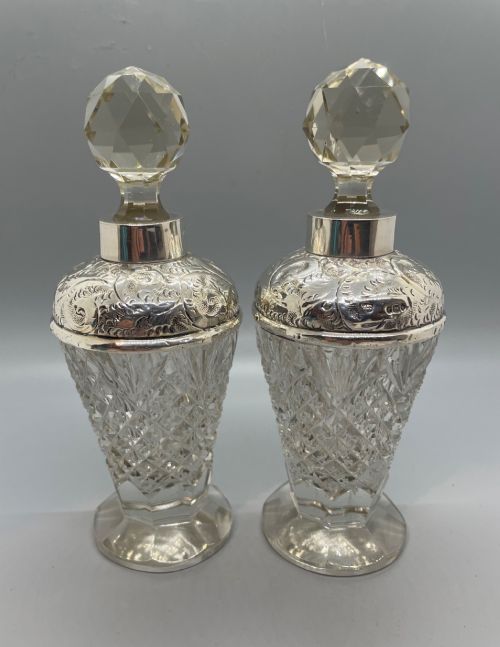
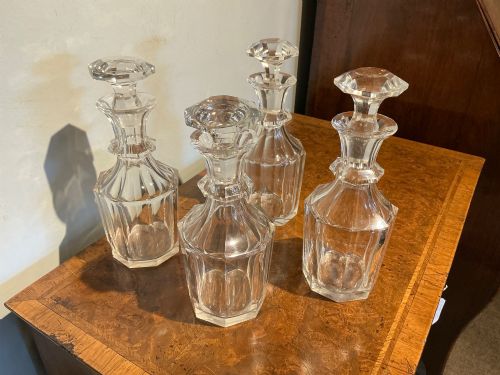
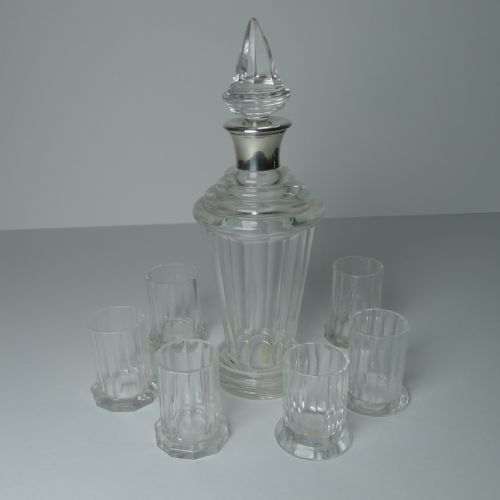
A faceted glass decanter set comprises matched vessels and sometimes complementary glasses or trays, designed for serving spirits and liqueurs. When searching for a faceted glass decanter set, you encounter groupings ranging from pairs to complete liqueur services with matching glasses.
The selections span the Victorian, Edwardian, and Art Deco periods, encompassing both British craftsmanship and continental European production. Sets from the nineteen-thirties often showcase geometric forms, while earlier examples display traditional cut crystal or silver mounts.
How they were made
The makers utilised clear glass, crystal, and lead crystal, shaping the vessels through heavy cutting and moulding to create distinct facets that catch the light. Many pieces incorporate sterling silver mounts or enamel detailing applied directly to the glass surface.
Continental workshops employed specialised techniques such as geometric etching and acid-staining on black glass or clear crystal. These methods produced sharp lines and contrasting textures characteristic of the twentieth-century avant-garde.
Listings feature periods from the nineteenth century through the nineteen-thirties, incorporating materials such as lead crystal, sterling silver, and black glass.
What varies in quality
Quality depends upon the crispness of the cutting and the weight of the crystal. Superior sets exhibit deep, clean facets with precise angles that refract light sharply, whereas lesser pieces show softer, shallower grinding.
The presence of matching original components, such as coordinated shot glasses, trays, and silver collars with proper hallmarks, elevates a set. The complexity of the design, particularly in Art Deco geometric arrangements, distinguishes standard production from notable maker output.
Karl Palda·Val Saint Lambert·Moser Glass
The Faceted Glass Decanter Set Glossary
- Facet
- A flat polished surface cut into glass or crystal to reflect light. Multiple facets give these decanters their characteristic sparkle.
- Lead crystal
- Glass containing a proportion of lead oxide, which increases brilliance and weight. This material allows for deeper and sharper cutting.
- Sterling silver mount
- A collar or neck band made of British standard silver, often bearing hallmarks for the assay office and year. These mounts frequently accompany Edwardian and George V bottles.
- Liqueur service
- A matched assembly comprising a decanter and a set of small glasses for serving cordials. They are often presented together on a matching tray.
Faceted Glass Decanter Set: Frequently Asked Questions
How do I date a faceted glass decanter set?
Dating relies on stylistic markers and hallmarks. Victorian and Edwardian examples often feature traditional cut patterns and silver mounts with assay dates, while nineteen-thirties sets display distinct Art Deco geometry.
The presence of specific continental glass techniques and signatures also helps establish the era of manufacture.
Are these sets safe for holding spirits?
Most historical glass and crystal decanters are suitable for short-term serving and display. Care must be taken with lead crystal if spirits are stored for extended periods.
Gentle hand washing preserves both the glass clarity and any delicate enamel or silver elements.
What items typically come in a complete set?
A complete set usually includes one or more decanters accompanied by matching glasses such as liqueur or shot glasses. Some twentieth-century configurations also include a dedicated glass or mirrored tray.
Smaller groupings consist of pairs or trios of decanters without accompanying glassware.
How do I distinguish Czech Art Deco pieces?
Czech pieces from the interwar period are recognised by bold geometric cutting, contrasting colours like black glass, and matching sets that include trays and small cups. Workshops in this region pioneered striking modernist silhouettes.
Signatures or characteristic forms help attribute these items to specific regional makers.