
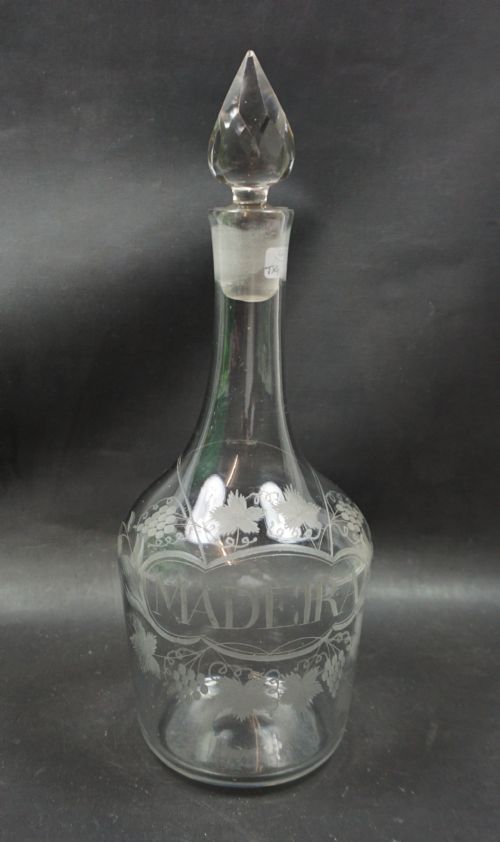


Faceted Crystal Glass Stoppers
These faceted crystal glass stoppers crown decanters and perfume bottles from the Georgian era to the Art Deco period, sealing spirits and scents with bright refractive detail.
Faceted Crystal Glass Stoppers
When you search for faceted crystal glass stoppers, you find the shaped and cut closures belonging to decanters, scent bottles, ewers and perfume bottles spanning periods from the eighteenth century to the nineteen-thirties.
The most common examples you meet on this page date from the Victorian and Edwardian eras, matching cut glass and lead crystal vessels designed for spirits, wine and dressing table fragrances.
Many items appear alongside silver collars, enamel details or locking mechanisms by makers such as Karl Palda and Hukin and Heath, showing how stoppers completed functional barware and vanity pieces.
Cutting and moulding crystal
These pieces rely upon lead crystal and cut glass, shaped by hand to create sharp facets that catch the light from every angle.
Craftsmen ground the lower peg of each stopper to fit securely into the neck of its specific decanter or perfume bottle, ensuring a snug closure for liquid contents.
Some Edwardian bottles boast locking metal collars, proving that nineteenth-century hosts guarded their scotch just as closely as their silver.
Clarity and depth of cutting
The distinction between ordinary production and the finest work lies in the purity of the glass and the crispness of the facets.
Superior examples display sharp, clean geometric cuts without surface nibbles on the edges, while lesser pieces show softer edges and minor casting bubbles within the material.
Karl Palda·Hukin and Heath·Betjemann Brothers
The Faceted Crystal Glass Stoppers Glossary
- Lead crystal
- Glass containing metal oxides that increase weight, brilliance and the refractive index, making faceted cuts sparkle intensely.
- Decanter
- A vessel used for holding and serving wine or spirits, fitted with a matching neck closure to preserve the contents.
- Silver collar
- A band of sterling silver fitted around the neck of a glass bottle or decanter, often holding hallmarks that date the piece.
- Faceting
- The process of grinding and polishing flat planes onto the surface of glass to bounce light through the material.
- Ewer
- A large jug with a wide spout, sometimes found paired with stoppers or matching the design of table decanters.
Faceted Crystal Glass Stoppers: Frequently Asked Questions
Are these stoppers original to the bottles?
Many items on this page are sold as complete pairs or sets with their original matching glass closures, preserved together through Victorian and Edwardian times.
Because stoppers were easily misplaced or broken over generations, replacement requires careful matching of the peg size and glass tint to the original vessel neck.
How do I clean an old decanter stopper?
Warm water and mild soap suit glass and crystal best, avoiding harsh abrasives that might scratch the polished facets or damage attached silver collars.
Allowing items to air dry on a soft cloth prevents moisture from trapping inside hollow or closed components.
What periods do these pieces represent?
The listings span from Georgian and Regency times through Victorian, Edwardian and Art Deco decades, showing shifts in glass design from heavy eighteenth-century cutting to nineteen-thirties geometric styling.
Evaluating the style of the facet work and any associated silver hallmarks helps place an item within its specific era.
How were locking decanters used?
Locking mechanisms with sterling silver necks, such as those by Betjemann Brothers, kept expensive spirits secure from servants or children in nineteenth-century homes.
A key turned the collar to release the stopper, combining functional barware security with decorative cut glass craft.