
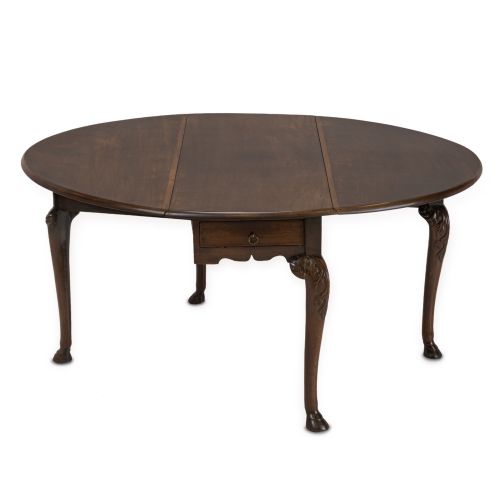


Extendable Gateleg Table
An extendable gateleg table provides adaptable dining space through folding leaves supported by pivoting legs.
Extendable Gateleg Table
When searching for an extendable gateleg table, a buyer encounters pieces designed to expand for dining and fold compactly when not in use. These forms incorporate hinged flaps alongside a central fixed section.
The versions most frequently met on this page date from the seventeenth century through to the early twentieth century, spanning oak and mahogany constructions. Many examples originate from the Georgian period or earlier eras, reflecting traditional British cabinet making.
Makers fashioned these dining tables to accommodate varying numbers of people, with larger examples capable of seating eight diners. Structural variations include oval, rectangular and drop-leaf configurations supported by swinging gate legs.
What varies in quality
Quality depends upon the choice of timber and the integrity of the pivoting gate mechanism that supports the drop leaves. Superior pieces exhibit tight joinery, original patination on the wood surfaces and robust hinges that bear weight evenly.
The refinement of leg turning and carving distinguishes standard utilitarian tables from finer examples produced in walnut and mahogany. Original brass hardware and well-preserved structural framing elevate the standing of a piece.
Certain seventeenth-century oak tables have survived centuries of family suppers while quietly hiding a single drawer for stray cutlery.
The Extendable Gateleg Table Glossary
- Gateleg table
- A table with hinged leaves supported by one or more legs that swing outward like a gate. This design allows the surface area to expand or contract as required.
- Drop-leaf table
- A table featuring a fixed centre section and hinged flaps that drop down at the sides. These leaves are raised and supported when extra surface space is needed.
- Pad foot
- A simple foot shape where the base of the leg rests on a flattened disc or pad. This style is frequently found on Georgian mahogany dining tables.
- Barley twist
- A decorative turning style resembling the spiral shape of a barley stalk. Craftsmen utilised this technique on table legs during the seventeenth and early twentieth centuries.
Extendable Gateleg Table: Frequently Asked Questions
How do you operate a gateleg table?
To expand the surface, lift the hinged drop leaf and swing the pivoting leg outward from the frame until it locks beneath the flap.
This movement transfers the weight of the extended leaf to the floor, creating a stable platform for dining.
What periods do these tables come from?
These tables appear from the seventeenth century through the Georgian and Victorian eras up to the early twentieth century.
Earlier pieces are predominantly constructed from oak, while later examples frequently utilise mahogany or walnut.
How many people can sit at one?
Larger versions are built to accommodate up to eight diners when fully extended with all leaves raised.
Smaller formats suit compact dining spaces and fold down flat against a wall when not in use.
Where were they used in the home?
These pieces served primarily as dining tables in kitchens, parlours and formal dining rooms.
Their flexible footprint made them practical for multi-use living spaces where room was at a premium.