

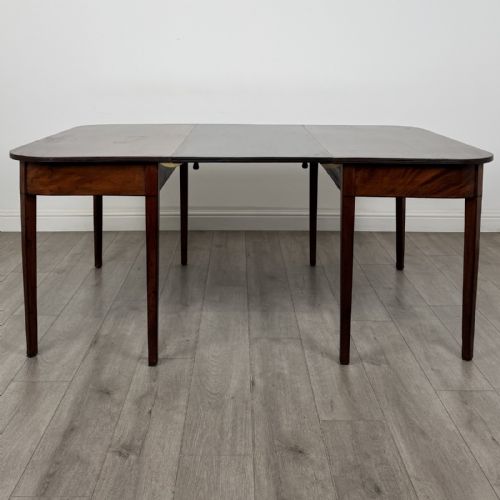
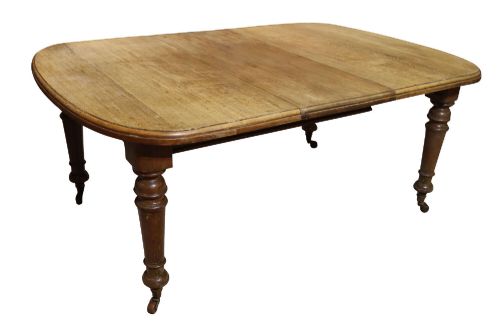
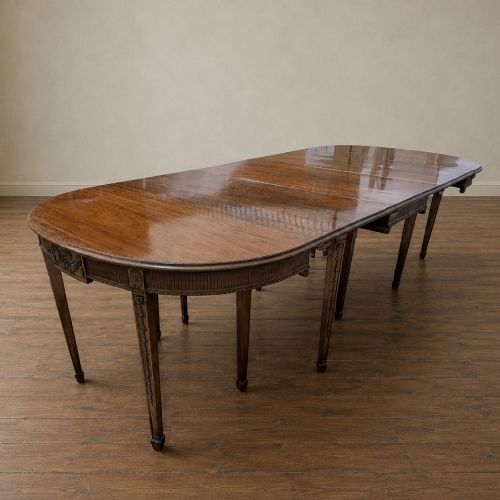
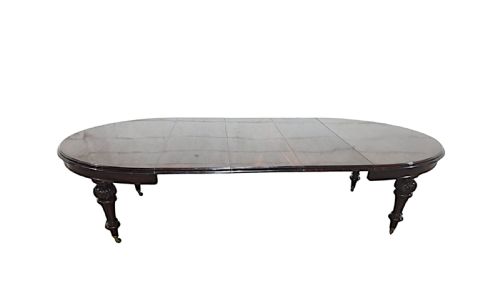
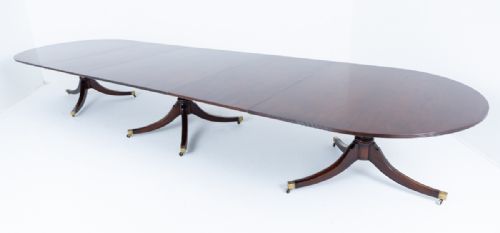
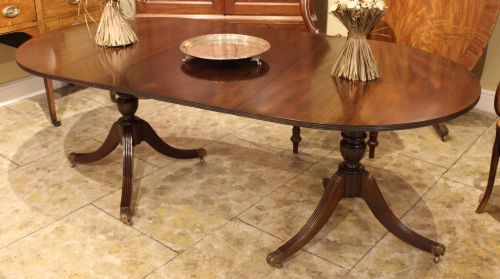


Extendable D End Table
An extendable d end table is a flexible dining piece that expands to host large companies while keeping classic proportions when closed.
Extendable D End Table
When you search for an extendable d end table, you are looking at formal dining furniture designed with semicircular ends that separate to receive extra leaves. These pieces emerge chiefly from the Georgian, Regency, and nineteenth century periods.
The version you are most likely to meet on this page is constructed from mahogany, often displaying drop leaves, pillar supports, or demilune forms that adapt to varying room capacities. Such tables bridge the gap between daily domestic use and grand entertaining.
Makers historically engineered these frames so households could alter table lengths without sacrificing stability. The evidence shows forms ranging from intimate breakfast settings to seating capacities exceeding twenty diners.
Materials and construction
Cabinet makers relied primarily on solid and figured mahogany, frequently accented with satinwood inlay to define borders and tabletops. These hardwoods provided the structural rigidity needed to support multiple extension leaves.
Workshops integrated brass mechanisms, drop-leaf hinges, and pillar supports to manage the transition between closed demilune consoles and fully expanded dining surfaces. Selected pieces also incorporated fine cabinet details in the manner of established Dublin and London makers.
Extendable D End Table Retail Price Guide 2026
Typical asking prices for extendable d end table among the pieces listed under this phrase on Sellingantiques today, from the lower quarter to the upper quarter. They describe what is for sale here now, not the wider market.
One listed piece carries the cheerful moniker The Bee Table.
What separates the finest examples
Quality rests in the selection of timber, where figured flame mahogany and crisp satinwood inlay elevate a piece far above plain utility versions. The grain pattern across matching sections reveals the cabinet maker's eye for harmonious surfaces.
Construction integrity during extension marks the superior tables. Seamless leaf insertion, robust brass fittings, and stable pillar or leg placement ensure the table maintains its balance whether seated for four or twenty.
William and Gibton·Robert Adam·Waring and Gillow·Jules Leleu
The Extendable D End Table Glossary
- D-End
- A table end shaped in a semicircle resembling the capital letter D. These sections detach or fold down when leaves are removed.
- Demilune
- A half-moon shape used for console ends or side tables. When joined together, they form a complete circular or oval top.
- Drop-Leaf
- A table top with hinged flaps on the sides that drop down when not in use. This mechanism allows the furniture footprint to shrink in smaller rooms.
- Satinwood Inlay
- Decorative wood veneers inserted into contrasting timber surfaces to create geometric or floral borders. It requires high precision from the artisan.
- Pillar and Claw
- A central column support resting on carved feet. This configuration gives legroom beneath large dining surfaces.
Extendable D End Table: Frequently Asked Questions
How do you extend a d end table?
You pull the semicircular ends apart along internal runners to create a central gap. Additional leaves drop into this space to increase the seating capacity.
Securing latches underneath then locks the sections together to keep the surface stable during meals.
What periods do these tables come from?
The pieces span the Georgian, Regency, Victorian, and Edwardian eras. Many examples date from around eighteen hundred through the nineteenth century.
Revival styles from the early twentieth century also appear frequently in the listings.
How many people can these tables seat?
Capacities range widely depending on the number of extra leaves stored with the frame. Standard dining formats seat eight to ten persons.
Larger banquet configurations in the evidence accommodate up to twenty two guests.
Where were d end tables used?
They originated as principal dining furniture in formal homes and townhouses. Their adaptable format suited them to drawing rooms and reception spaces.
When closed, the demilune sections served as side tables against the wall.