






Expressionist Nude Artwork
Expressionist nude artwork captures the human form through bold brushwork and emotive colour palettes.
Expressionist Nude Artwork
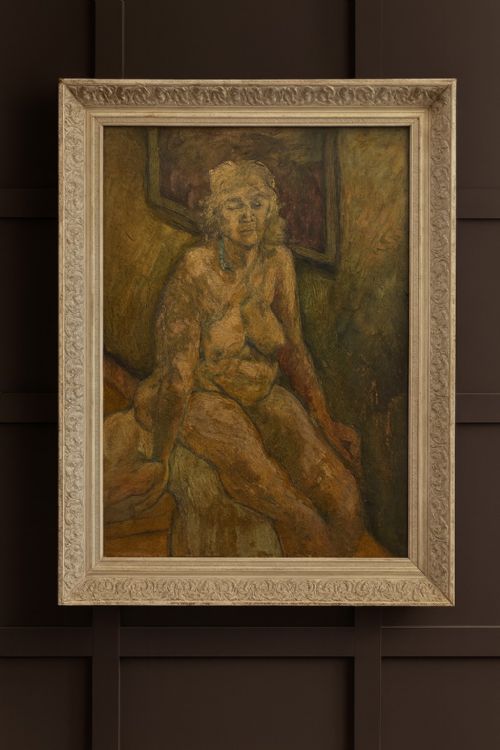
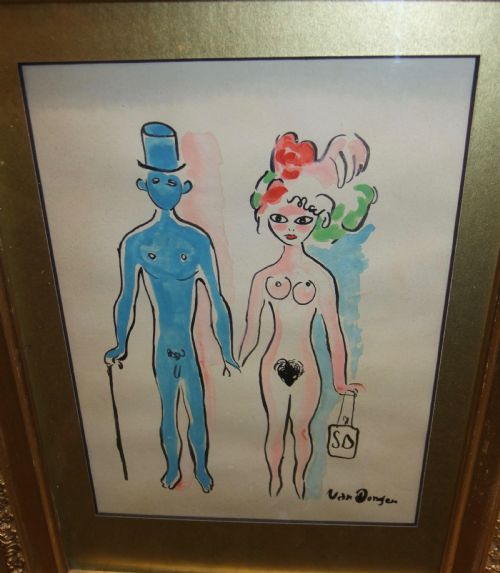
Expressionist nude artwork encompasses paintings, drawings, and framed studies focusing on the human body through various modernist lenses. These pieces frequently manifest as oil on canvas, oil on board, watercolours, and ink drawings created across the early to mid-twentieth century.
Buyers encounter works reflecting movements such as Fauvism, Cubism, Art Deco, and Mid-Century Modernism. Subjects range from reclining and seated female figures to narrative scenes involving dancers and quiet interior moments.
Originating largely from British and French studios, these works date from the nineteen-twenties through to the nineteen-sixties. The selection highlights individual figurative studies alongside distinctively expressive portraiture.
Materials and techniques
Artists relied primarily on oil paint applied to canvas, board, or paper surfaces to achieve rich textures and layered compositions. Some creators utilised watercolours and ink on paper to produce lighter, immediate graphic lines.
Supports often include traditional stretched canvas as well as canvas laid onto board for added stability. Hand-drawn elements demonstrate direct draughtsmanship beneath or alongside pigment application.
Cats and doves occasionally share the canvas with the human subjects, adding domestic charm to modernist studies.
Distinctions in quality
Quality rests upon the strength of the composition and the confidence of the draughtsmanship used to define the figure. Superior examples demonstrate a cohesive relationship between pigment application and the emotional resonance of the subject.
The handling of support materials, from durable oil on canvas to delicate works on paper, influences the visual impact and preservation of the piece. Works retaining clear provenance and signatures by recognised figures command distinct attention from collectors.
Tony Giles·Gaetan Dumas·Peter Jackson·Jean Hippolyte Marchand·Pinchus Krémègne·Yetta Kane·Raymond Arthur Roadnight·Kees van Dongen
The Expressionist Nude Artwork Glossary
- Chiaroscuro
- Strong contrast between light and dark to give a three-dimensional volume to figures. This technique heightens the dramatic tension within figurative compositions.
- Fauvism
- An early twentieth-century style employing painterly qualities and strong, non-naturalistic colours. Practitioners prioritised painterly vigour over representational accuracy.
- Cubism
- An avant-garde movement that revolutionized European painting by breaking subjects down into faceted geometric planes. It is visible in works that reinterpret anatomical forms through multiple simultaneous viewpoints.
- Provenance
- The chronology of the ownership and origin of a historical artwork. Clear documentation establishes authenticity and historical context.
- Support
- The physical material upon which a painting is executed, such as canvas, wood panel, board, or paper. Each surface interacts differently with oil paint and ink.
Expressionist Nude Artwork: Frequently Asked Questions
What periods do these artworks cover?
The available pieces span from the nineteen-twenties through to the nineteen-sixties. This timeframe covers early avant-garde developments and mid-century modern figurative work.
Eras represented include the Art Deco period, early twentieth-century Fauvism, and post-war British and French modernism.
What materials were commonly used?
Makers utilised oil paint on canvas, board, and paper supports. Ink and watercolour also appear on paper works.
Canvases are occasionally laid onto board for additional structural support during the painting process.
How should I frame these pieces?
Works on canvas generally suit traditional wooden frames that allow the painted edges to remain visible. Paper works require archival mounting behind glass to protect the delicate medium.
Consulting a professional framer ensures the materials used will not compromise the integrity of the paper or canvas.
How do I identify different styles?
Style identification relies on examining brushwork, colour choices, and the treatment of anatomy. Fauvist pieces feature vibrant, non-naturalistic hues, while cubist examples break the figure into geometric planes.
Mid-century modern pieces often focus on simplified figurative outlines and expressive textures.
Where were these artworks produced?
The pieces originate primarily from British and French studios and artistic circles. Influential groups such as the Bloomsbury Group contributed to this artistic landscape.
Artists working in these regions frequently exhibited within European modernist networks.