
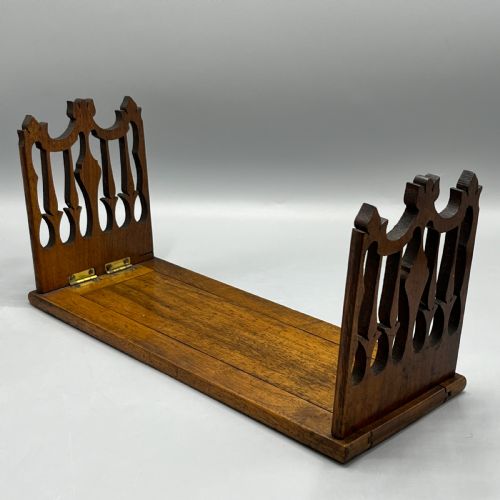

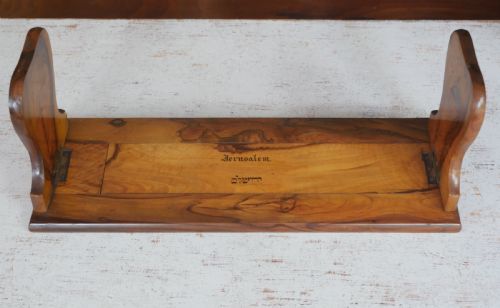


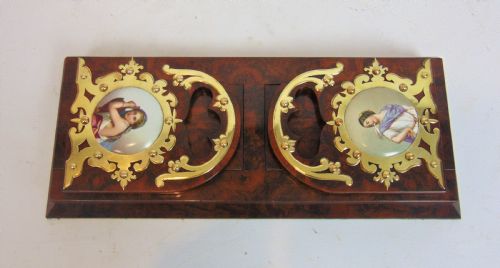
Expanding Desk Book Rack
An expanding desk book rack keeps your volumes upright and within reach, bringing clever mechanical extension to the Victorian library table.
Expanding Desk Book Rack
When you search for an expanding desk book rack, you encounter practical desk accessories designed to hold varying numbers of volumes securely between sliding ends. The pieces on this page span the Victorian and Edwardian periods, stretching from the Regency era into the early twentieth century.
You meet various forms on this page, including traditional book slides, sliding bookends, and extending book rests. Materials range from dense hardwoods to ornamental brass mountings, serving both utilitarian and decorative roles in the home library.
Origin and regional craftsmanship also define these objects, with examples ranging from English workshops to Anglo-Indian carvings, Jerusalem olive wood, Kashmiri production, and Tunbridge Ware. Walnut and coromandel versions appear frequently alongside oak and burr walnut constructions.
Materials and construction
Cabinet makers utilised dense timbers such as walnut, coromandel, oak, rosewood, and olive wood to build durable bases that could withstand the friction of sliding actions. Brass mountings reinforce the joints and provide the sliding mechanism tracks.
Decorative embellishments include inset porcelain plaques, bone details, finely painted ceramic panels, and intricate Tunbridge Ware mosaic patterns. Carved teak appears on Anglo-Indian pieces, whilst specialised makers incorporated patented expanding scissor actions.
Book slides described as novel rests show that Victorians enjoyed theatrical engineering even when simply tidying up their dictionaries.
Judging quality and craftsmanship
The finest examples display precision in their extending mechanism, allowing the action to glide smoothly without binding or sagging at full extension. Superior timber selection, such as figured burr walnut or richly grained coromandel, elevates the visual presence of the piece.
Detailing distinguishes standard items from exceptional ones, notably through hand-painted porcelain plaques, meticulous brass mounts, and complex woodwork like Tunbridge Ware mosaics or deeply carved teak panels.
Betjemanns·Tiffany & Co
The Expanding Desk Book Rack Glossary
- Book slide
- A desk accessory featuring a fixed base and at least one movable end that extends to accommodate more volumes. These pieces keep reference books tidy on a library table.
- Tunbridge Ware
- A form of British woodwork characterised by mosaic veneers creating pictorial or geometric designs using thousands of tiny coloured wood blocks. This technique appears on nineteenth century desk pieces.
- Coromandel
- A dense, heavy cabinet wood imported from Asia, featuring dark brown colouring with dramatic black grain streaks. It was favored by Victorian makers for luxury desk accessories.
- Burr walnut
- Timber taken from the growth excrescence of a walnut tree, showing swirling grain patterns prized by cabinet makers. It provides decorative surfaces on nineteenth century book holders.
- Patent book slide
- An extending book rack incorporating a specific mechanical design registered by a maker. These mechanisms often utilise folding actions or smooth rack-and-pinion tracks.
Expanding Desk Book Rack: Frequently Asked Questions
How do expanding book slides work?
These pieces utilise hinged folding arms or sliding tracks underneath the base that allow the side panels to pull outward or push inward. This design lets you adjust the length of the rack to hold a growing or shrinking row of volumes.
Most mechanisms operate smoothly by hand, maintaining tension to keep the books firmly vertical when the rack is extended to various widths on a desk or shelf.
Where should I place a book rack?
An expanding desk book rack sits well upon a sturdy library table, a writing desk, or a bookshelf where heavy reference volumes require structural support. Keep them away from direct sunlight and extreme heat sources to protect polished timber surfaces and inlaid plaques.
Ensure the surface is level so the sliding mechanism functions correctly without straining the joints or scratching the wooden base.
How do I date an antique book slide?
Dating relies on observing the timber species, the style of brass mounts, and any patent marks or maker signatures stamped into the metal or wood. Regency and early Victorian pieces often feature simpler architectural forms, whilst high Victorian examples incorporate painted porcelain plaques and exotic woods like coromandel.
Later Edwardian and early twentieth century items frequently employ plain oak construction with straightforward sliding mechanisms.
What maintenance do wooden book racks need?
Maintain the timber by dusting regularly with a soft, dry cloth and occasionally applying a suitable furniture wax to nourish the grain. Avoid using liquid polishes or harsh chemical cleaners that can damage delicate brass mountings or inlaid ceramic plaques.
Check the sliding mechanism periodically to ensure no dust accumulates in the tracks, allowing the moving parts to glide freely.