
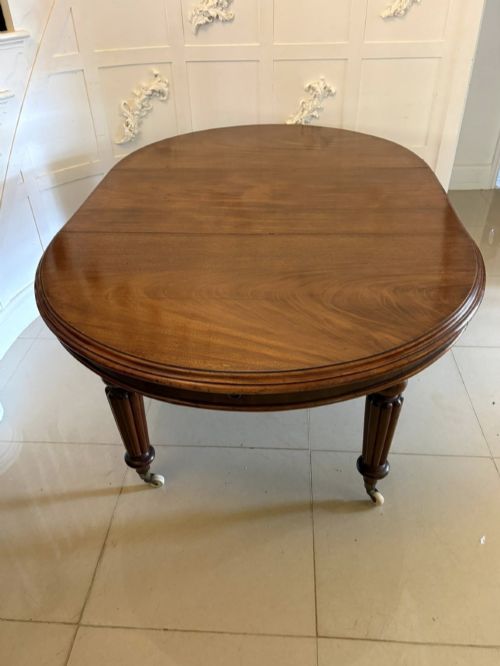
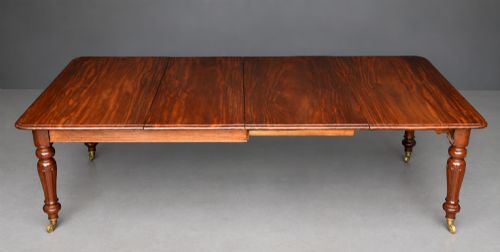
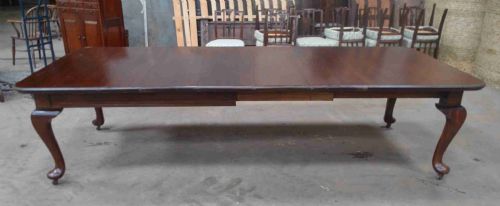
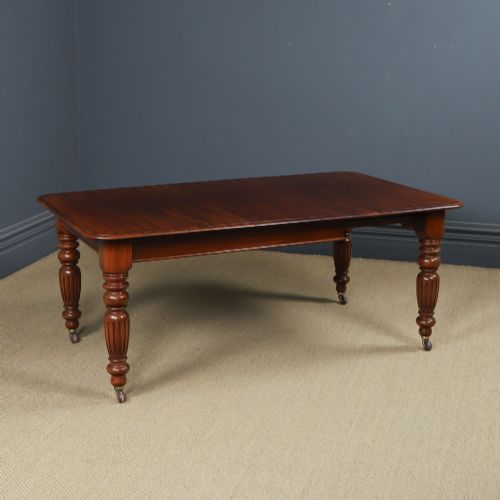
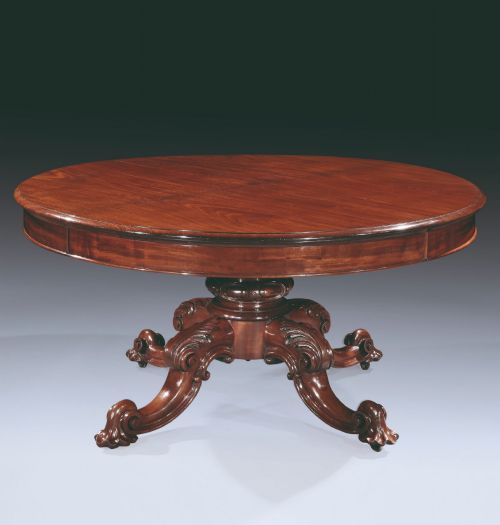


Expandable Mahogany Dining Table
An expandable mahogany dining table accommodates large gatherings easily through clever mechanics hidden inside rich timber frames.
Expandable Mahogany Dining Table
An expandable mahogany dining table serves as the central gathering place for formal meals, adapting from intimate proportions to banquet sizes through inserted leaves or mechanical wind-out systems. The pieces available here span from the Georgian and Regency eras through the William IV period and deep into Victorian production.
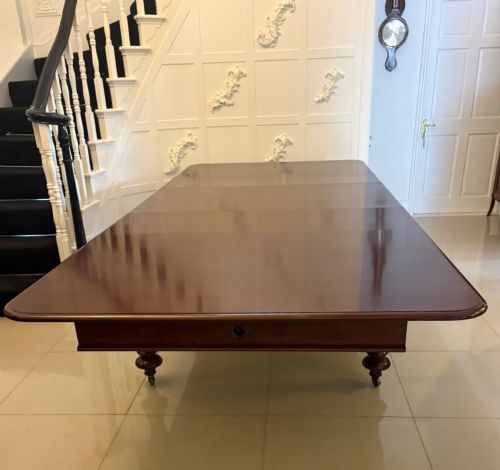
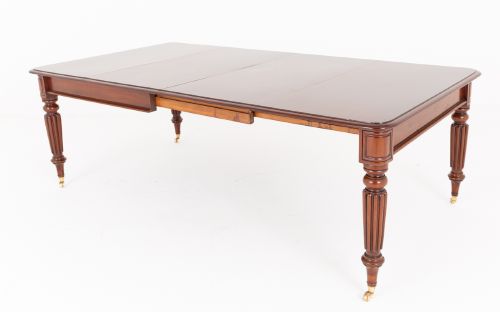
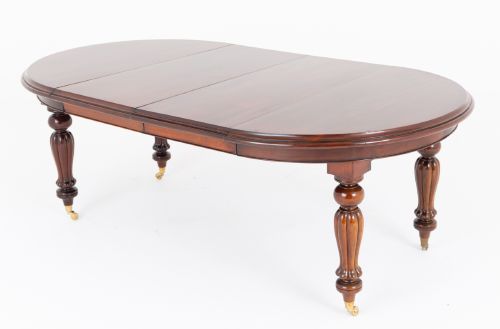
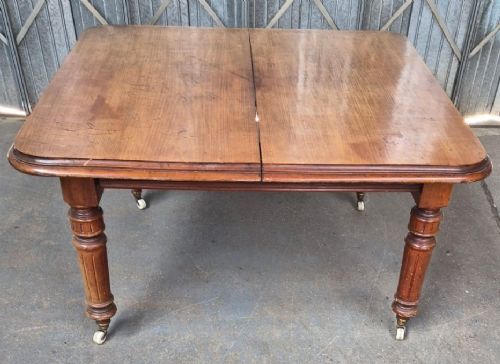
The most common form encountered on this page is the Victorian extending dining table, frequently fitted with a winding mechanism that separates the top to accept multiple extra leaves. Alongside these wind-out formats, buyers discover twin pedestal designs, drop-leaf configurations, and metamorphic console tables that transform for dining.
Origins trace primarily to nineteenth-century English workshops, where cabinetmakers engineered timber frames to support heavy loads without sagging when fully extended. These tables range from standard six-seater formats up to massive boards designed to seat over twenty guests.
Materials and construction methods
Makers relied heavily on solid mahogany, Cuban mahogany, and flame mahogany veneers applied to stable secondary timbers, selected for deep colour and striking grain patterns. Cabinetmakers often highlighted the natural figuring of the wood on table tops, contrasting rich brown tones with polished finishes.
Mechanical ingenuity defined these pieces, utilising brass winding gears, metal screws, and wooden runners to allow smooth expansion and contraction. Many examples rest upon heavy pedestals or turned legs fitted with castors to ease movement across heavy carpets and wooden floors.
Listings feature mahogany, brass, ceramic, and porcelain elements across styles spanning Georgian, Regency, William IV, and Victorian periods.
Distinctions in quality and execution
The distinction between ordinary production and top-tier execution rests in the selection of timber and the precision of the extending mechanism. Superior tables utilise dense Cuban or flame mahogany with matching grain continuity across added leaves, ensuring a uniform appearance when fully opened.
Structural integrity also separates the grades, marked by robust internal runners and heavy brass components that operate without binding. Tables bearing maker stamps, particularly from distinguished firms like Gillows, reflect higher standards of design and joinery.
Gillows Lancaster
The Expandable Mahogany Dining Table Glossary
- Wind out
- A mechanical system utilising a handle and internal screw mechanism to expand the table top evenly. This device allows a single person to open the frame before inserting extra leaves.
- Leaf
- A removable section of timber inserted into the middle of the table to increase its length. Matching leaves preserve the grain pattern and colour of the main top.
- Cuban mahogany
- A dense, heavy variety of timber sourced from the Caribbean, prized for its dark rich colour and exceptional durability. Cabinetmakers favoured it for high-status nineteenth-century dining furniture.
- Twin pedestal
- A base configuration featuring two distinct column supports resting on splayed legs, commonly found on Georgian and Regency tables. This design provides stable support while maximising legroom for diners.
Expandable Mahogany Dining Table: Frequently Asked Questions
How many leaves can a table take?
The capacity depends entirely on the original frame strength and the length of the internal runners. Many standard Victorian models accept between one and three additional leaves, while larger banquet formats accommodate four or more.
Check the stability of the central legs or support pillars when fully extended with multiple leaves inserted. Extra intermediate legs are sometimes required on very long tables to prevent sagging under heavy service.
How do I care for a mahogany dining surface?
Protect the polished timber from direct heat and moisture by using quality mats and tablecloths during meals. Clean the surface regularly with a soft, dry cloth to remove dust and maintain the natural lustre of the wood.
Apply high-grade beeswax periodically to nourish the grain and resist minor scuffs. Avoid silicone-based polishes, as they build up residue and dull the traditional finish over time.
How do I distinguish Regency from Victorian tables?
Regency tables typically exhibit cleaner neoclassical lines, often featuring reeded edges, brass lion paw castors, and pedestal bases derived from earlier Georgian traditions. They date from the early nineteenth century and lean toward architectural restraint.
Victorian tables generally display heavier proportions, more exuberant carved details such as ball and claw feet, and darker finishes. They also show greater mechanical complexity, frequently incorporating wind-out gear systems for larger family gatherings.