


Exhibition Quality Sideboard
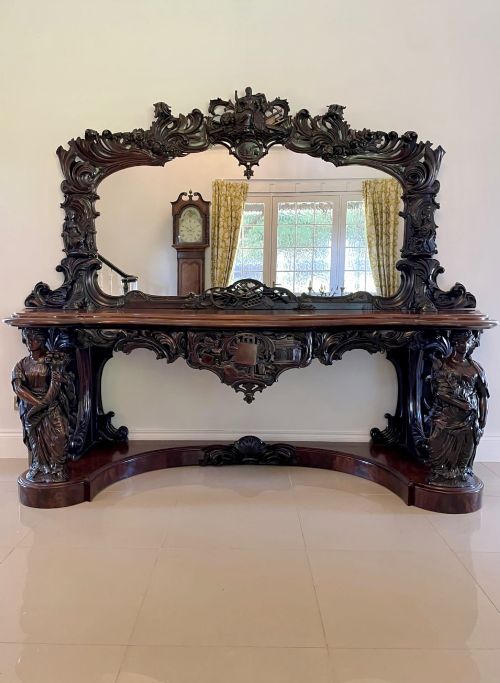
An exhibition quality sideboard brings grand nineteenth-century presence and meticulous cabinet-making directly into your principal rooms.
Exhibition Quality Sideboard
When you search for an exhibition quality sideboard, you are looking at substantial nineteenth-century and early twentieth-century furniture designed for display and formal entertaining. These pieces encompass credenzas, mirror-back console tables, side cabinets, and pedestal sideboards originating from English, French, Italian, and Swiss workshops.
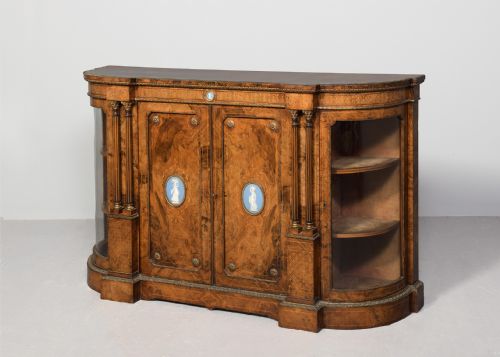
The version you are most likely to meet on this page is the Victorian burr walnut or mahogany credenza, often featuring glazed doors, mirrored backs, or ormolu mounts. Alongside these sit neoclassical satinwood cabinets, massive oak sideboards, and serpentine forms spanning the 1850s to the 1930s.
How they were made
Cabinet-makers built these carcasses using solid timbers such as mahogany, oak, and walnut, overlaid with figured veneers including burr walnut and satinwood. Marquetry inlay added complex floral or geometric decoration across curved and serpentine surfaces.
Metalworkers contributed cast and chased ormolu mounts, whilst specialist ceramicists supplied painted porcelain panels. Glassmakers provided bevelled mirror plates and curved glazed panels, finished with hand-polished French polish.
Several credenzas retain the ghosts of nineteenth-century French polishers in the tiny specks of gold leaf trapped within their door mouldings.
What varies in quality
The distinction between ordinary production and exhibition standards lies in the ambition of the design and the discipline of the execution. Finer examples employ heavier timbers, more complex serpentine curves, and superior depth of marquetry inlay.
Integration of secondary materials dictates the tier of the piece. The finest items combine fire-gilt ormolu mounts and hand-painted porcelain plaques with flawless burr walnut veneers, whereas simpler versions rely solely on timber figure and basic brass fittings.
Maple and Co.·Maple of London·Pietro Ferrario
The Exhibition Quality Sideboard Glossary
- Credenza
- A low cabinet, usually enclosed by doors, originating as a side table for holding food or displaying plate. In nineteenth-century contexts, it denotes a decorative reception room cabinet featuring central mirrored doors flanked by curved glass cabinets.
- Ormolu
- Gilt bronze ornamentation applied to furniture mounts, cast and hand-finished with mercury gilding or modern electroplating. It provides metallic contrast against dark walnut or mahogany timbers.
- Marquetry
- The art of applying pieces of veneer to a structure to form decorative patterns and pictorial designs. Craftsmen select contrasting woods to achieve natural shading without paint.
- Serpentine
- A furniture front or side curving inward at the centre and outward at the ends, following a wave-like contour. This shape demands high joinery skill to veneer accurately.
- Pedestal sideboard
- A large dining room sideboard comprising two pedestals flanking a central section, popular in formal nineteenth-century dining spaces.
Exhibition Quality Sideboard: Frequently Asked Questions
What is an exhibition quality sideboard?
An exhibition quality sideboard is a high-status piece of nineteenth or early twentieth-century furniture made to showcase the pinnacle of a workshop's cabinet-making, inlay, and decorative metalwork skills.
These pieces were frequently destined for international exhibitions, private mansions, or important commission work before entering the antique market.
Where were these sideboards placed?
Owners placed these large cabinets in formal reception rooms, grand dining rooms, and drawing rooms where guests gathered for entertaining.
Mirrored backs and glazed display sections served to reflect candle or gas lighting while exhibiting porcelain, silver, and glassware collections.
How do I care for burr walnut and satinwood?
Protect delicate polished wood surfaces by keeping them away from direct sunlight and maintaining stable room humidity to prevent veneer splitting.
Dust gently with a dry, soft cloth and avoid chemical sprays or silicone polishes that can degrade the historic French polish finish.
How can I tell the difference between periods?
Mid-nineteenth-century examples often embrace exuberant revival styles with heavy ormolu mounts, curved serpentine fronts, and rich burr walnut veneers.
Later pieces from the turn of the century and the 1930s tend toward refined neoclassical satinwood finishes, lighter proportions, and architectural lines.