

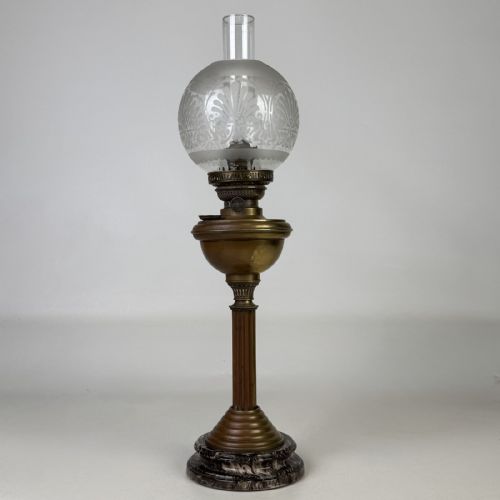
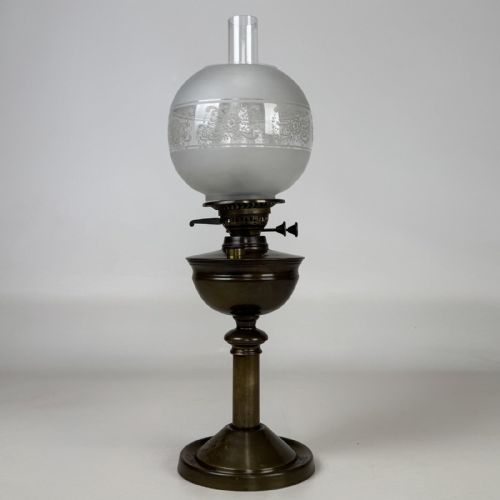
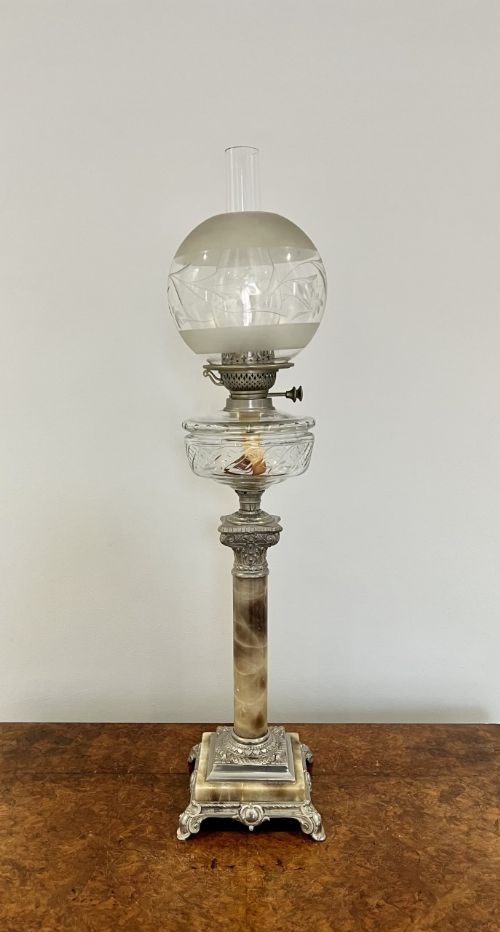


Etched Globe Kerosene Lamp
These etched globe kerosene lamp examples bring warm Victorian and Edwardian character to a room through decorative glass shades and metal bases.
Etched Globe Kerosene Lamp
An etched globe kerosene lamp combines a functional Victorian or Edwardian lighting vessel with an ornamental glass shade, often paired with a brass, bronze, or ceramic body. Buyers investigating this category typically encounter sturdy table lamps dating from the late nineteenth century up to the early twentieth century.
The selections on this page span several distinct regional styles, featuring English brass designs alongside French Napoleon III faience models and Art Nouveau bronze pieces. Most examples retain their original configuration as table oil lamps, though some bear later conversions for modern electrical use.
Makers such as Hinks of Birmingham appear among the brass oil lamps, while other pieces showcase colourful glass fonts in pink, blue, or cranberry tones. The overall variety centres on nineteenth century and 1900s manufacturing traditions that combined heavy metal casting with decorative glasswork.
How they were made
The construction of an etched globe kerosene lamp relies on heavy metal casting for the base and font holder, utilising brass, bronze, and sometimes onyx or ceramic faience. These supportive structures provide the necessary weight to balance the upper glass components safely.
Glass production forms the decorative centrepiece, involving frosted glass, cranberry glass, and clear surfaces subjected to acid etching or wheel cutting. This technique creates opaque patterns against translucent backgrounds, diffusing the light evenly across the room.
Etched Globe Kerosene Lamp Retail Price Guide 2026
Typical asking prices for etched globe kerosene lamp among the pieces listed under this phrase on Sellingantiques today, from the lower quarter to the upper quarter. They describe what is for sale here now, not the wider market.
Some nineteenth-century makers stamped their metal oil lamps with regional foundry marks that outlived the original kerosene burners entirely.
What varies in quality
Quality in an etched globe kerosene lamp rests on the crispness of the glass decoration and the solidity of the metal mounting. Finer examples display deeply cut or uniformly frosted motifs on the shade alongside substantial brass or bronze castings.
The material composition of the font also distinguishes the grade of a piece, with coloured cranberry glass, layered onyx, or hand-painted faience indicating more ambitious production standards. Maker attribution, such as signed Hinks components, adds further distinction to the metalwork.
Hinks of Birmingham
The Etched Globe Kerosene Lamp Glossary
- Etched globe
- A spherical glass shade decorated with chemical or mechanical engraving that produces frosted patterns. This treatment softens the glare of the burner flame.
- Kerosene lamp
- A domestic lighting device that burns paraffin oil through a wick enclosed by a glass chimney. These units served as standard household illumination before widespread electrification.
- Cranberry glass
- A rich pinkish-red glass created by adding gold chloride to the molten batch. It appears frequently in late nineteenth-century table lamp vessels.
- Faience
- Tin-glazed earthenware originating from continental ceramic traditions. It forms the decorative body on specific nineteenth-century French lamp bases.
- Font
- The oil reservoir section of the lamp positioned above the base. It is often cast in brass, ceramic, or coloured glass.
Etched Globe Kerosene Lamp: Frequently Asked Questions
What is an etched globe kerosene lamp?
An etched globe kerosene lamp is a nineteenth or early twentieth century lighting device featuring a decorative glass shade and a supportive base made of brass, bronze, or ceramic. These pieces were designed to burn paraffin oil for domestic illumination.
Today, they survive as decorative interior objects, with many retaining their original glass shades and metal burners while others have undergone careful conversion for electrical use.
How do I date an oil lamp?
Dating relies on examining the materials, manufacturing marks, and stylistic indicators such as Victorian brass casting or Art Nouveau bronze shaping. Period pieces often feature specific burner mechanisms and glass formulations typical of the late nineteenth century.
Makers' stamps on the metal components or registration numbers on the glass can provide more precise manufacturing decades between the Victorian era and the 1930s.
Are these lamps still safe to use with oil?
Most antique lamps are acquired primarily for display or decorative lighting rather than active paraffin burning. Converting them to electricity is a common practice to preserve the antique aesthetic while meeting modern safety standards.
Those intending to burn oil must inspect the reservoir and burner assembly thoroughly for cracks or perished seals before operation.
What colours do the glass shades come in?
The glass components appear in various finishes, predominantly frosted glass, clear glass, and vibrant shades like cranberry glass or cobalt blue. These colours were achieved through specific mineral additions during the glassmaking process.
The etching on the globes creates contrasting matte designs against the translucent coloured background, enhancing the visual effect when illuminated.