
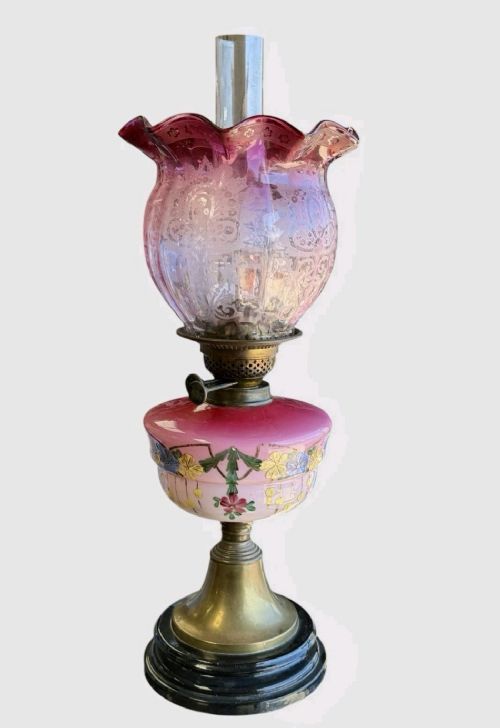


Etched Glass Hurricane Shade
An etched glass hurricane shade filters the light and protects the flame, holding a practical British history of Victorian and later oil lamps.
Etched Glass Hurricane Shade
An etched glass hurricane shade sits above the burner of an oil lamp to steady the flame while diffusing the light. When you search for an etched glass hurricane shade, you encounter functional Victorian and turn-of-the-century lighting components paired with metal bases.
The examples seen here mostly form part of complete oil lamps or brass lustres rather than surviving as isolated glass cylinders. They appear alongside cranberry glass, tinted glass and crystal components dating from the nineteenth century up to nineteen hundred.
Materials and construction
These shades are formed from blown glass, incorporating clear, cranberry, tinted, or hand-painted surfaces that receive their decoration through surface etching. The glass sits within or atop mounts fashioned from brass and silver plate.
Support structures frequently involve cast brass, embossed brass elements, or silver-plated metal, occasionally combined with ceramic, slate, or crystal components to add weight and stability to the lamp base.
Some Victorian householders insisted on matching their hurricane shades to the colour of the evening tea service.
Assessing quality
Quality rests in the crispness of the glass etching and the depth of colour in the material, such as rich cranberry or clear crystal. Finer pieces display balanced proportions between the shade and the metal reservoir.
The standard of metalwork also determines the tier of the piece, where heavier brass castings, refined silver plating, and embossed detailing separate standard utility lamps from more ambitious decorative items.
The Etched Glass Hurricane Shade Glossary
- Hurricane shade
- A tall glass cylinder or globe designed to shield a candle or oil lamp flame from drafts. It ensures the flame burns steadily.
- Cranberry glass
- A rich red-pink transparent glass created by adding gold chloride to the molten batch. It is characteristic of Victorian tableware and lighting.
- Font
- The oil reservoir of a lamp, usually positioned beneath the burner and above the main base. It holds the paraffin or lamp oil.
- Lustre
- A decorative tabletop ornament featuring hanging crystal prisms around a central stem, occasionally fitted with storm shades. They were popular in Victorian drawing rooms.
Etched Glass Hurricane Shade: Frequently Asked Questions
What is an etched glass hurricane shade?
It is a protective glass cylinder or globe decorated with acid-etched patterns, designed to fit over the burner of an oil lamp.
Its primary role is to steady the flame against draughts while softening and diffusing the illumination into the room.
How do I date an oil lamp?
Dating relies on examining the materials, burner mechanism patents, and the manufacturing style of the base and shade. Victorian examples often utilise heavy brass, cranberry glass, or hand-painted botanical motifs.
Later pieces from around nineteen hundred show shifts in metal plating techniques and simpler glass moulding silhouettes.
Were these shades used outdoors?
Despite the name hurricane shade, most surviving Victorian examples were intended for interior drawing rooms and parlours.
They protected interior furnishings from soot and kept indoor breezes from extinguishing the paraffin flame.
Can I use modern oil in these lamps?
Most period lamps function with standard liquid paraffin or lamp oil suitable for flat wick burners. Care must be taken with antique fonts and historic glass burners during filling and lighting.