





Engraved Gilt Table Clock
An engraved gilt table clock brings striking Victorian presence and meticulous chased brass detail to a room, offering both reliable timekeeping and undeniable decorative weight.
Engraved Gilt Table Clock
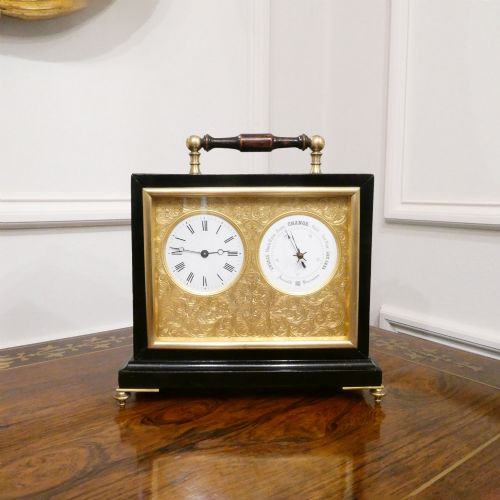
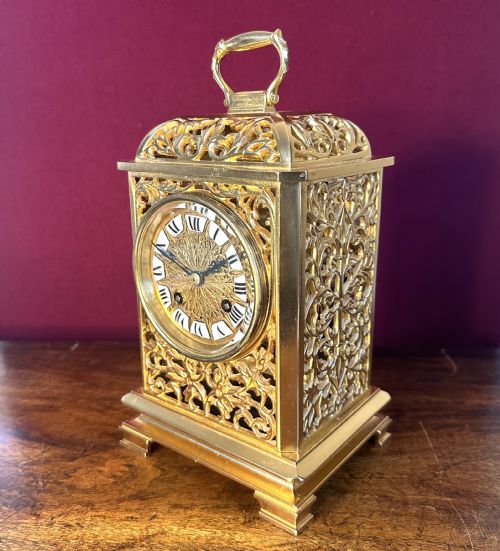
When you search for an engraved gilt table clock, you find timepieces designed to sit on a mantelpiece or desk, predominantly originating from the nineteenth century. These objects combine timekeeping with architectural or decorative housing, often utilising glass, enamel, and gilt brass.
The most common forms you will encounter on this page are carriage clocks and mantel clocks spanning periods from the 1850s to the Edwardian era. These pieces frequently exhibit French or British origins, taking the form of striking or repeating mechanisms housed within highly decorated metallic cases.
Makers such as Thomas Cole, Arnold and Frodsham, and Drocourt demonstrate the caliber of work associated with these pieces. Whether executed as a miniature carriage clock or a grander mantel design, each example relies on engraved metallic surfaces to create its distinct visual appeal.
How they were made
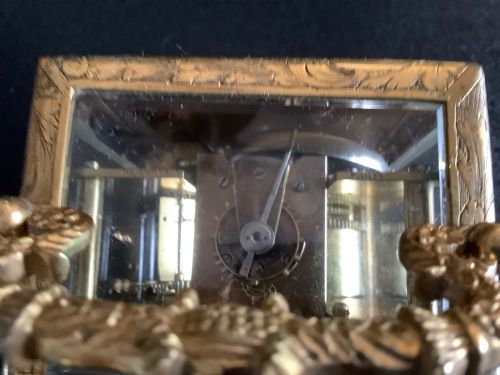
Makers constructed these clocks using robust metallic foundations of brass and gilded brass, frequently applying deep hand-engraving directly to the exterior surfaces. Glass panels protected the delicate internal movements while allowing visibility into the escapement and dial.
Enamel dials provided a crisp, legible face for roman or arabic numerals, while secondary materials like ebonised wood or leather occasionally formed supplementary bases and travel cases. Movements incorporated intricate gear trains, fusee mechanisms, and sometimes striking or repeating complications.
The integration of gilt finishes required careful application of gold leaf or electroplating over base metals, ensuring a lasting lustre that complemented the precision hand-cutting of the brass cases.
Some travel clocks came with leather outer cases so Victorian gentlemen could take timekeeping precision right into their sleeper carriages.
What varies in quality
The crispness and depth of the hand-engraving separate standard production from superior examples. Master workshops invested significantly more time in carving intricate foliate or geometric patterns directly into the gilt brass case.
Complexity of movement and reputation of the maker heavily influence the standing of a piece. Signed works by renowned horologists feature superior gear tolerances, high-grade escapements, and refined finishing on internal components.
The preservation of original mercury gilding and the intactness of delicate enamel dials determine how well an object maintains its intended appearance over time.
Thomas Cole and James Cole·Arnold and Frodsham·Charles Frodsham·Drocourt·Tiffany·Howell And James
The Engraved Gilt Table Clock Glossary
- Carriage clock
- A portable spring-driven timepiece originally designed for travelling officers and wealthy Victorians. These clocks typically feature a rectangular glazed brass case with a carrying handle on top.
- Fusee
- A conical pulley used in mechanical clocks to maintain an even pull on the gear train as the mainspring unwinds. This mechanism improves timekeeping accuracy across the power reserve.
- Gilt brass
- Base brass metal treated with a gold wash or mercury gilding to impart a rich, reflective golden surface. It provides the signature metallic sheen seen across nineteenth-century table clocks.
- Repeating mechanism
- A complication that allows the clock to strike the hours and quarters upon demand when a lever or button is pressed. It was especially useful for checking the time in darkness.
- Platform escapement
- A small, self-contained escapement unit mounted on a platform inside the clock. This innovation allowed portable clocks to keep accurate time in any orientation.
Engraved Gilt Table Clock: Frequently Asked Questions
How do I wind a carriage clock?
Most nineteenth-century carriage clocks require a dedicated winding key inserted into arbors located on the underside or backplate of the movement. Turn the key gently until resistance indicates the mainspring is fully tensioned, taking care not to overwind.
Keep track of the winding schedule, as many mechanical timepieces require attention every eight days. Ensure the clock is stationary on a level surface before operating the winding mechanism.
Why does my clock gain or lose time?
Mechanical clocks from the Victorian period rely on adjustable balance wheels or pendulums that can be influenced by temperature changes and environmental vibrations. Regulating the movement requires a small adjustment lever positioned near the escapement.
Changes in lubrication over decades also affect timekeeping precision. Routine servicing by a qualified horologist restores consistent performance.
How should I clean the gilt brass case?
Dust the exterior regularly using a soft, dry artist's brush to prevent particulate buildup in the engraved recesses. Avoid chemical polishes or abrasive cloths, which strip away the thin layer of original gilding.
For glass panels, use a minimal amount of glass cleaner applied to a cloth rather than sprayed directly onto the clock. This protects the adjacent metal surfaces from unwanted moisture.
What is the difference between a timepiece and a striking clock?
A timepiece indicates the hours and minutes without sounding an audible chime on the hour. Its internal train focuses solely on driving the hands.
A striking or repeating clock incorporates an additional gear train and hammer system to sound bells or gongs at set intervals. This adds both mechanical complexity and acoustic presence.