

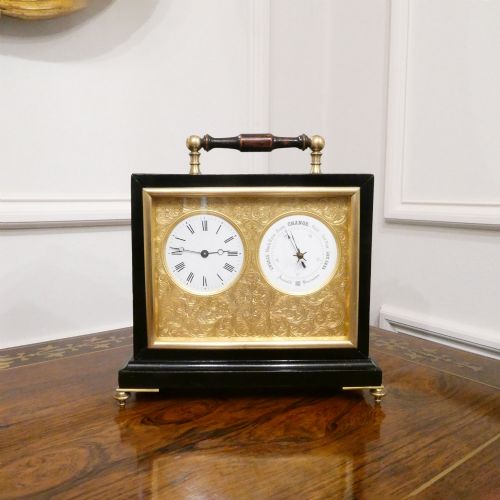
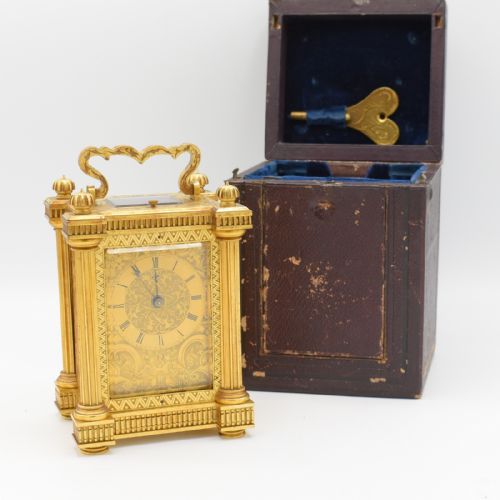


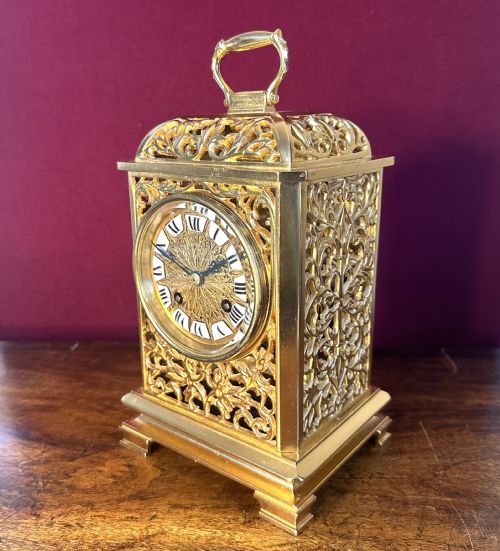


Engraved Gilt Clock
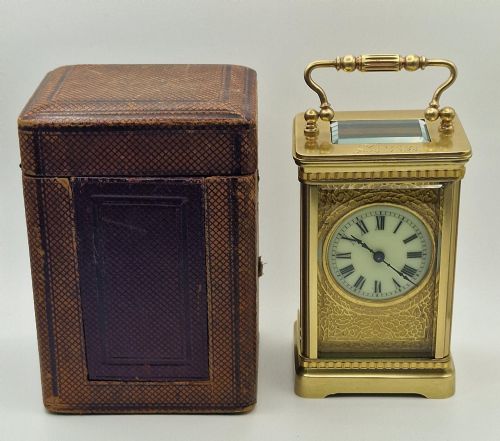
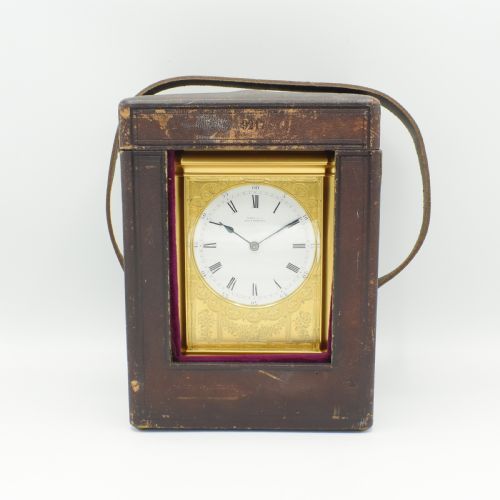
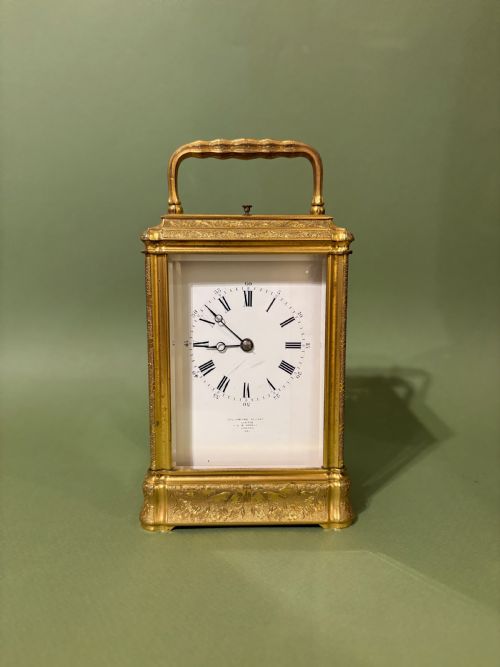
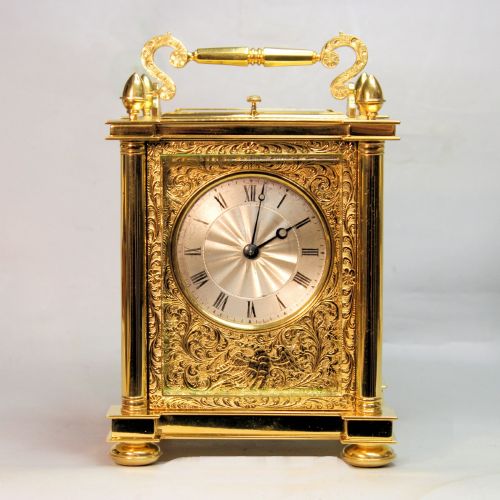
These engraved gilt clock selections bring together Victorian and Edwardian timepieces featuring ornate brass cases, enamel dials, and intricate hand-chased surface work.
Engraved Gilt Clock
When buyers search for an engraved gilt clock, they encounter portable timepieces designed primarily as carriage clocks and mantel clocks originating from Victorian and Edwardian periods. The selection frequently includes French carriage clocks with fully engraved cases, gorge frames, and repeating mechanisms.
Most pieces date from the nineteenth century, spanning decades from the eighteen-fifties through the eighteen-nineties. Forms range from miniature travel clocks to giant striking examples with inset panels and specialised platform escapements.
Evaluating Quality
Quality separates through the depth, crispness, and coverage of the hand-engraving across the sides and mask of the case. Fully engraved surfaces that extend continuously around every brass panel represent finer production than sparse linear accents.
The sophistication of the internal movement dictates the upper tier of the range, particularly complications such as repeating strikes, alarm functions, grande-sonnerie systems, and robust fusee gear trains.
Engraved Gilt Clock Retail Price Guide 2026
Typical asking prices for engraved gilt clock among the pieces listed under this phrase on Sellingantiques today, from the lower quarter to the upper quarter. They describe what is for sale here now, not the wider market.
French workshops dominate the production records alongside London retailers and specialist fusee clockmakers.
Henri Jacot·Cousens And Whiteside·Howell And James·Delépine Barrois·Gontard And Bolviller·Mappin And Webb·Arnold And Frodsham·Thomas Cole·James Cole·Hunt And Roskell·Charles Frodsham And Holingue Frères·Drocourt·Paul Garnier·Bourdin·Tiffany·Moser
The Engraved Gilt Clock Glossary
- Carriage clock
- A small, spring-driven clock designed for travel, traditionally housed in a brass and glass case with a folding handle on top.
- Platform escapement
- The tiny regulated balance wheel assembly mounted visibly on a small platform inside the upper part of a carriage clock movement.
- Gorge case
- A specific French carriage clock case style characterised by stepped mouldings along the top and bottom frames.
- Fusee
- A conical pulley used in mechanical clocks to maintain equal force on the gear train as the mainspring unwinds.
- Repeater
- A mechanism that chimes the hours and quarters on demand when a button or pendant is pressed.
- Grande-sonnerie
- A complex striking train that automatically chimes both the hours and the passing quarters on every quarter hour.
Engraved Gilt Clock: Frequently Asked Questions
What is a carriage clock?
A carriage clock is a portable spring-driven timekeeper developed in the nineteenth century for travellers to carry in horse-drawn carriages or stagecoaches. They rely on sturdy brass frames and glass windows to protect the delicate escapement during transit.
Most examples feature a hinged handle on the top plate and sit upon small supporting feet. Their compact nature made them practical for domestic desk use as well as journeys.
How do I date a gilt clock?
Dating relies on stylistic clues, maker signatures stamped on the backplate, and the evolution of the escapement design. Victorian and Edwardian pieces often display registration marks or specific French foundry stamps.
Examining the depth of the case engraving and the shape of the brass handle provides further chronological context for nineteenth-century specimens.
How do I wind a carriage clock?
Winding requires a matching key inserted into the winding squares on the underside or backplate of the movement. Care must be taken not to overwind the mainspring barrel.
Most nineteenth-century movements operate for eight days on a single full wind, requiring attention just once a week to maintain accurate timekeeping.