


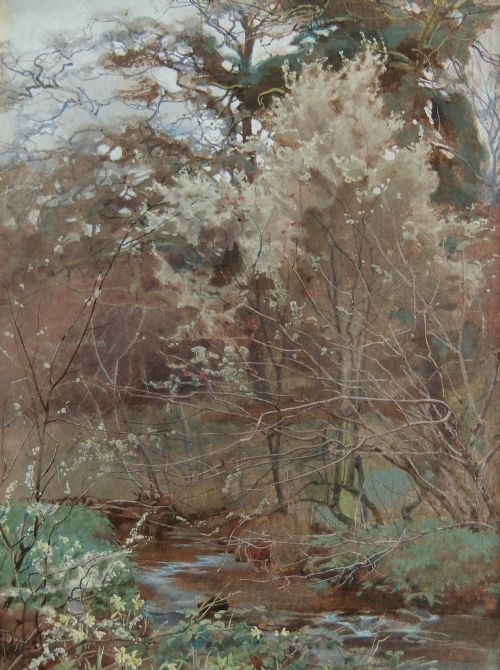


English Woodland Painting
These English woodland painting examples capture the quiet detail of rural scenes, valued by collectors for their atmospheric record of trees, streams, and seasonal light.
English Woodland Painting
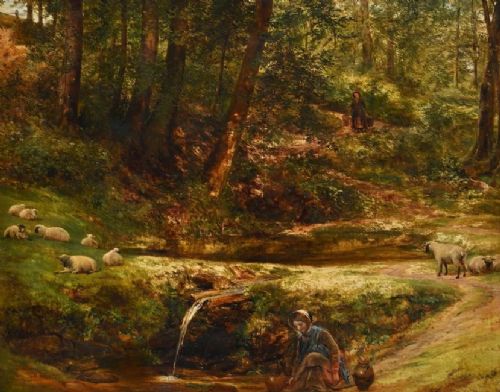
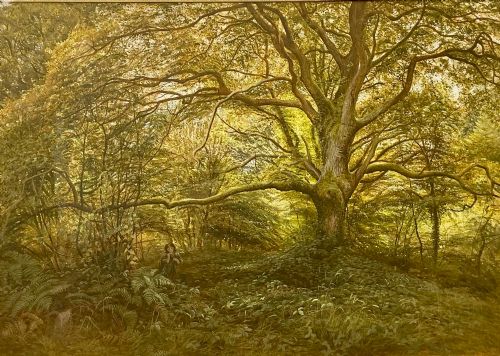
An English woodland painting records the scenery of trees, rivers, and country paths across Britain through various periods of artistic output. The pieces gathered here range from nineteenth-century Victorian works to mid-twentieth-century examples.
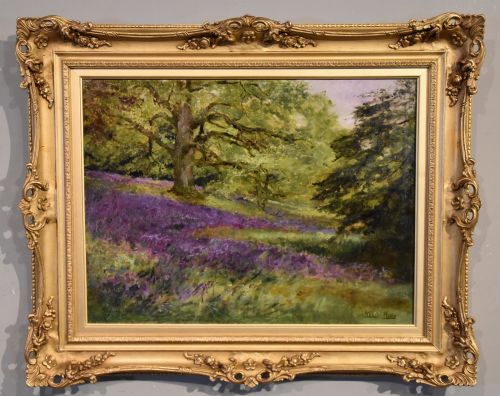
Buyers will encounter oil on canvas, oil on panel, and watercolour on paper, framed under glass or set within ornate wooden surrounds. The subjects span tranquil bluebell woods, river glens, and shaded copses executed by named artists and the broader English School.
How They Were Made
Artists deployed oil paint upon canvas, board, and oak panel to build durable surfaces with textured depth. Watercolour was applied directly to paper or card, sometimes supplemented with charcoal, ink, and pencil to define woodland paths and foliage.
Supports were enclosed in traditional wooden frames, occasionally protected by glass sheets, preserving the delicate pigments of nineteenth and twentieth-century landscapes.
Terriers and campers occasionally share the woods with the trees.
What Varies in Quality
The degree of observation in natural light and seasonal foliage dictates the visual strength of an individual composition. Works showing careful tonal control over trees and water stand apart from standard decorative examples.
The handling of the medium, whether through fluid watercolour washes or thick oil impasto, determines the longevity and immediate presence of the landscape.
Richard Redgrave·Henry Yeen King·William Mellor·John Wright Oakes·Walter Follen Bishop·Rowland Henry Hill·Edmund George Warren·Alfred W Parsons·Charles James Adams·Ernest Higgins Rigg·Charles Edward Holloway·Beatrice Parsons·Frederick Golden Short·Lester Sutcliffe·Benjamin Callow·Walter Emsley·Kershaw Schofield·Florence F Wilmot·Majorie Hoare·A F Rolfe·Lewis Creighton·Garnet Ruskin Wolseley·Fred Lawson·Thomas Dudley·John Westall
The English Woodland Painting Glossary
- Watercolour
- A paint consisting of pigment suspended in a water-soluble binder, traditionally applied to paper sheets.
- Impasto
- Paint applied in thick layers that stand out from the surface, giving texture to foliage and tree trunks.
- Provenance
- The documented history of ownership attached to a specific painting, verifying its origin and past collections.
- Tonalism
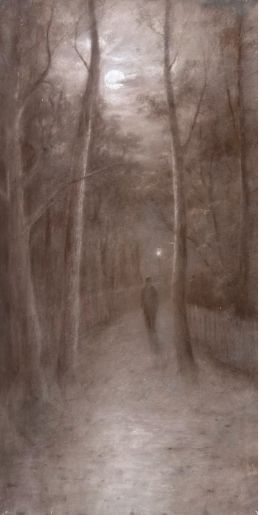
- An artistic style where artists let shadow and overall tone predominate over crisp line work, common in atmospheric landscapes.
English Woodland Painting: Frequently Asked Questions
What periods do these paintings cover?
The available selection spans from the late eighteenth century through the Victorian era and into the early decades of the twentieth century. Artists worked across these changing periods using traditional British landscape conventions.
Most pieces date from the nineteenth and early twentieth centuries, reflecting shifting approaches to naturalism and tonal painting in the English countryside.
Which materials were used by the artists?
Painters employed oil paint on canvas, wood panel, board, and card. Others chose watercolour on paper, occasionally combining ink and charcoal for preliminary drawing lines.
These varied media were housed in period wooden frames, with watercolours typically preserved behind glass to protect the paper surface from atmospheric moisture.
How do I care for an antique painting?
Keep works away from direct sunlight and sources of heat to protect pigments from fading or cracking over time. Maintaining stable indoor humidity prevents wood panels and canvases from warping.
Dust frames gently and avoid applying liquid cleaners directly to the painted surface or exposed paper components.
How are different regional schools identified?
Regional styles often emerge through the specific landscapes depicted, such as Yorkshire valleys, the New Forest, or Cumbrian lakes. Signatures, artist records, and stylistic traits link individual works to the English School and broader regional movements.
Examine the back of the canvas, panel, or frame for inscriptions, gallery labels, and signature stamps that record the artist's identity and location.