



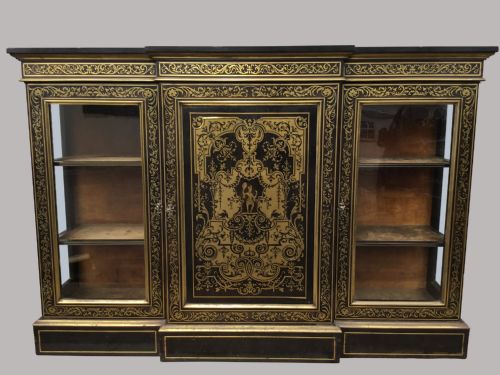


English Revival Credenza
An English revival credenza brings substantial historical weight and elaborate timber work into a room.
English Revival Credenza
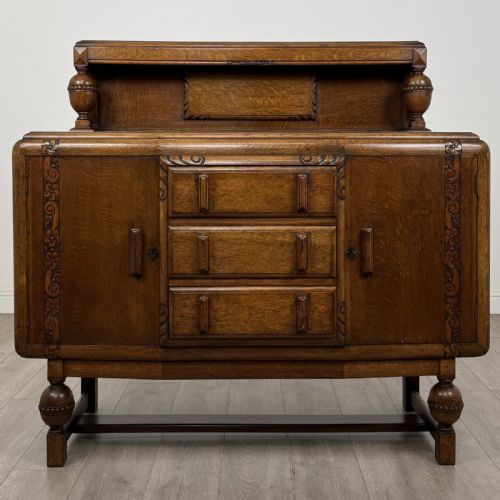
An English revival credenza represents a deliberate historical look backward, drawing on Gothic, Tudor, Sheraton, and Charles II motifs during the nineteenth century. These pieces serve primarily as storage cupboards, side cabinets, and sideboards within domestic interiors.
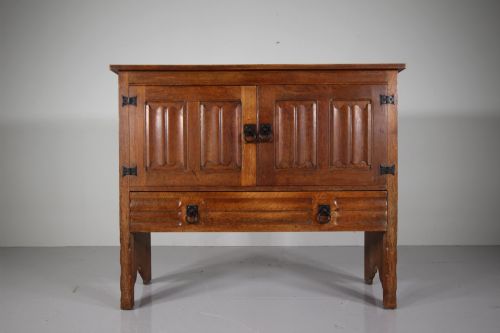
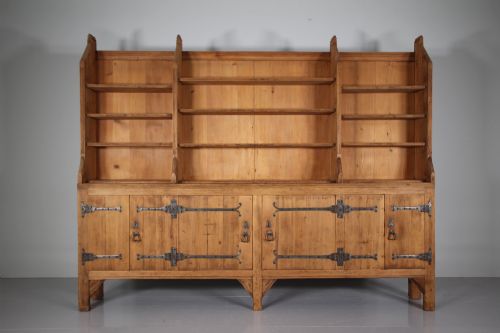
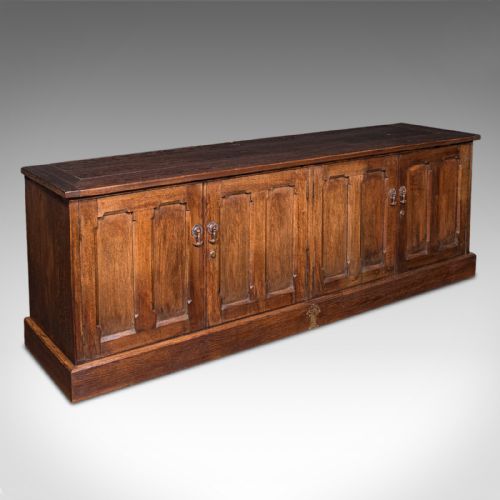
The versions met most frequently on this page span the Victorian era, utilising dense woods such as oak and pine to recreate earlier architectural styles. Alongside traditional credenzas and side cabinets, related forms like bookcases and dresser bases appear frequently.
How they were made
Cabinet makers utilised heavy timbers like oak, pine, and rosewood, often enriching surfaces with intricate inlaid marquetry wood and brass or iron hardware. Techniques combined structural joinery with decorative elements such as carved linenfold panels and Boulle work.
Workshop construction focused on durability and visual richness, pairing robust structural carcases with refined details like satinwood veneers and ebony accents.
English Revival Credenza Retail Price Guide 2026
Typical asking prices for english revival credenza among the pieces listed under this phrase on Sellingantiques today, from the lower quarter to the upper quarter. They describe what is for sale here now, not the wider market.
Materials recorded across the inventory range from sturdy oak and pine to decorative satinwood, rosewood, coromandel, and ebony.
What varies in quality
Quality rests primarily in the ambition of the design and the execution of surface decoration, distinguishing standard production from exceptional cabinet work. Pieces featuring precise marquetry inlay, ebony detailing, or signed maker attribution sit well above simpler utility cupboards.
The choice of primary timber and secondary woods dictates the overall solidity and visual depth of the cabinet. Finer examples display meticulous attention to period revival details, from carved linenfold motifs to well-balanced proportions.
Lamb of Manchester
The English Revival Credenza Glossary
- Credenza
- A low cabinet or sideboard designed for display and storage, often featuring central doors flanked by shelving or side compartments.
- Marquetry
- Decorative veneer work arranged in geometrical or pictorial patterns using various coloured woods.
- Linenfold
- A style of wood carving representing folded linen, commonly found on panels of Tudor and Gothic revival furniture.
- Boulle
- An elaborate form of marquetry utilising tortoiseshell and brass inlay, popular in luxury cabinet making.
- Chiffonier
- A small sideboard or low cupboard, typically featuring shelves or a raised superstructure on the top surface.
English Revival Credenza: Frequently Asked Questions
What is an English revival credenza?
An English revival credenza is a nineteenth-century storage cabinet designed in the style of earlier periods such as the Gothic, Tudor, or Sheraton eras. These pieces combine historic decorative motifs with the practical storage requirements of Victorian homes.
They function as substantial sideboards and display cabinets, utilising timbers like oak, satinwood, and rosewood to achieve an ornate historical appearance.
How were these cabinets used originally?
Originally, these cabinets served in dining rooms, libraries, and parlours to store tableware, books, and household objects. The top surface provided space for displaying decorative items, silver, or lamps.
Their substantial construction and enclosed storage made them central pieces of furniture for organising and displaying domestic possessions.
How do I live with a revival credenza?
Living with a revival credenza involves placing it in a room with adequate wall space to accommodate its heavy proportions and rich timber tones. It works well as a focal point in a dining room or living area, providing deep storage inside.
Keep the piece away from direct heat sources and strong sunlight to protect the polished wood surfaces and delicate marquetry inlay.
How do I tell different revival styles apart?
Distinguishing revival styles depends on identifying specific decorative vocabulary used by the cabinet maker. Gothic and Tudor revival pieces feature heavy carved oak and linenfold panels, whereas Sheraton revival examples show lighter satinwood and delicate marquetry.
Looking closely at the timber choice and ornamental motifs reveals whether the design references seventeenth-century oak furniture or eighteenth-century neoclassical elegance.