


English Regency Tall Clock
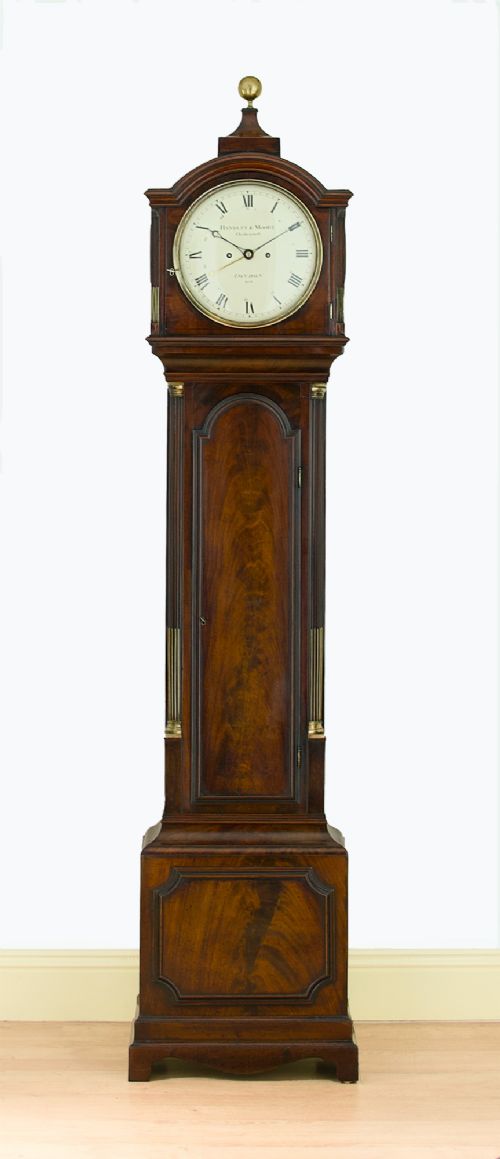
An English regency tall clock stands as a monumental timekeeper of the early nineteenth century, prized for architectural mahogany cases and precise London movements.
English Regency Tall Clock
An english regency tall clock encompasses grand architectural longcase clocks spanning the Regency and Georgian periods. These substantial timepieces house intricate mechanisms within stately wooden housings.
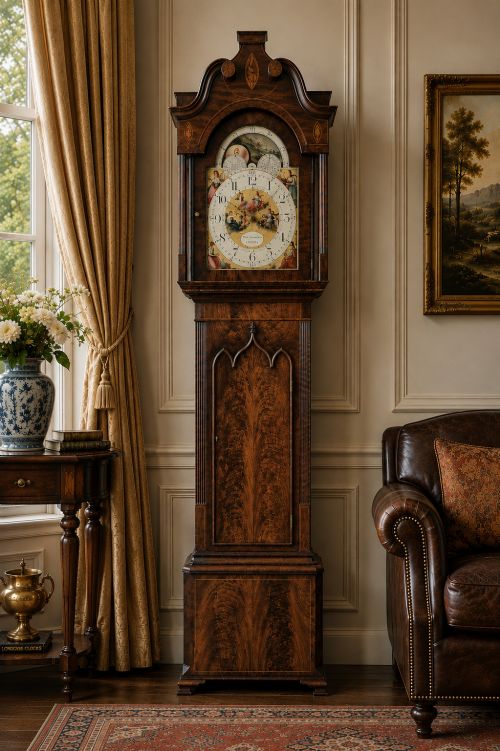
Makers working in London and regional centres produced these floor-standing clocks in mahogany and flame mahogany cases. Examples range from simple dial faces to complex quarter striking and moonphase movements.
Most pieces seen here date from around eighteen hundred to eighteen ten, displaying the clean classical proportions characteristic of the Regency style alongside earlier Georgian survivals.
Construction and materials
Cabinetmakers constructed the tall cases using solid mahogany and figured veneers such as flame mahogany and burr mahogany. They selected timber with deep grain patterns to catch the light on the trunk door and hood.
Internal clockwork relies on brass gear trains and iron components, often driven by heavy weights suspended on lines. Dial faces integrate brass work, painted surfaces and glass doors to protect the hands.
The selection spans the Regency, Georgian and George III periods, reaching into the nineteenth century.
Judging quality and execution
The sophistication of the movement separates standard timekeepers from exceptional examples. Quarter striking mechanisms and precision regulators represent higher levels of horological skill than basic time-only clocks.
Cabinet work quality depends on the choice of timber figure and the crispness of inlaid details. Finer cases exhibit carefully matched mahogany veneers and well-proportioned architectural hood mouldings.
Handley and Moore·Samuel Kellett·William Moon·Dwerrihouse and Carter·Jno Lane·French Royal Exchange·Hampston Prince and Cattles·James McCabe·Perigal
The English Regency Tall Clock Glossary
- Longcase clock
- A tall pendulum clock enclosed in a wooden case that stands directly on the floor. These pieces are frequently referred to as grandfather clocks.
- Moonphase
- A dial mechanism tracking the phases of the lunar cycle through a rotating painted disc. This complication adds visual interest above the main clock face.
- Quarter striking
- A mechanism that chimes the quarters of the hour on bells or gongs. This feature demands greater mechanical complexity from the movement.
- Regulator
- A high-precision clock designed for exact timekeeping and used as a standard to set other watches. They often feature simplified dials to make reading the seconds hand effortless.
- Flame mahogany
- Timber cut from the fork of the mahogany tree where branches meet the trunk, yielding a distinctive branching flame pattern. Cabinetmakers used these veneers on prominent surfaces.
English Regency Tall Clock: Frequently Asked Questions
Where should I place a tall clock?
Position the clock against a solid interior wall away from direct sunlight and strong draughts. Wooden cases respond to stable environmental conditions.
Ensure the floor beneath the case is level so the pendulum swings evenly and keeps accurate time.
How do I wind the weights?
Open the waist door to access the heavy metal weights suspended inside the trunk. Use the winding key on the dial face to slowly draw the weights back to the top.
Take care not to overwind the mechanism, stopping as soon as resistance increases.
Why does the clock lose time?
Small temperature shifts cause timber cases to expand and contract slightly, which alters the beat of the pendulum. Seasonal changes frequently require minor regulation.
Adjust the small nut at the bottom of the pendulum bob up or down to correct the speed.
How do I identify a Regency case?
Regency cases favor classical architectural lines, clean mouldings and rich mahogany veneers without heavy carving. Details often draw on ancient Roman and Greek design influences.
Later Victorian interpretations tend to feature heavier proportions and more ornate surface decoration.