




English Regency Canterbury
An English Regency canterbury is a practical library stand designed to hold sheet music, newspapers, and folios in style.
English Regency Canterbury
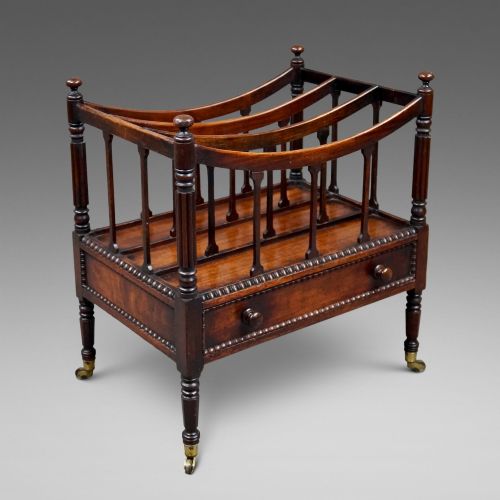
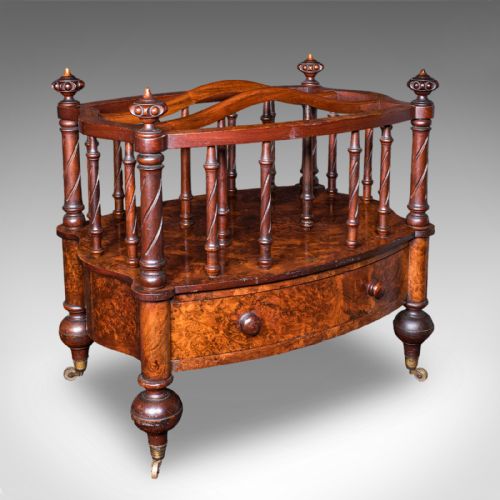
An English Regency canterbury is a low-standing piece of furniture featuring divided compartments above a base, frequently incorporating a drawer. The form serves primarily for holding newspapers, magazines, sheet music, and folios within the home.
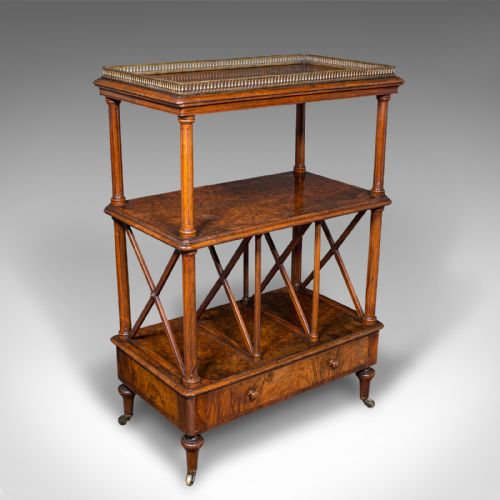
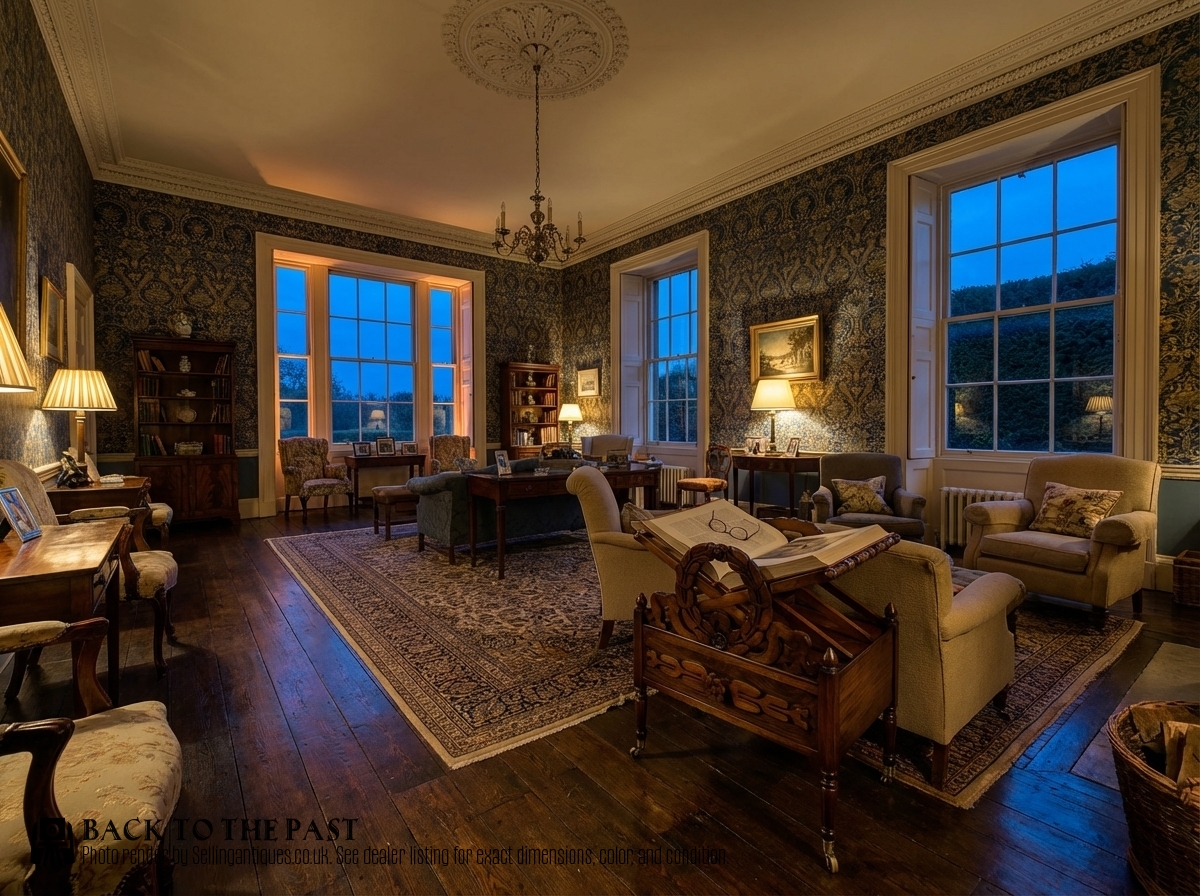
Buyers encounter variations ranging from simple four-division magazine racks to elaborate reading tables with built-in lecterns, folio stands, and combination whatnot etageres. Mahogany and rosewood examples dominate the selection, alongside pieces executed in burr walnut and walnut.
Originating during the late Georgian and Regency eras, these pieces span periods from George III through to William IV and the early Victorian years. The typical layout places slatted partitions above turned or octagonal legs, often mounted on castors for easy movement across a room.
Materials and construction
Cabinetmakers utilised dense tropical hardwoods, turning principally to mahogany and figured rosewood for their strength and rich grain. Burr walnut appears on select decorative models, providing striking patterns across the surfaces and drawer fronts.
Construction relied on precise joinery to build the upright divisions and support the slatted sides without warping under the weight of heavy folios. Brass castors and subtle turned details completed the lower framework, allowing freestanding placement.
English Regency Canterbury Retail Price Guide 2026
Typical asking prices for english regency canterbury among the pieces listed under this phrase on Sellingantiques today, from the lower quarter to the upper quarter. They describe what is for sale here now, not the wider market.
Mahogany and rosewood are the primary woods seen across these listings, supplemented by burr walnut and brass accents.
Distinctions in quality
The refinement of the turning on the uprights and the selection of timber figure dictate the visual standing of a piece. Finer examples display carefully matched grain patterns across the divisions and incorporate smoothly operating drawers with dovetailed joints.
Scale and proportion separate standard reading stands from grander library pieces. Pieces with double-size proportions or combined functions, such as integrated reading lecterns and tiered shelving, demonstrate higher ambition from the maker.
J C Loudon
The English Regency Canterbury Glossary
- Canterbury
- A low stand with partitioned sections designed for holding music sheets, newspapers, and unbound books. The name derives from the Archbishop of Canterbury, who reportedly commissioned the first such piece.
- Folio stand
- A substantial rack built to support large books, maps, and unbound art prints. These stands often feature adjustable mechanisms or deep compartments.
- Etagere
- A set of open display shelves supported by columns or slender uprights. When combined with a canterbury base, it provides both storage and display space.
- Whatnot
- A piece of furniture consisting of multiple open shelves for displaying ornaments or books. Examples often merge with lower canterbury compartments.
- Lectern
- An angled reading desk built onto a table or stand for holding books at a comfortable height. These frequently appear on reading tables from the Regency period.
English Regency Canterbury: Frequently Asked Questions
What is an English Regency canterbury used for?
These stands were originally built to hold daily newspapers, sheet music, and unbound literary folios near a seating area. They kept reading materials organised and accessible in drawing rooms and libraries.
Today, they serve the exact same domestic function while adding period character to a modern interior as accent furniture.
How do I distinguish a Regency canterbury from a Victorian one?
Regency and late Georgian pieces typically exhibit crisp joinery, restrained classical proportions, and fine mahogany or rosewood timbers. Details often include finely turned legs and subtle brass fittings.
Victorian interpretations tend toward heavier proportions and more ornate carving, reflecting the shifting tastes of later decades.
Can I use a canterbury as a bedside table?
The partitioned upper section and low profile make these stands ideal for holding books and magazines beside a bed or sofa. Models featuring an integrated drawer offer discreet storage for smaller items.
Care should be taken to place them where modern lamps or heavy objects will not strain the wooden divisions.