




English Mahogany Serpentine Drawers
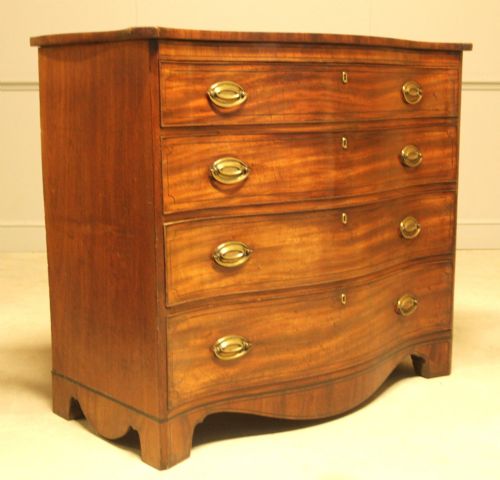
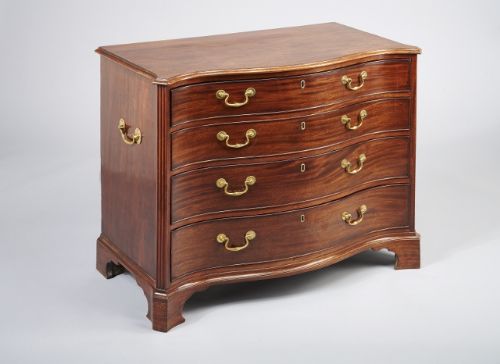
English mahogany serpentine drawers bring undeniable fluid movement to formal rooms through their gently curved fronts.
English Mahogany Serpentine Drawers
These english mahogany serpentine drawers encompass robust Georgian chests, compact dressing pieces, and lowboys alongside later Edwardian interpretations and twentieth-century revival styles. The form relies on a characteristic undulating front profile that projects outward at the centre and curves inward at the corners, demanding exceptional skill from the cabinetmaker.
Most examples found here date from the Georgian period or draw heavily upon its design vocabulary, utilising rich timber and traditional joinery. Buyers frequently encounter standard chests of drawers alongside more specialised forms like the chest on stand or the lowboy, each offering practical storage paired with sophisticated lines.
Originating primarily from eighteenth-century workshops, these pieces combine utility with decorative presence through figured timber grain and polished brass hardware. Surviving examples demonstrate the enduring appeal of serpentine shaping in British furniture design across multiple eras.
Materials and construction methods
Makers relied primarily on dense mahogany, frequently selecting flame mahogany veneers to accentuate the curving drawer fronts with dramatic, figured grain patterns. This timber provided the structural stability necessary to cut and plane complex serpentine shapes without warping over centuries of use.
Brass handles and escutcheons were cast and chased to complement the dark timber, fixed securely to the drawer faces with traditional pins or threaded posts. Cabinetmakers joined the carcase using dovetailed corners and fitted dust boards between drawers to ensure smooth operation of the undulating fronts.
English Mahogany Serpentine Drawers Retail Price Guide 2026
Typical asking prices for english mahogany serpentine drawers among the pieces listed under this phrase on Sellingantiques today, from the lower quarter to the upper quarter. They describe what is for sale here now, not the wider market.
Drawers that curve like gentle waves remind us that eighteenth-century cabinetmakers refused to let wood stay straight.
Distinguishing quality in serpentine furniture
The degree of refinement in the serpentine curve largely dictates the sophistication of the piece, with subtle, hand-carved contours surpassing rigid or mechanical profiles. Superior examples exhibit continuous grain matching across the drawer fronts, requiring careful selection and cutting of the timber veneers.
Proportion and scale separate exceptional items from standard workshop output, particularly in how the serpentine sweep integrates with the bracket feet or dressing table legs. Original brass hardware and untouched patination on the mahogany surface indicate a higher standard of preservation and craftsmanship.
The English Mahogany Serpentine Drawers Glossary
- Serpentine front
- A furniture front characterised by a convex centre flanked by concave wings, creating an undulating wave shape. This contour requires precise woodworking to execute successfully.
- Flame mahogany
- A veneer cut from timber where the branch meets the trunk, producing a distinctive flickering flame pattern. Cabinetmakers reserved this decorative grain for primary display surfaces.
- Lowboy
- A small side table with drawers, typically raised on four tall legs and used for dressing or storage. Eighteenth-century examples often incorporate curved or shaped aprons.
- Chest on stand
- A tall case of drawers elevated upon a separate or integrated frame with legs. This configuration lightens the visual weight of heavy case furniture.
- Bracket foot
- A structural support foot shaped like a bracket, commonly seen on eighteenth-century case pieces. It provides a stable base while maintaining clean architectural lines.
English Mahogany Serpentine Drawers: Frequently Asked Questions
What is a serpentine chest?
A serpentine chest is a storage piece featuring a curved front that bends outward in the middle and inward at the sides. This rhythmic contour breaks up the boxy appearance of standard chests.
Cabinetmakers adopted this shape during the eighteenth century to display the figured grain of mahogany timber more dramatically.
How do I identify Georgian pieces?
Georgian pieces display hand-cut dovetails, dense mahogany timber, and traditional brass hardware that matches the period of manufacture. The proportions tend to be balanced and architectural.
Later Edwardian or twentieth-century revivals often utilise machine-sawn elements and different internal secondary woods.
Where were lowboys placed?
Lowboys served as versatile side tables in bedrooms, hallways, or reception rooms for holding small personal items. Their compact height made them suitable for dressing or writing.
They provided accessible drawer storage without dominating the floor space of smaller chambers.
How should I maintain mahogany?
Mahogany requires consistent indoor humidity and protection from direct sunlight to prevent the timber from drying out or fading. Gentle dusting with a dry cloth preserves the polished surface.
Occasional application of traditional wax helps nourish the wood grain and maintain its natural depth of colour.