




English Leather Sofa
An english leather sofa brings substance and rich texture to a room, built to soften gracefully through decades of daily sitting.
English Leather Sofa
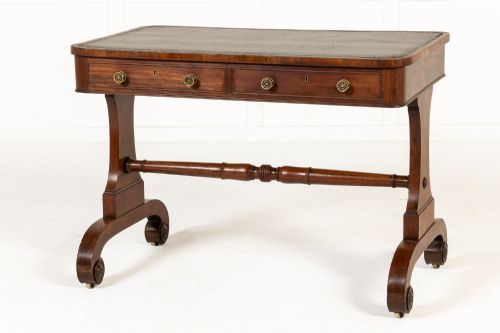
An english leather sofa encompasses sturdy frames upholstered in hide, spanning periods from the Regency era through the nineteenth century and into the nineteen-twenties and nineteen-thirties. You will regularly encounter traditional chesterfields, button-backed club settees, and double-ended couches alongside heavy library tables adapted for seating.
The aesthetic leans towards classic English country house comfort, traditional styling, and occasional art deco cloud shapes. Forms range from compact two-seater club settees to large four-seater drop-arm variations and open arm frames.
Origins trace directly to British workshops and periods such as the Regency, Victorian, and William IV epochs, utilising native timbers like mahogany, walnut, oak, and rosewood beneath the leather upholstery.
Materials and construction
Frames rely on hardwoods such as mahogany, walnut, oak, and rosewood, providing a rigid internal skeleton to support heavy upholstery. Metal components like brass appear in decorative inlay work, castors, and structural detailing.
Traditional padding methods involve horsehair filling and fully loose coil springing beneath the outer skin. Hides are applied by hand, frequently featuring tufted buttons or hand-dyed finishes in shades of brown, green, and red.
English Leather Sofa Retail Price Guide 2026
Typical asking prices for english leather sofa among the pieces listed under this phrase on Sellingantiques today, from the lower quarter to the upper quarter. They describe what is for sale here now, not the wider market.
Some nineteenth-century sofas conceal horsehair stuffing originally sheared from Victorian carriage horses.
Assessing quality and execution
The distinction between standard examples and finer pieces lies in the integrity of the frame timber and the depth of hand-carving or brass inlay. Superior frames use dense hardwoods like mahogany or walnut with crisp architectural details rather than plain secondary timbers.
Upholstery execution dictates longevity and comfort, particularly the density of the horsehair stuffing and the resilience of the coil springing. Hand-dyed hides that retain natural grain variation and supple texture distinguish better preserved or restored surfaces from flat, uniform treatments.
Howard and Sons·Marsh and Tatham
The English Leather Sofa Glossary
- Chesterfield
- A deep-buttoned sofa traditionally upholstered in leather with arms and back of the same height. This form remains a staple of traditional English seating.
- Library table
- A large freestanding table fitted with a leather top, occasionally adapted or grouped with seating in period interiors.
- Double-ended couch
- A nineteenth-century couch featuring raised scrolls at both ends rather than a single headboard. These pieces often combine mahogany frames with brown leather upholstery.
- Knoll drop arm
- A sofa style featuring adjustable or lowering armrests operated by mechanisms or wooden supports. This allows the seating area to convert into a daybed.
- Horsehair gilled
- An internal stuffing method utilising cleaned horsehair packed tightly within the upholstery lining. This provides firm, resilient support beneath the leather.
English Leather Sofa: Frequently Asked Questions
What is an english leather sofa?
An english leather sofa is a traditional seating piece built on a hardwood frame and upholstered in cattle hide, dating from the nineteenth and early twentieth centuries. These pieces encompass styles ranging from button-backed chesterfields to Regency double-ended couches.
Craftsmanship from these periods typically incorporates coil springing and horsehair stuffing beneath the leather. Over decades of use, the material develops a distinctive patina that defines the character of the furniture.
How do I date an english leather sofa?
Dating relies on identifying structural characteristics, timber choices, and upholstery methods specific to historical design periods. Regency and William IV pieces often display mahogany frames with brass inlay, while Victorian examples frequently feature deep tufted buttoning.
Twentieth-century variations introduce art deco cloud shapes and nineteen-thirties styling. Comparing the frame construction and foot design against documented period forms helps establish the approximate decade of manufacture.
How should I care for vintage leather?
Vintage leather requires regular conditioning with appropriate balms to prevent the hide from drying and cracking over time. Keeping the furniture away from direct sunlight and strong heat sources preserves the natural oils within the material.
Gentle dusting with a soft, dry cloth maintains the surface without stripping hand-dyed finishes. Professional restoration may be necessary if the leather requires re-dyeing or structural repairs to the internal horsehair.
Where were these sofas used?
These sofas traditionally furnished the libraries, drawing rooms, and studies of English country houses and town residences. Their robust construction suited both formal reception rooms and daily private living quarters.
Today, they function well as central seating pieces in living rooms or studies, pairing easily with wood furniture and traditional rugs. Their enduring design allows them to anchor both classic and contemporary interior schemes.