


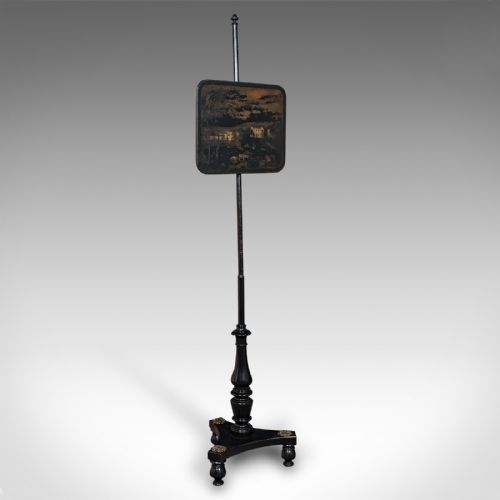


English Hearth Screen
These English hearth screen pieces turn an ordinary fireplace into a considered interior, offering warmth control and decorative focus.
English Hearth Screen
An english hearth screen serves to block radiant heat or conceal a cold grate during the warmer months, taking forms such as cheval frames, adjustable pole screens, and nursery guards. You will most frequently encounter nineteenth-century examples on this page, spanning the Georgian, Regency, William IV, and Victorian periods.
The objects range from large giltwood and mahogany standing panels to slender pole screens featuring embroidered needlepoint or glass reflectors. Early forms also include iron and wicker down hearth designs, though timber and brass constructions dominate the later periods.
Makers utilised rich hardwoods including mahogany, walnut, and rosewood alongside gilded frames to house textiles, wool tapestries, and adjustable shields. These pieces combine practical fireside utility with the distinct stylistic shifts of the aesthetic movement and the late Victorian era.
Materials and construction
Joiners and cabinetmakers shaped dense timbers like mahogany, rosewood, and walnut into sturdy pedestal bases and standing frames, often enriching the surface with giltwood accents. These woods provided the necessary weight to support tall poles and heavy cheval panels near the hearth.
Regency ladies adjusted their pole screens just so, saving their complexion from melting candle wax and roaring coal.
Evaluating quality and execution
The quality of an english hearth screen lies in the crispness of the timber carving and the tightness of the joinery on the base and pole mechanism. Finer examples display meticulous hand-stitching in the needlepoint panels, utilising complex wool tapestries rather than simpler printed textiles.
Hardware and adjustment mechanisms reveal the standard of manufacture, where smooth movement in pole screens and robust brass construction in guards indicate superior workshop production. The choice of materials, from figured mahogany to heavy giltwood, dictates the overall presence of the piece in a room.
The English Hearth Screen Glossary
- Pole screen
- A standing fireside screen with an adjustable panel that slides up and down a vertical wooden shaft. This design allowed occupants to shield their faces from the intense heat of an open coal fire.
- Cheval screen
- A standing frame supported by two pillars and feet, allowing the central panel to swing or remain fixed. These typically offer a larger viewing area than pole screens.
- Needlepoint
- A form of canvas work embroidery executed with yarn using a tapestry stitch. It frequently forms the decorative pictorial panel of nineteenth-century fireside screens.
- Giltwood
- Timber that has been coated with a thin layer of gold leaf or gesso preparation. It appears on finer decorative frames from the Georgian and Regency periods.
- Nursery guard
- A protective metal barrier, often constructed from bowed brass mesh or wire. It was placed around the hearth to keep children and trailing garments safely away from open flames.
English Hearth Screen: Frequently Asked Questions
What is an English hearth screen?
An English hearth screen is a decorative and functional furnishing designed to stand before a fireplace. It protects occupants from intense radiant heat or conceals an empty grate when the fire is not lit.
These pieces range from tall wooden pole screens with embroidered textile panels to solid brass nursery guards and heavy glass reflectors.
How do pole screens work?
Pole screens feature a vertical wooden shaft mounted on a weighted base, with a sliding panel held in place by a friction collar or screw mechanism. This allows the user to raise or lower the embroidered shield to block heat at eye level.
They were essential movable furniture in nineteenth-century drawing rooms where coal fires burned unevenly.
What materials were used?
Cabinetmakers built the frames and stands using dense hardwoods such as mahogany, rosewood, walnut, and giltwood. Decorative panels typically incorporated wool needlepoint tapestry, embroidered textiles, or glass.
Metal versions relied on brass and iron, particularly for nursery guards and down hearth accessories.
How do I date a piece?
Dating relies on stylistic clues, combining the form of the timber turning with the aesthetic of the needlepoint panel. Regency and George III pieces often display classical giltwood or slender poles, while Victorian examples introduce heavier rosewood frames and aesthetic movement motifs.
Construction methods within the base joints also help distinguish eighteenth-century ironwork from later nineteenth-century production.