
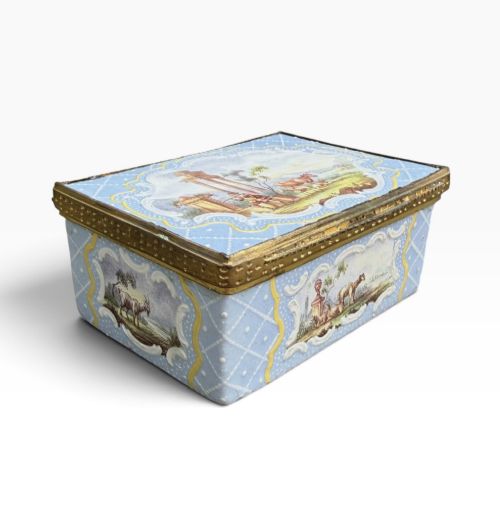


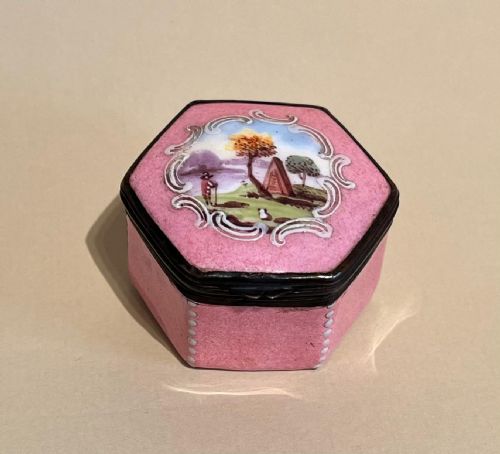

English Enamel Trinket Box
An English enamel trinket box brings pocket-sized colour and Georgian or Edwardian charm to a desk.
English Enamel Trinket Box
An English enamel trinket box takes the form of patch boxes, snuff boxes, and small lidded jars designed for personal dressing table use. These portable containers emerge principally from the eighteenth century in Staffordshire and Bilston workshops, alongside later Edwardian examples.
The objects span Georgian rococo forms through to Edwardian silver and guilloche enamel pieces. Buyers encounter powder pink colourways, novelty shapes including spaniels, and inscribed mottoes such as a token of esteem.
Eighteenth-century examples rely on copper alloy bodies coated in opaque white or coloured enamel, while twentieth-century iterations incorporate sterling silver frames and translucent engine-turned decoration. Each container preserves small keepsakes, powder, or patches.
How they were made
Maker fuse powdered glass to copper or brass bases through repeated kiln firings to achieve the glossy enamel surface. Artisans then paint decorative motifs, landscapes, or inscriptions directly onto the hardened white or tinted ground by hand.
Mounts, bezels, and hinges utilise gilt metal, brass, or sterling silver, securing the lid to the base with precision. Edwardian pieces frequently employ guilloche techniques, engraving geometric patterns beneath translucent enamel applied over silver.
An eighteenth-century Bilston box shaped as a King Charles Cavalier spaniel waits to guard your dressing table.
What varies in quality
Quality rests upon the crispness of the hand-painted detail and the preservation of the delicate enamel surface across both body and lid. Finer eighteenth-century boxes display controlled brushwork on figurative scenes and minimal crazing or restoration to the glass coating.
The execution of the metal mounts and hinges distinguishes standard production from superior workshops. Solid sterling silver frames and intricate guilloche engraving elevate twentieth-century examples above simpler base-metal counterparts.
The English Enamel Trinket Box Glossary
- Bilston
- A Staffordshire town renowned for eighteenth-century enamel production. Workshops here specialised in small luxury containers like snuff and patch boxes.
- Patch box
- A small container originally used to hold cosmetic silk or velvet patches for the face. Eighteenth-century examples often featured a mirror inside the lid.
- Guilloche
- A decorative technique involving precise mechanical engraving beneath translucent enamel. This method was widely utilised on Edwardian silver dressing table wares.
- Snuff box
- A pocket-sized vessel designed to hold powdered tobacco. These containers frequently featured hinged lids and detailed painted or enamelled scenes.
English Enamel Trinket Box: Frequently Asked Questions
What is an English enamel trinket box?
These small lidded containers feature fused glass enamel on copper or silver bases, produced primarily in Staffordshire during the eighteenth century and later revived in the Edwardian period.
They served functional roles on dressing tables and in pockets, holding items like cosmetic patches, snuff, or small trinkets.
How do I date an enamel box?
Dating relies on materials, mounting styles, and the manufacturing technique of the body and hinges. Eighteenth-century pieces typically feature copper bases with hand-painted enamel, whereas Edwardian items incorporate sterling silver and guilloche work.
Inscriptions, subject matter, and stylistic traits like rococo mounts also provide clear chronological markers.
Were these boxes used for snuff?
Many eighteenth-century examples functioned specifically as snuff boxes for powdered tobacco. Other forms served as patch boxes or general trinket containers.
Their compact scale made them easily transportable in pockets or small bags by Georgian and Edwardian owners.
How do I care for antique enamel?
Protect the glass surface by keeping the pieces away from moisture, harsh chemicals, and drops that could crack the fragile coating. Clean them gently with a dry or barely damp soft cloth.
Display them away from direct sunlight to preserve the hand-painted colours.