
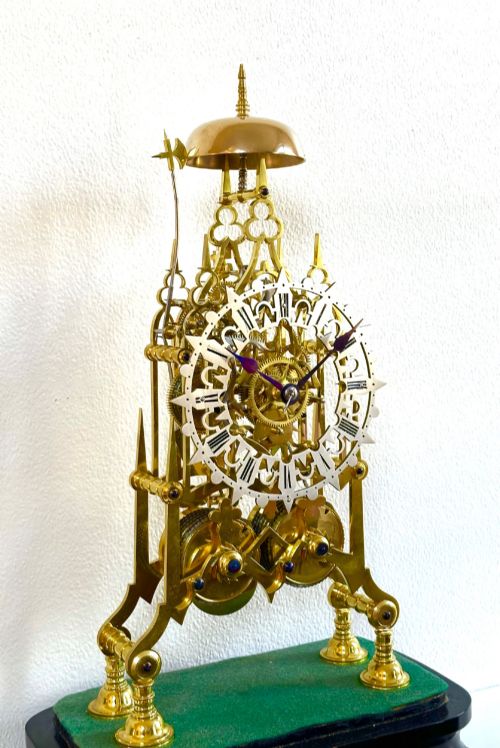


English Double Fusee Clock
An english double fusee clock is a precision mechanical timepiece driven by chain and cone pulleys, prized by collectors for its steady power delivery.
English Double Fusee Clock
When you search for an english double fusee clock, you encounter substantial mantel clocks, bracket clocks, and wall clocks spanning the eighteenth and nineteenth centuries. These timepieces rely on a specialised twin-movement system that powers both the going train and the striking mechanism.
The pieces on this page appear in various timber and metal housings, including mahogany, oak, ebonised wood, and gilt bronze. Victorian examples predominate alongside earlier Georgian and Regency period forms.
Materials and construction
Maker workshops housed these complex movements within robust timber cases of mahogany, oak, or ebonised wood, complemented by brass bezels and glass dial covers. Finer examples incorporate gilt bronze or ormolo mounts and intricate silvered metal dials.
The mechanical heart utilises steel components and brass plates driven by chains or cords wrapped around conical fusee pulleys, ensuring even torque as the mainspring unwinds.
The listings feature mahogany, oak, and ebonised wood clock cases alongside gilt bronze and brass components spanning the eighteenth and nineteenth centuries.
Assessing quality
Quality rests upon the crispness of engraving on the brass backplate and the sophistication of the architectural or figural case design. Finer specimens display signed movements from established makers with robust architectural joinery.
The integration of secondary complications, such as bell striking or regulator dials, distinguishes standard domestic pieces from high-grade horological examples.
Geo. Carter·Richard Rooker·Budgen Croydon·Goldsmiths & Silversmiths London·James Murray London·Osborn of Bognor Regis·Edwards Of London·Thwaites & Reed·Charles Raymond Of Lydeway
The English Double Fusee Clock Glossary
- Fusee
- A conical pulley used in mechanical clocks to equalize the diminishing power of the mainspring as it unwinds. This ensures consistent force reaches the escapement.
- Bracket clock
- A portable table or shelf clock originally designed to sit on a matching wall bracket. Many examples feature detailed wooden cases with carrying handles.
- Regulator
- A high-precision clock designed to keep exceptionally accurate time. These pieces often feature simplified, legible dials for easy reading.
- Ormolo
- Gilded bronze ornamentation applied to clock cases and furniture. The technique involves a mercury amalgam applied to a bronze base.
English Double Fusee Clock: Frequently Asked Questions
How do I wind my clock?
You use a specific winding key inserted into the dial holes to tension the springs via the fusee chains. Care must be taken not to overwind the mechanism.
Most traditional bracket and mantel clocks require weekly attention to keep the movement running steadily.
Where should I place a bracket clock?
These clocks need a stable, level surface away from direct sunlight, drafts, and sudden temperature shifts. A heavy sideboard or a dedicated wall bracket works best.
A stable foundation prevents vibrations that can interfere with the delicate pendulum and escapement.
How do I tell Victorian from Georgian clocks?
Georgian pieces often display restrained classical proportions with fine mahogany veneers and understated brass mounts. Victorian examples frequently embrace bolder architectural forms or revival styles.
Examining the engraving style on the backplate and the construction of the case helps confirm the period of manufacture.