
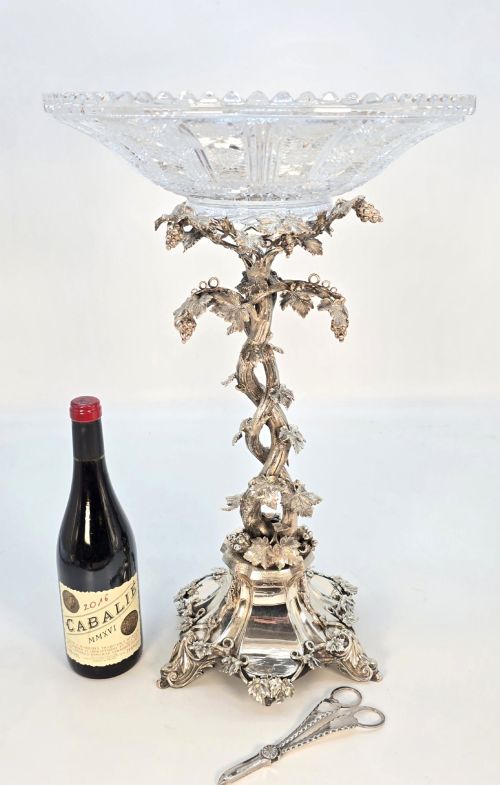


English Cut Glass Bowls
These English cut glass bowls combine brilliant refractivity with robust mounts, offering substantial decorative presence for a table or ceiling.
English Cut Glass Bowls
English cut glass bowls encompass a variety of forms spanning the Georgian, Regency, Victorian, and Edwardian periods. You will encounter table centrepieces, finger bowls, decorative dishes, and ceiling lights suspended on silver plate or brass mounts.
The pieces on this page range from early nineteenth-century finger bowls and tazze to substantial Victorian and Edwardian centrepieces featuring silver-plated frames and nautical themes. Table centrepieces and hanging dish lights represent the primary forms available in this selection.
Origins trace across the nineteenth and early twentieth centuries, capturing the shift from Regency restraint through Victorian elaboration to Edwardian brightness. Each period brings distinct mounting styles and glass colours, including amber and yellow cased crystal.
Materials and Making
Makers utilised heavy lead crystal and cut glass, frequently combining them with silver plate, sterling silver, or brass mounts. The glass vessels were wheel-cut to create deep facets and optical patterns that catch light from every angle.
Cased glass techniques appear in pieces such as yellow over crystal vessels, where a layer of coloured glass is fused to a clear crystal base before cutting. Metalwork components, including silver-plated frames and nautical mounts, were cast and assembled to support the heavy glass bowls.
Several grand nineteenth-century centrepieces star a sailor prince, proving that even a formal dining table appreciates a nautical narrative.
Judgement of Quality
Quality rests in the crispness of the glass cutting and the weight of the metal mounts. Superior pieces display deep, sharp facets with clean polished edges that refract light cleanly without distortion.
The integration between the glass bowl and its silver-plated or brass mount indicates the standard of manufacture. Well-executed pieces feature mounts tailored precisely to the contours of the crystal, whilst secondary details such as cast nautical motifs retain sharp definition.
The English Cut Glass Bowls Glossary
- Lead crystal
- Glass containing a high proportion of lead oxide, which increases weight, brilliance, and softness for deep cutting. This material allows the sharp prismatic effects seen in nineteenth-century bowls.
- Finger bowl
- A small bowl filled with water, used at the table for rinsing fingers between courses. Regency and nineteenth-century examples often appear in matched sets.
- Tazza
- A shallow bowl or cup mounted on a stem and foot, used for serving fruit or sweets. These elevated vessels showcase coloured and cut crystal from the mid-nineteenth century.
- Plafonnier
- A ceiling-mounted bowl light or dish light held close to the ceiling by metal fixtures. Edwardian examples utilise cut glass bowls to diffuse illumination across a room.
English Cut Glass Bowls: Frequently Asked Questions
How are English cut glass bowls dated?
Dating relies on the combination of glass colour, cutting style, and the nature of any metal mounts. Regency pieces often show simpler geometric cutting, whereas Victorian and Edwardian examples incorporate heavier silver-plated frames and complex optical patterns.
Changes in metalwork technology and lighting hardware also provide chronological markers. Ceiling lights reflect the transition from early electrical fittings back to period suspension systems.
What is the difference between cut glass and cut crystal?
Cut crystal contains lead oxide, which gives the material a greater density and a higher refractive index than standard cut glass. This higher lead content permits deeper, sharper facet cutting that creates brighter prismatic reflections.
Both materials appear across the nineteenth-century listings on this page. Crystal examples typically feel heavier in the hand and produce a clear resonant tone when struck.
How were centrepieces used in period dining?
Table centrepieces served as the focal point of formal dining tables, often holding fruit, flowers, or sweetmeats. Large silver-plated and cut glass constructions dominated the middle of the table during Victorian meals.
Nautical and figural motifs reflected the host's interests and conversation pieces for guests. Paired with smaller finger bowls, they formed a cohesive suite of table glass.
Can antique ceiling lights be wired safely?
Edwardian and nineteenth-century dish lights and plafonniers can be adapted for modern electrical standards by a qualified electrician. The structural glass bowls and metal suspension chains remain durable when handled with care.
Wiring updates preserve the original cut glass bowl and silver-plated or brass frame while ensuring compliance with contemporary safety regulations. Inspect the suspension points and chains during installation.