


English Country Overmantel Mirror
An english country overmantel mirror brings domestic character and width to a chimney breast, shaped by nineteenth-century hands.
English Country Overmantel Mirror
An english country overmantel mirror is a substantial wall glass designed specifically to sit above a fireplace, anchoring the proportion of the chimney breast. These pieces belong to the nineteenth century, spanning decades from the eighteen-sixties through the eighteen-eighties into Victorian production.
The primary forms found here are large overmantel mirrors and wall mirrors shaped with distinct architectural tops. Makers produced them to reflect light into rooms while serving as the visual centrepiece of a domestic interior.
Originating within English country houses, these examples carry regional interpretations of broader stylistic movements. They combine traditional joinery with decorative surface treatments suited to period reception rooms.
What Varies In Quality
The depth and precision of the carved wood work dictate the baseline quality of the frame. Skilled carvers created crisp foliage and architectural details that remain sharp beneath layers of historic paint or gesso.
The application of gold leaf and the preservation of original gilt or painted surfaces distinguish finer examples from simpler utilitarian pieces. Original mirror glass plates retaining their historic silvering add substantial character to the work.
Some frames still wear traces of soot from coal fires burning merrily below them a century ago.
The English Country Overmantel Mirror Glossary
- Overmantel mirror
- A large horizontal or shaped glass made to sit directly upon the mantelpiece shelf. These pieces dominate the hearth visually and physically.
- Gesso
- A plaster-like mixture applied to wood frames to create a smooth surface for gilding or painting. Artisans carved intricate relief patterns directly into this hardened material.
- Parcel-gilt
- A decorative technique where only specific raised portions of a painted wooden frame receive gold leaf. This method creates contrast between the gilded highlights and the painted background.
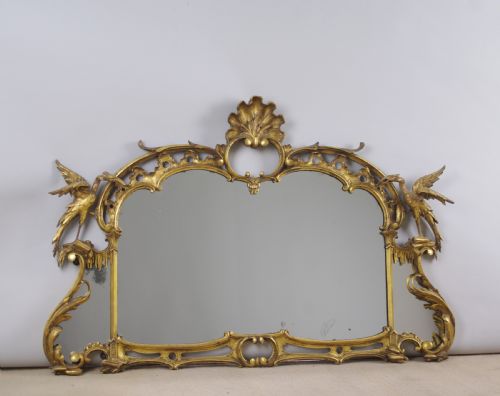
- Chinese Chippendale
- A decorative style incorporating asymmetric rococo scrolls and oriental motifs into nineteenth-century English furniture and mirror frames. It reflects eighteenth-century revival tastes popular during the Victorian era.
English Country Overmantel Mirror: Frequently Asked Questions
How do I hang an overmantel mirror?
These mirrors carry significant weight due to their timber frames and large glass plates. Secure fixings into solid masonry or substantial wall studs are essential for safe installation above a fireplace.
Position the frame so the bottom edge rests stably on the mantelpiece shelf while mechanical hangers take the vertical load off the wall.
What is the difference between an overmantel and a wall mirror?
An overmantel mirror is specifically proportioned to span the width of a fireplace breast, often featuring a landscape orientation or a shaped top designed for low ceilings.
Standard wall mirrors lack this specific architectural relationship to the hearth and generally hang independently in hallways or bedrooms.
How do I date a nineteenth-century mirror?
Dating relies upon examining the construction of the wooden frame, the composition of the gesso, and the style of the carved ornamentation. Nineteenth-century examples often display specific Victorian revival motifs.
The backboards, fixing methods, and the characteristics of the glass plate provide additional clues to the decade of manufacture.
Should I replace old mirror glass?
Historic glass plates often show foxing, speckling, and silver loss that accumulate over generations of use. This natural ageing process proves the authenticity of the piece.
Replacing the original glass removes the historic character that collectors value in nineteenth-century country house mirrors.