

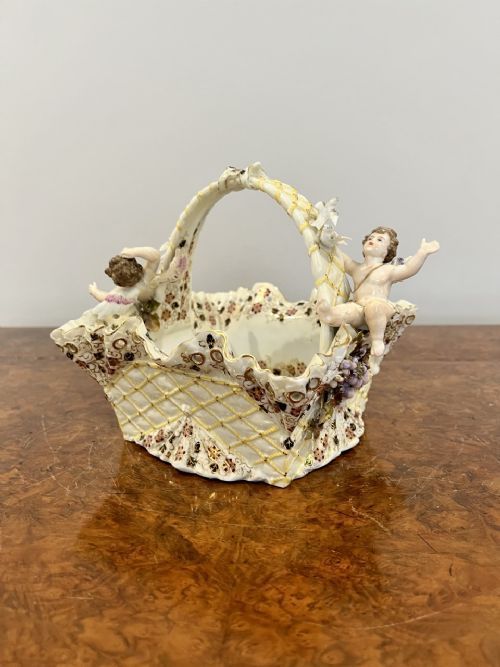


Encrusted Floral Centrepiece
An encrusted floral centrepiece brings sculptural porcelain bloom and nineteenth-century table theatre straight to the dining room.
Encrusted Floral Centrepiece
An encrusted floral centrepiece is an elaborate nineteenth-century table ornament designed to dominate a dining table or sideboard with three-dimensional porcelain flowers, baskets, and figures. Buyers searching for an encrusted floral centrepiece typically encounter German porcelain works from the Victorian and Edwardian eras, featuring intricate moulded petals and cherubic figures.
The selections available here span from the 1880s to around 1910, drawing heavily on Rococo Revival aesthetics with asymmetrical curves and organic forms. Alongside traditional centrepieces, the category encompasses decorative baskets, figural candelabra, and bowls heavily adorned with botanical details.
Originating predominantly from German factories such as Plaue, Sitzendorf, and Meissen-style workshops, these items serve as decorative centrepieces rather than functional tableware. They reflect a Victorian appetite for ornate, floral-laden display pieces that celebrate botanical abundance in ceramic form.
How they were made
These pieces are constructed from hard-paste porcelain, moulded and fired at high temperatures to achieve a durable, glossy body. Artisans built the floral encrustations by hand, applying individual ceramic petals and leaves directly to the surface before the final glaze and colour firing.
Decoration relied on hand-painted enamel pigments applied over the glaze, often accented with gold leaf, gilding, or gilded enamel. Metal components appear occasionally in multi-arm candelabra, while the core body remains entirely ceramic.
Encrusted Floral Centrepiece Retail Price Guide 2026
Typical asking prices for encrusted floral centrepiece among the pieces listed under this phrase on Sellingantiques today, from the lower quarter to the upper quarter. They describe what is for sale here now, not the wider market.
Musical putti holding tiny ceramic instruments frequently hide among the leaves.
What varies in quality
Quality in these porcelain works rests primarily on the delicacy and density of the hand-modelled flowers, where finer examples display individually shaped petals rather than cast blocks. The crispness of the moulded figures, such as putti and cherubs, further separates ambitious sculptural pieces from simpler production.
The application of paint and gilding dictates visual depth, with superior items showing careful hand-brushing of enamel colours and bright leaf highlights. Preservation of the fragile protruding floral elements also defines the upper tier of the range, as intricate petals are prone to loss over time.
C.G. Schierholz and Sohn·Plaue Schierholz·Sitzendorf
The Encrusted Floral Centrepiece Glossary
- Putti
- Winged infant figures, often depicted as cherubs, commonly modelled climbing over porcelain baskets and candelabra bases. They add a narrative, figural element to Rococo Revival compositions.
- Hard-paste porcelain
- A dense, vitrified ceramic material composed of kaolin and petuntse, fired at high temperatures. It provides the durable foundation necessary for intricate, thin-walled floral modelling.
- Enamel
- Coloured vitreous glass fused to the porcelain surface during a secondary low-temperature kiln firing. It supplies the vibrant reds, blues, and greens seen on the petals.
- Rococo Revival
- A nineteenth-century design movement characterised by asymmetrical C-scrolls, shell motifs, and naturalistic floral ornamentation. This style heavily influences the silhouettes of late Victorian centrepieces.
Encrusted Floral Centrepiece: Frequently Asked Questions
How were centrepieces used?
These large porcelain pieces sat in the middle of formal dining tables during the Victorian and Edwardian periods as decorative focal points. They were designed to impress guests rather than to hold food or fruit.
Hosts used them alongside matching candelabra to create a unified tablescape during elaborate dinner parties. Today, they function best as standalone decorative objects on sideboards or mantelpieces.
How do I clean them?
Dusting requires a very soft, dry brush to navigate the fragile porcelain flower petals without causing breakage. Moisture and harsh cleaning agents should be avoided entirely.
Water can dislodge old adhesives or damage exposed ceramic surfaces, so professional restoration methods are recommended for deeper cleaning.
How do I spot Rococo Revival style?
Look for asymmetrical curves, C-scrolls, and flowing botanical motifs that mimic natural organic growth. These design elements replace rigid geometric symmetry with fluid, theatrical lines.
Applied flowers and putti climbing over the edges are classic hallmarks of this nineteenth-century revival aesthetic.
Are these pieces functional?
Most examples are strictly decorative, intended to showcase sculptural craftsmanship and botanical modelling. Baskets and bowls can hold dry items, but their delicate construction makes daily utility impractical.
Candelabra versions do hold candles, though care is needed around the surrounding porcelain foliage.