

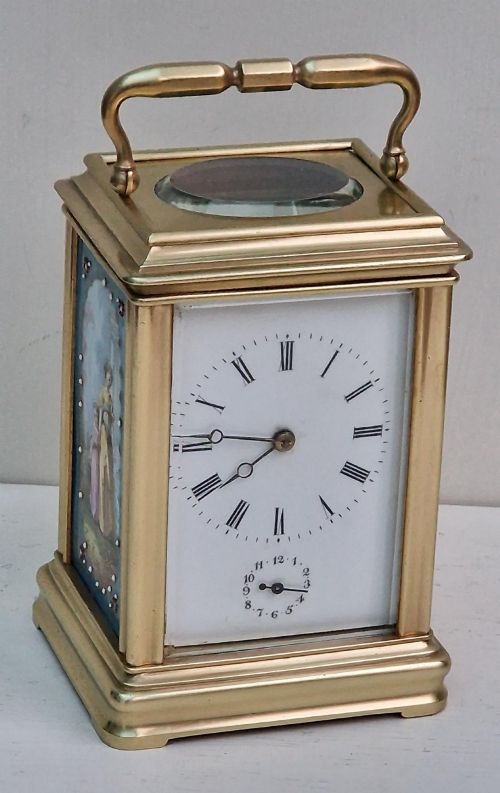


Enamel Panel Clock
An enamel panel clock brings vibrant colour and meticulous French metalwork into a room, prized by collectors for detailed dials and decorated cases.
Enamel Panel Clock
An enamel panel clock is typically a brass, gilt brass, or ormolu timepiece housing hand-painted or coloured decorative plaques. The selection spans the Victorian, Edwardian, and Second Empire periods, with French carriage clocks and crystal regulators appearing most frequently.
Makers such as Margaine, Alfred Drocourt, Henry Capt, and J C Vickery produced these pieces in miniature, standard carriage, and mantel formats. Surviving examples often feature repeating mechanisms, engraved cases, or four glass panels alongside their decorated sections.
How they were made
The construction combines heavy brass, gilt bronze, or ormolu framing with glass and fired enamel or porcelain panels. Metal cases are cast, chased, and gilded, sometimes incorporating intricate filigree masks or steel components within the movement.
Enamel panels are fused to metal bases at high temperatures, often featuring hand-painted floral motifs or portrait plaques such as Molière. Crystal regulators employ bevelled glass panes to showcase the internal escapement alongside coloured enamel side plaques.
Enamel Panel Clock Retail Price Guide 2026
Typical asking prices for enamel panel clock among the pieces listed under this phrase on Sellingantiques today, from the lower quarter to the upper quarter. They describe what is for sale here now, not the wider market.
Listings feature brass, gilt bronze, and ormolu frames paired with glass, porcelain, and fired enamel components.
What varies in quality
Quality rests in the crispness of the gilt brass casting, the depth of engraving on the case, and the artistic merit of the painted enamel panels. Signed works by established makers command greater attention due to superior mechanical execution and finishing.
The integrity of the enamel work dictates value, with flawless fired surfaces outperforming damaged or later-restored panels. Heavier ormolu mountings and complex movements, including repeaters, distinguish finer examples from standard timepieces.
Margaine Of France·Alfred Drocourt·J C Vickery London·Henry Capt Geneve
The Enamel Panel Clock Glossary
- Carriage clock
- A portable spring-driven timepiece designed for travel, typically housed in a brass case with a glass top and bevelled side panels. These clocks often feature a folding handle above the dial.
- Crystal regulator
- A mantel clock constructed with four glass panes held in a brass or gilt bronze frame, allowing an unobstructed view of the pendulum and movement. They frequently incorporate coloured enamel side panels.
- Ormolu
- Gilt bronze produced by applying a finely ground mercury and gold amalgam to a bronze object before heating to drive off the mercury. This technique creates a rich, durable golden surface.
- Repeater
- A mechanical complication in a clock that strikes the hours and quarters on demand when a lever or button is pressed. It was especially useful for telling time in the dark.
- Sevres style
- A descriptor for porcelain decorated in the manner of the famous French Sèvres factory, often featuring rich blue or pink grounds with hand-painted gilt details.
Enamel Panel Clock: Frequently Asked Questions
How do I wind a carriage clock?
Most carriage clocks use a key inserted into the winding square on the backplate to tension the mainspring.
Turn the key gently until firm resistance is felt, taking care not to overwind the mechanism.
What is a crystal regulator clock?
A crystal regulator is a mantel clock featuring heavy bevelled glass panels on all four sides held within a brass frame.
This design exposes the movement and mercury or gridiron pendulum to light from multiple angles.
How do I clean enamel panels?
Enamel panels require only a very soft, dry microfiber cloth to remove dust and surface fingerprints safely.
Moisture and chemical cleaners must be avoided entirely to protect painted details and metal mounts.
Are these clocks suitable for daily use?
Antique spring-driven clocks can keep reliable time if serviced regularly by a professional horologist.
Placing them on a stable, level surface away from direct sunlight protects both the case and the delicate escapement.