


Empire Wine Table
An empire wine table brings neoclassical symmetry and rich timber into a room, serving as a compact centrepiece or bedside stand.
Empire Wine Table
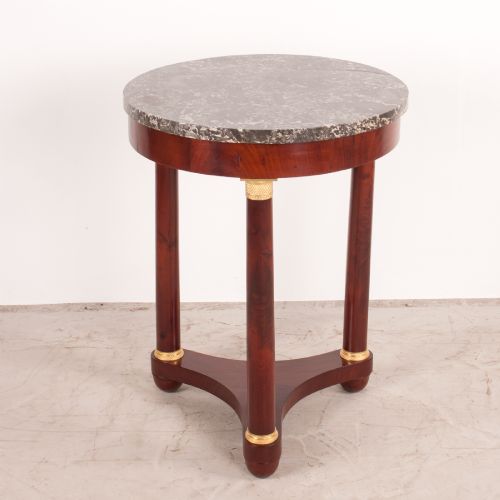
An empire wine table is primarily represented here by French and Swedish pieces from the nineteenth century, including the decades around eighteen-ninety and nineteen-twenty, alongside Regency examples. These items span side tables, occasional tables, centre tables, and gueridons designed with circular tops and central pedestals.
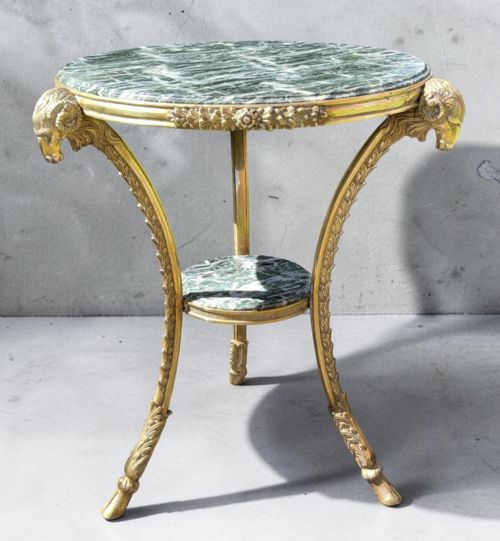
Buyers encounter forms that incorporate marble, sometimes paired with carved swans, rams heads, or giltwood details, alongside timber versions in mahogany, burr elm, burr walnut, and coromandel. The aesthetic draws heavily on French Empire, French Restoration, and neoclassical design principles.
The typology often overlaps with the gueridon, a small stand traditionally used for holding candles or small objects, adapted over time into wine tables and occasional tables within the empire taste.
How they were made
Cabinetmakers constructed the primary structures using dense timbers such as mahogany, burr elm, and coromandel, occasionally employing tilt-top mechanisms for versatility.
Surface ornament relied heavily on inset marble tops, cast brass and ormolu mounts, and gilt bronze detailing that accentuated the architectural lines of the pedestal base.
Some tables feature cast brass rams heads or carved swans staring steadfastly from the pedestal base.
What varies in quality
The refinement of the cast bronze or ormolu mounts separates standard production from finer work, with sharper chased details and heavier metalwork indicating superior craftsmanship.
The selection of timber veneers, particularly figured burr elm or mahogany, and the integrity of the fitted marble slab dictate the visual impact and structural fidelity of each piece.
The Empire Wine Table Glossary
- Gueridon
- A small French table, typically round and supported by a single central pillar, often featuring a marble top.
- Ormolu
- Gilded bronze applied as decorative mounts to furniture, characteristic of the neoclassical and empire styles.
- Regency
- An English design period spanning the early nineteenth century that shares neoclassical influences with continental empire furniture.
- Neoclassical
- A style reviving classical Greek and Roman motifs, visible in the clean lines and symmetrical mounts of these tables.
Empire Wine Table: Frequently Asked Questions
What is an empire wine table?
An empire wine table is a small, typically round pedestal table rooted in neoclassical and nineteenth-century French design.
These pieces function as versatile occasional surfaces, often featuring marble tops and decorative mounts.
How do I use one at home?
These tables fit easily beside a chair, serve as lamp stands, or hold drinks in a reception room.
Their compact circular footprint allows them to occupy corners or central spaces without crowding the room.
Are these tables French or English?
The majority of pieces in this style originate from France, encompassing nineteenth-century gueridons and empire designs.
Some English and Swedish examples also appear, reflecting the broader spread of the empire taste across Europe.
What materials should I expect?
Common materials include solid and veneered mahogany, burr elm, and coromandel, often paired with inset marble slabs.
Ormolu, cast brass, and giltwood provide the distinctive metallic and gilded embellishments typical of the period.