
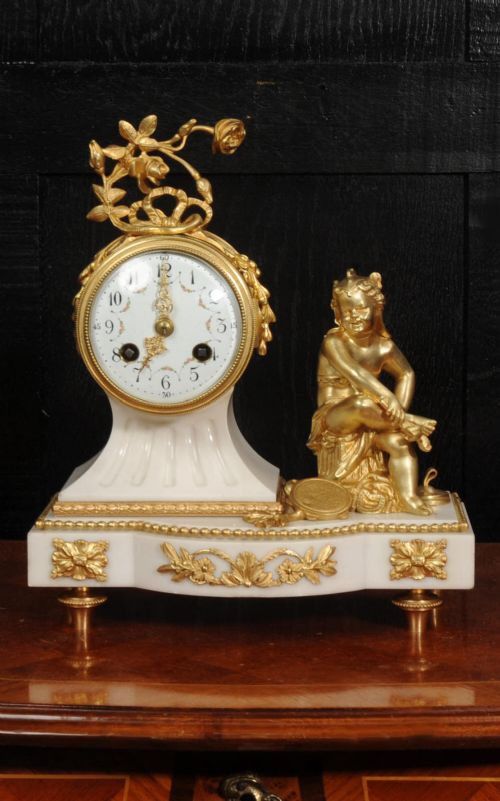
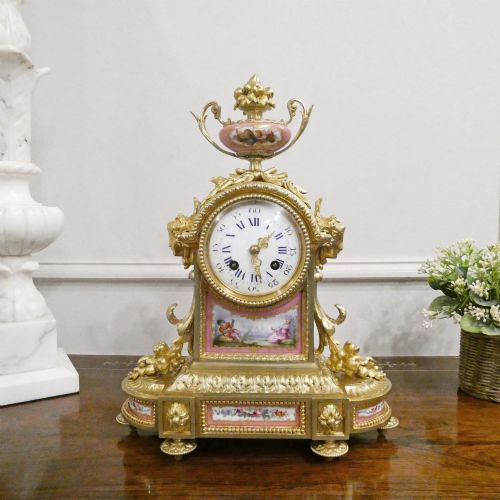
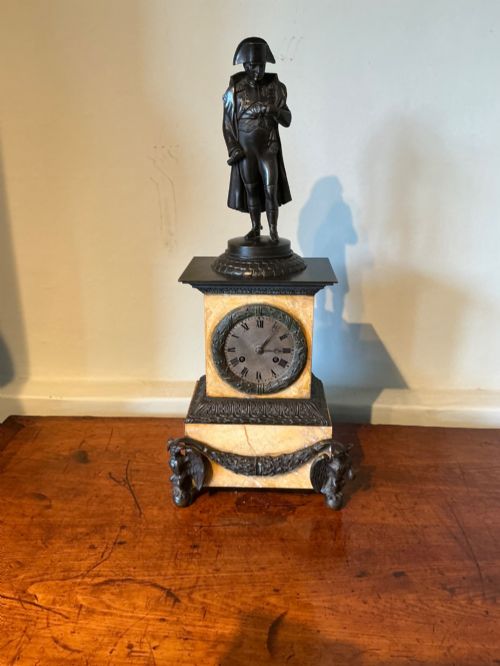
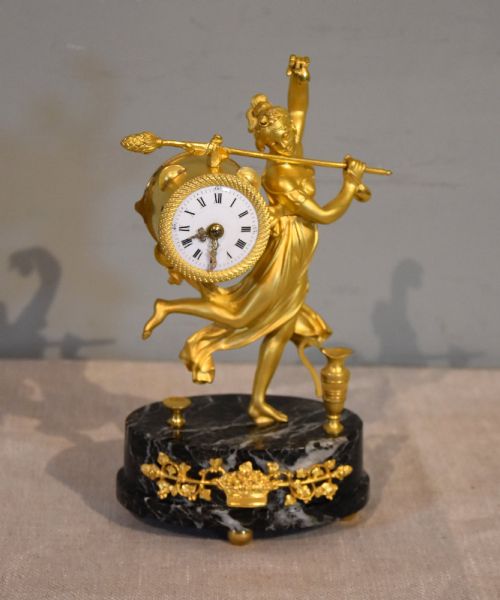


Empire Style Bronze Clock
An empire style bronze clock brings grand neoclassical weight and disciplined proportion to a room, driven by heavy gilt metal and dark patination.
Empire Style Bronze Clock
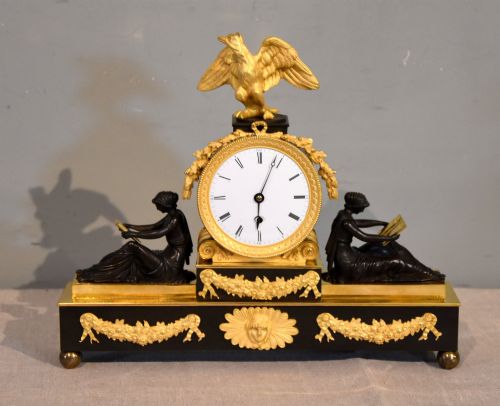
An empire style bronze clock is primarily a nineteenth-century mantel timepiece or striking clock housed in patinated bronze and gilt ormolu, often paired with contrasting marble bases.
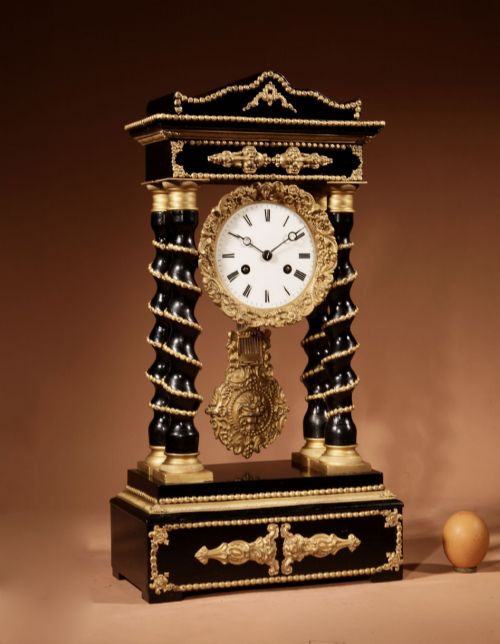
The objects appearing here span French workshops and English Regency makers, taking forms that range from architectural portico clocks to figural pieces depicting historical or mythological subjects.
Buyers commonly meet mantel clocks and multi-piece clock garnitures featuring enamel dials, standing as substantial ornaments designed for prominent display surfaces.
How they were made
Casting provided the core structure, utilising patinated bronze for figural elements and brass or ormolu for decorative mounts, bezels, and feet.
Makers integrated natural stone elements, cutting and polishing white, green, black, or red marble to form heavy architectural pedestals and columns.
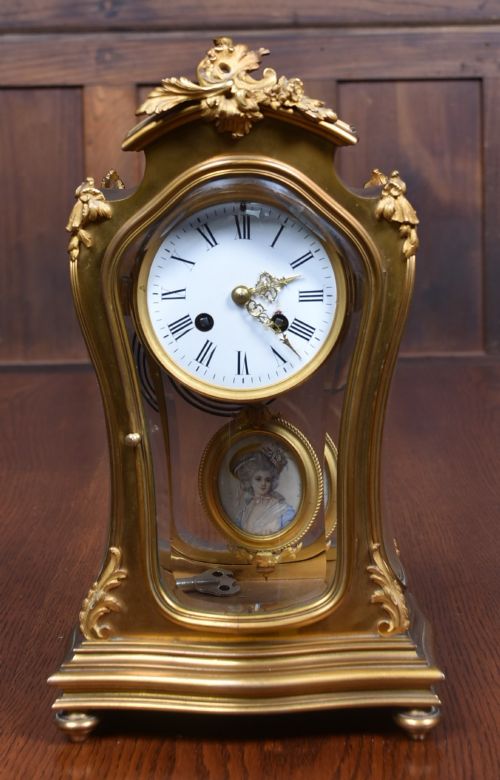
Dials combined fired enamel on copper with delicate hand-painted numerals, protected by glass bezels and driven by brass gear trains within eight-day movements or single chain fusee mechanisms.
Several fierce bronze lions stand guard over these clock faces, seemingly tasked with ensuring the hours pass without incident.
What varies in quality
The crispness of the bronze chasing dictates the visual success of the piece, separating sharp, hand-finished relief work from soft, mass-produced casts.
The integration of materials determines the overall dignity of the object, where heavy solid marbles and well-balanced ormolu mounts outweigh thin veneers and mismatched components.
Movement sophistication and dial preservation separate standard timepieces from exceptional signed works by notable Paris or London makers.
Japy Freres·Vincenti of Paris·Baetens London·FB Adams London·Bellenot Paris
The Empire Style Bronze Clock Glossary
- Ormolu
- Gilt bronze created by applying a mercury and gold amalgam to a bronze base and firing it. This finish produces a deep, durable golden lustre characteristic of high-end nineteenth-century decorative arts.
- Portico clock
- A timepiece suspended within an architectural frame supported by four or more columns. The pendulum often swings visibly through the central opening.
- Clock garniture
- A matching set consisting of a central clock flanked by twin side ornaments such as urns or candelabra. These sets created a balanced decorative display on a mantelpiece.
- Fusee movement
- A conical pulley connected to the mainspring by a chain or cord. This mechanism equalises the diminishing power of the spring as it unwinds to maintain steady timekeeping.
- Patinated bronze
- Metal treated with chemical solutions to darken the surface and create a stable brown or black finish. It provides contrast against bright gilt mounts.
Empire Style Bronze Clock: Frequently Asked Questions
How do I wind an eight day clock?
Insert the winding key into the designated dial holes and turn gently until resistance increases, taking care not to over-wind the mainspring.
Most nineteenth-century movements require this attention roughly once a week to keep the brass gear train running reliably.
Where should I place a heavy marble clock?
Position the piece on a sturdy, level mantelpiece or sideboard capable of supporting substantial weight without sagging.
Avoid locations near direct heat sources or damp walls to protect the marble surface and the delicate interior movement.
What is a clock garniture set?
A garniture comprises a central mantel clock accompanied by two matching decorative side pieces, such as ornamental urns.
These balanced groupings were designed to fill large nineteenth-century fireplace mantels as unified decorative schemes.
How do I distinguish French and English movements?
French pieces of this period typically employ rack striking mechanisms and circular brass plates, often stamped with maker marks like Japy Freres.
English Regency examples frequently utilise chain fusee movements housed in heavy wooden or bronze cases with distinct signature engravings on the backplate.