
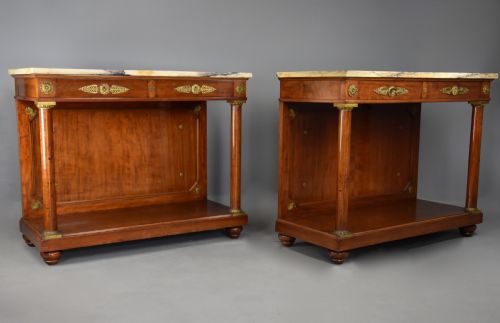
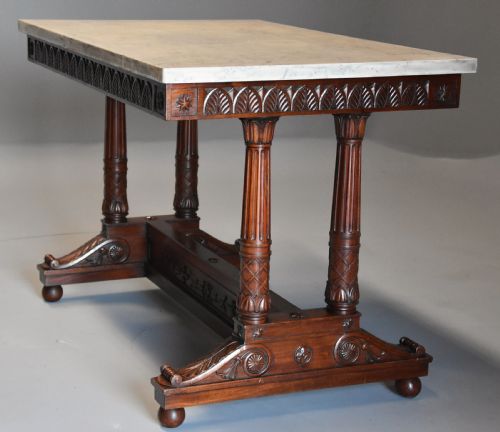


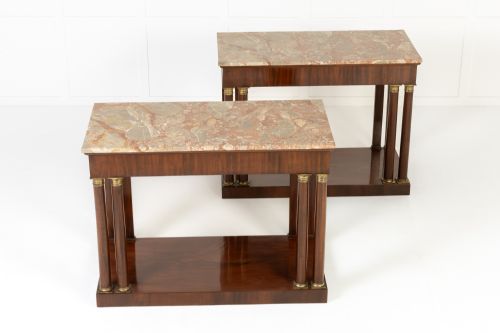


Empire Mahogany Console Table
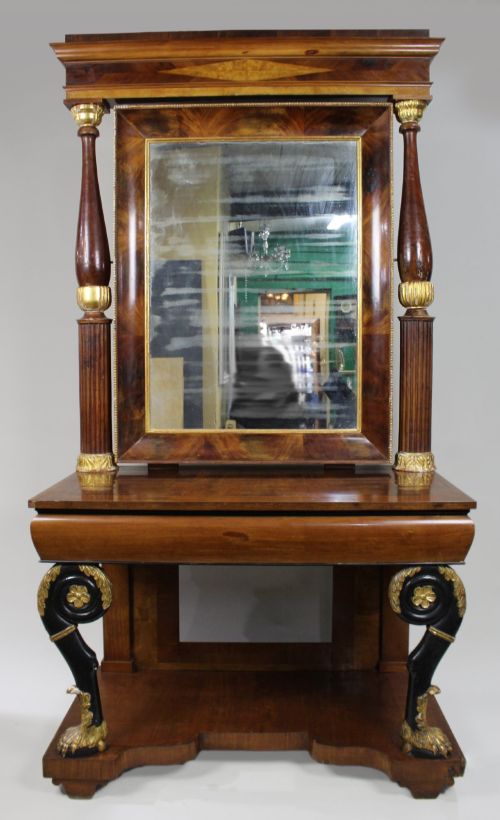
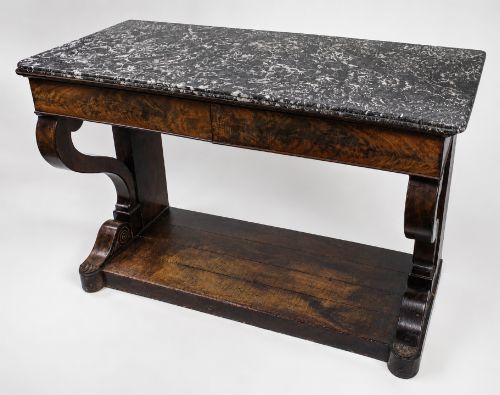
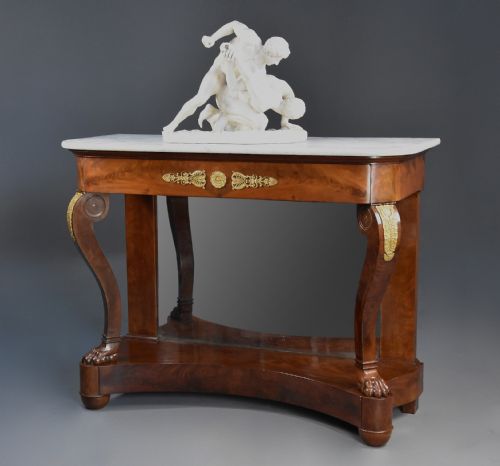
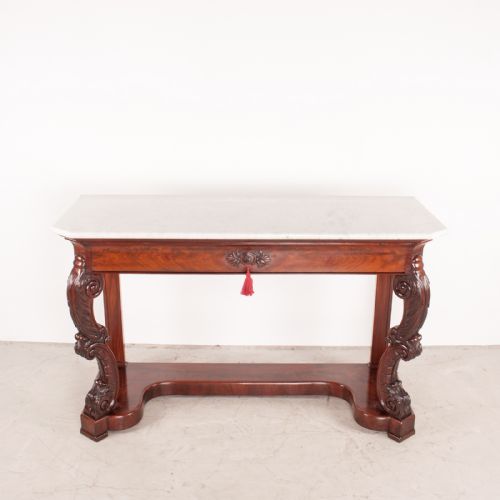
An empire mahogany console table anchors a room with architectural confidence, bringing classical French and Italian gravitas to an interior through dark timber and cold stone.
Empire Mahogany Console Table
When you search for an empire mahogany console table, you encounter heavy architectural forms designed to stand against a wall, frequently paired with a contrasting stone surface. The versions most commonly met on this page originate from nineteenth-century France or Italy, carrying the characteristic vocabulary of the Napoleonic period and later revivals.
Beyond the standard wall-mounting form, the listings encompass related freestanding variations such as centre tables, sofa tables, and pier tables that share the same dark timber construction. Makers across France, Italy, and England adapted the heavy classical silhouette into chiffoniers, dressing tables, and writing desks while retaining the core Empire aesthetic.
The aesthetic spans strict early nineteenth-century production through to later revival periods around nineteen hundred. Pieces appear singly or in matched pairs, offering symmetrical presence for hallways, salons, and principal reception rooms.
Construction and Materials
Cabinet makers built these pieces upon robust softwood carcases entirely faced in rich mahogany, frequently selecting flame mahogany veneers to create dramatic, symmetrical grain patterns across large vertical surfaces. This timber was often polished to a high sheen that accentuates the deep reddish-brown warmth of the wood.
Heavy stone tops in white carrara marble or fossil varieties rest directly on the timber frames, adding substantial weight and a cool tactile contrast to the polished wood below. Ormolu, gilt bronze, and cast brass mounts punctuate the dark timber with classical brass caryatids, floral rosettes, and military trophies.
Parcel gilt details and contrasting giltwood carvings appear on select Italian and French examples, highlighting structural columns and paw feet. The joinery combines traditional framing methods with substantial veneering techniques suited to the broad, flat expanses characteristic of the style.
Dolphin carvings populate several Italian console supports, navigating the drawing room with aquatic confidence.
Distinctions in Quality
The distinction between ordinary and exceptional examples rests heavily on the selection of the mahogany veneer and the precision of the cast mounts. Superior pieces display book-matched flame mahogany with continuous grain patterns that reveal thought in the layout, whereas lesser items rely on plain timber with uniform, uninspired grain.
Structural harmony also dictates standing; workshop skill appears in how cleanly massive marble slabs integrate with the wooden frames beneath without awkward overhangs or clumsy bracing.
Krieger Paris·JACOB·Jean-Joseph Chapuis
The Empire Mahogany Console Table Glossary
- Ormolu
- Gilt bronze applied as decorative mounts to furniture frames. The technique involves creating an amalgam of gold and mercury.
- Flame mahogany
- A veneer cut from the fork of the mahogany tree where branches meet the trunk. This method produces a distinctive flickering flame pattern across the panel.
- Console table
- A table supported by wall brackets or console legs, designed to stand flush against a wall. It frequently carries a heavy marble slab.
- Pier mirror
- A tall mirror designed to hang on the pier wall between two windows, often paired with a matching console table placed directly beneath it.
- Restauration period
- A French stylistic phase bridging the full Empire style and later revivals. It maintains classical proportions while introducing slightly softer domestic lines.
Empire Mahogany Console Table: Frequently Asked Questions
How were console tables used originally?
In nineteenth-century interiors, these pieces served as decorative side furnishings placed against drawing room walls beneath pier mirrors. They held candelabra, clocks, and decorative porcelains rather than bearing heavy domestic use.
Their substantial marble tops provided a cool, durable surface impervious to wax drips from tall candles. Positioned centrally in entrance halls, they offered an immediate visual statement to arriving guests.
How do I distinguish original pieces from revivals?
Original pieces from the early nineteenth century display construction methods, timber shrinkage, and hand-cut secondary woods consistent with the Napoleonic eras. Examination of the carcase timbers beneath the veneers usually reveals period-specific sawing techniques.
Revival pieces made around nineteen hundred often utilise machine-prepared secondary woods and standardised hardware while copying the earlier classical proportions with great technical accuracy.
Are marble tops always original to the tables?
Marble slabs on nineteenth-century consoles were heavy drop-in components designed to lift out independently of the wooden frame. Replacement stone happens frequently due to historic breakages during domestic moves.
An original marble top matches the exact footprint of the rebate in the timber frame, showing uniform edge profiling and consistent age-related weathering underneath where it contacts the wood.
How do I care for flame mahogany veneer?
This timber requires stable indoor humidity levels away from direct sunlight and artificial heat sources. Excessive dryness causes the underlying veneer to lift or crack along the grain.
Routine maintenance involves dusting with a dry, soft cloth and applying appropriate beeswax formulations sparingly to nourish the polish without building up cloudy residues.